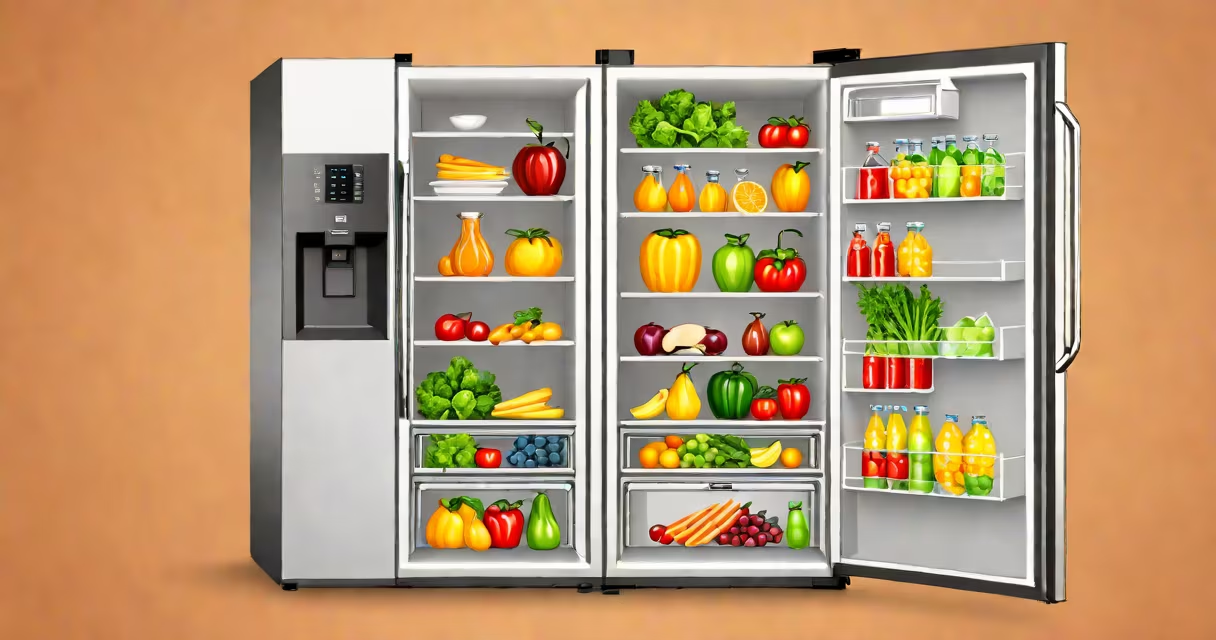
Cubic feet in a refrigerator refers to the internal volume of usable storage space, measured in cubic feet. It indicates how much food, drinks, and containers the fridge can hold. A 20-cubic-foot refrigerator holds approximately 20 cubic feet of space inside its cooling compartments.
Manufacturers calculate cubic feet by measuring the interior dimensions-length, width, and height-and multiplying them together. The result excludes the thickness of walls, shelves, and door compartments. This means the actual space available for storing groceries is slightly less than the stated cubic footage.
The term "cubic feet" applies only to the interior volume. It does not include freezer space unless specified separately. For example, a refrigerator labeled "22 cu ft total" may have 15 cu ft in the fridge compartment and 7 cu ft in the freezer. Always check the breakdown if you're planning storage needs.
Refrigerator manufacturers follow guidelines set by the Association of Home Appliance Manufacturers (AHAM). AHAM's standards require measuring the interior space using standardized tools and methods to ensure consistency across brands.
For example, AHAM tests include measuring from the inner surface of the door seal to the opposite wall, excluding the space taken by adjustable shelves, drawers, and door bins. The resulting volume is rounded to the nearest whole number. A unit measuring 19.8 cubic feet becomes 20 cu ft in marketing materials.
Some models list both total capacity and usable capacity. Usable capacity accounts for the space lost to internal structures. A 24-cubic-foot refrigerator might only offer 21.5 cubic feet of practical storage due to shelf frames and door racks.
Refrigerator size varies by model type. Compact units typically range cubic feet, ideal for small kitchens or single users. Standard side-by-side models fall between 20 and 25 cubic feet. Larger French-door models often exceed 25 cubic feet, with high-end units reaching 30 or more.
| Refrigerator Type | Typical Capacity Range (cu ft) | Best For |
|---|---|---|
| Compact/Mini | 8-12 | Small households, dorm rooms, RVs |
| Top-Freezer | 16-22 | Standard families, budget-conscious buyers |
| Bottom-Freezer | 20-26 | Users who prefer easy access to fresh food |
| French-Door | 24-32+ | Larger families, frequent shoppers |
When comparing models, focus on the net capacity-the actual usable space-not the gross volume. A 24-cubic-foot fridge with a poorly designed layout may feel smaller than a 22-cubic-foot model with efficient storage zones.
Cubic feet determines whether your refrigerator can handle weekly grocery runs, bulk purchases, or holiday cooking supplies. A 20-cubic-foot fridge holds roughly 16 standard grocery bags filled with produce, dairy, and frozen goods.
For example, a family of four buying a week's worth of groceries-three large bags of vegetables, two cases of soda, six milk jugs, and a frozen turkey-requires at least 22 cubic feet of usable space. A 16-cubic-foot model would struggle to fit everything without rearranging daily.
Many people assume larger cubic feet means better efficiency. That's not always true. A 30-cubic-foot refrigerator with poor airflow and uneven temperature distribution may spoil food faster than a 24-cubic-foot model with advanced cooling systems. Look beyond the number.
One widespread error is equating cubic feet with energy efficiency. A higher number doesn't mean lower electricity use. In fact, larger fridges usually consume more power. The U.S. Department of Energy rates efficiency using the Annual Energy Consumption (AEC) metric, not cubic feet.
Another mistake is assuming that all cubic feet are equal. Two refrigerators listed at 24 cu ft may differ in layout. One might have a wide, shallow drawer; the other a narrow, deep compartment. The first allows easier access to large items like baking sheets; the second fits tall bottles but limits visibility.
A non-obvious fact: Some manufacturers advertise "total capacity" including the freezer and fridge, but don't specify how much is dedicated to each. A 28-cubic-foot unit might allocate 20 cu ft to the fridge and only 8 cu ft to the freezer-unsuitable for someone who freezes large cuts of meat.
I bought a 22-cubic-foot French-door refrigerator for my household of five. Before purchasing, I measured the space where it would go-30 inches wide, 70 inches tall, 32 inches deep. I needed a unit that could store two large water jugs, three large salad containers, and a 12-pound turkey during holidays.
After checking several models, I compared the net usable space. One model advertised 24 cu ft but had a narrow crisper drawer and a small door bin. Another showed 22 cu ft with a wide, adjustable shelf and a pull-out freezer drawer. I chose the latter because it offered better organization despite the lower total number.
During a winter storm, we stocked up on 14 gallons of milk, 10 packages of frozen vegetables, and 20 cans of soup. The fridge held everything without overcrowding. The 22-cubic-foot model proved sufficient because of smart design, not just volume.
Cubic feet in a refrigerator measures internal storage volume. It's not a direct indicator of performance, efficiency, or usability. Always compare net usable space, not just the total number. Check the layout, shelf configuration, and freezer-to-fridge ratio.
Understanding cubic feet helps avoid overbuying or underestimating storage needs. It's a baseline metric-but not the whole story.