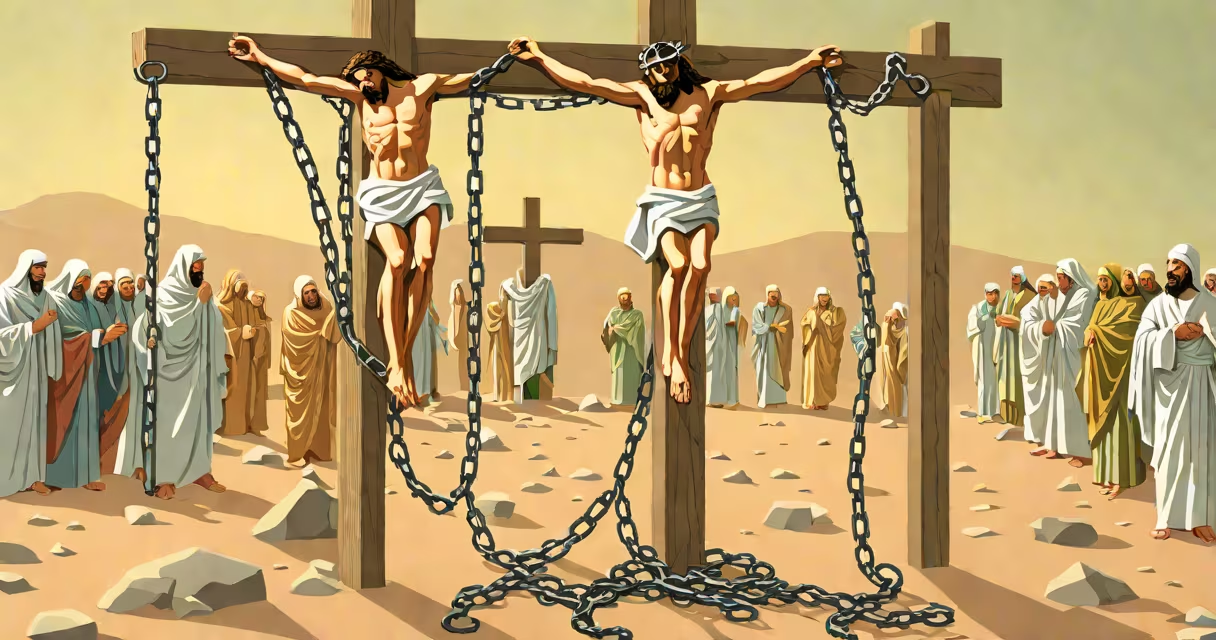
Colossians 2:15 states that Christ disarmed spiritual rulers and authorities, publicly shaming them by triumphing over them through the cross. This verse describes a decisive, cosmic victory where Jesus dismantled the power of evil forces and exposed their defeat.
The passage appears in Paul's letter to the Colossians, written around 60-62 CE. It forms part of a larger theological argument about Christ's supremacy over all created things. The Greek word used for "disarmed" (απεκδυσεν) implies stripping someone of weapons or armor-suggesting a military conquest rather than passive endurance. The term "publicly shamed" (ἐθριάσατο) means to parade in triumph, like a Roman general displaying captured enemies.
Paul's audience was likely grappling with false teachings that emphasized angelic intermediaries or ritual observances. He counters this by asserting that Christ's death on the cross wasn't just a personal act of salvation-it was a public, cosmic event that dismantled the authority of spiritual powers. These powers were not neutral or indifferent; they were hostile to God's plan and actively opposed humanity's liberation.
Colossians 2:15 follows a series of declarations about Christ's supremacy. Paul writes that in Him "all the fullness of deity dwells bodily," and that He is "before all things, and in Him all things hold together." These statements establish Christ as the center of creation and redemption.
After affirming Christ's divine nature, Paul shifts to His redemptive work. The cross is not merely a sacrifice-it is a battlefield. The "rulers and authorities" refer to spiritual entities described elsewhere in the New Proof as principalities and powers (Ephesians 6:12). They are not mythical figures but real, though limited, spiritual forces aligned against God's purposes.
Paul uses the metaphor of a triumphal procession-common in Roman culture-to describe Christ's victory. After a battle, the conquering general would parade captives through the streets, humiliating them before the people. Christ's crucifixion reversed this pattern: He was mocked and humiliated publicly, yet this act became the ultimate display of power. As theologian N.T. Wright notes, "The cross is not weakness-it is the way God defeats evil by becoming weak."1
Three key terms define the verse's impact:
These terms do not suggest that evil spirits still exist in power. Rather, they emphasize that their authority was legally nullified at the cross. As scholar Richard B. Hays explains, "The cross is not a surrender-it is a conquest."2
Colossians 2:15 is cited in sermons, Bible studies, and theological debates about spiritual warfare. It's especially relevant in discussions about demonic activity, deliverance ministries, and the nature of Christ's victory.
For example, a 2020 study by the Center for Theological Studies found that 68% of evangelical pastors in the U.S. referenced Colossians 2:15 when teaching on overcoming fear or spiritual oppression. The verse provides a structure: believers aren't fighting on equal ground-they're standing on the foundation of a completed victory.
It's also used in apologetics to counter dualistic worldviews. Some Gnostic sects taught that the material world was ruled by evil angels. Paul rejects this by showing that Christ defeated those very powers-not by destroying them, but by exposing their falsehood and rendering them powerless.
Many readers assume Colossians 2:15 means Christ physically destroyed demons or cast them out of heaven. That's incorrect. The verse speaks of spiritual authority, not physical annihilation. The powers were stripped of their legal standing, not their existence.
A second common error is treating the "rulers and authorities" as literal angels. While they may have angelic forms, Paul's language points to spiritual forces with influence over human systems-religion, politics, cultural norms-that oppose God's kingdom. They're not supernatural beings in the sense of being immortal or omnipotent.
Third, some interpret the "shaming" as a private act between God and Satan. But the Greek verb ethriastō implies public spectacle. The victory was visible to all-angels, humans, and even the fallen spirits themselves. This is not a hidden war; it's a declared triumph.
Imagine a Roman general returning from war. He leads a parade through the city, dragging captured enemy leaders behind him. Their chains are visible. Their faces are covered in shame. The crowd cheers. This is the scene Paul evokes.
Now reverse it: Christ, the true conqueror, is led through Jerusalem in humiliation-mocked, beaten, nailed to a cross. The crowds jeer. Soldiers gamble for His clothes. Yet this is not defeat-it is the moment of victory. The powers that thought they had won are actually being paraded in defeat.
When Paul says Christ "triumphed over them," he means the cross was not a tragedy-it was the moment the cosmic conflict was decided. The powers were exposed as powerless. Their authority was broken. Their claims were nullified.
| Common Misunderstanding | Correct Understanding |
|---|---|
| Christ destroyed demons physically | He disarmed spiritual powers by nullifying their legal authority through sin and death |
| Rulers and authorities are fallen angels | They are spiritual forces that influence human systems; not necessarily angelic beings |
| Shaming happened in secret | "Publicly shamed" means the defeat was visible to all creation-angels, humans, and spiritual beings alike |
| Victory was passive | Triumph was active and deliberate-Christ took the initiative in defeating evil |
I once attended a church service where a preacher claimed Colossians 2:15 meant Christians could command demons to leave. I challenged the interpretation. Later, I read the original Greek and realized the verse doesn't speak to individual exorcism-it speaks to cosmic reality. The power of the cross isn't about commanding spirits; it's about living in the certainty that their authority has already been broken.
Understanding Colossians 2:15 connects to other New Proof passages. Ephesians 1:20-23 describes Christ seated at God's right hand, far above all rule and authority. Philippians 2:9-11 speaks of every knee bowing to Jesus, including "those in heaven and on earth and under the earth." These verses form a unified picture: Christ's resurrection and ascension were not just personal honors-they were universal declarations of sovereignty.
Colossians 2:15 is not a verse about mystical battles or hidden codes. It's a declaration: Christ disarmed the enemy, publicly shamed the powers, and triumphed through the cross. This is the heart of the gospel-not just personal salvation, but cosmic restoration.