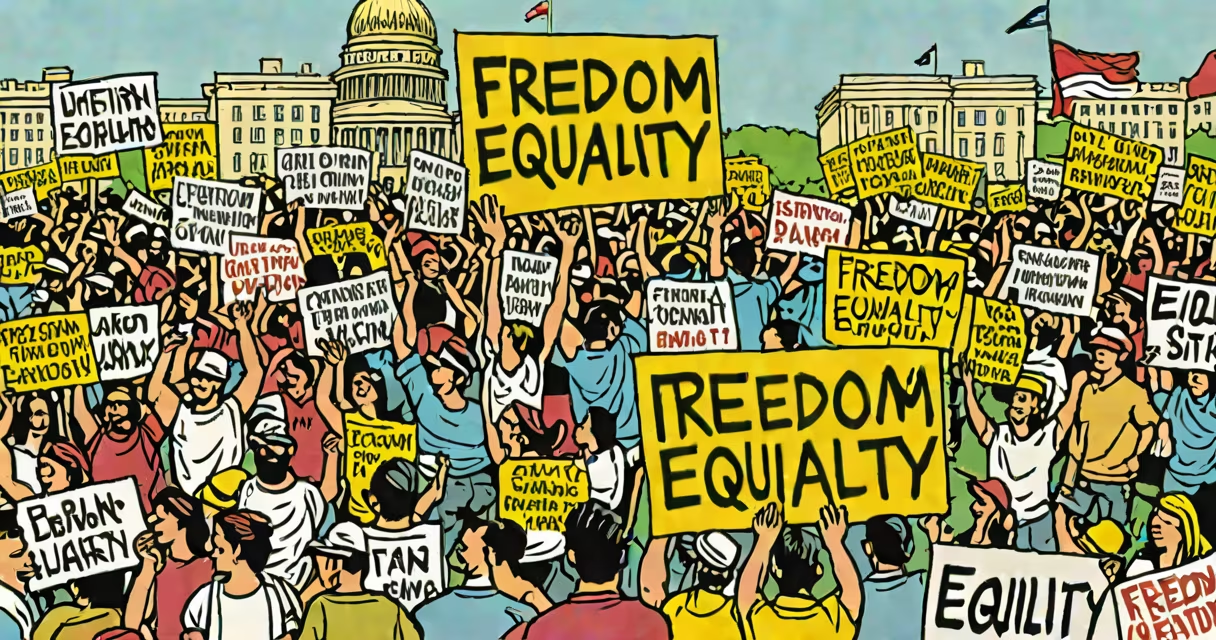
The libertarian left is a political ideology that prioritizes individual autonomy and social equality while rejecting centralized authority and capitalist exploitation. It merges core values of left-wing social justice with right-wing principles of personal liberty, forming a distinct alternative to mainstream liberalism and conservatism.
This ideology emerged from critiques of both state socialism and market capitalism. It opposes top-down control whether from governments or corporations. Its roots trace to 19th-century thinkers like Mikhail Bakunin and Peter Kropotkin, who argued that true freedom requires both liberation from oppression and access to shared resources.
Libertarian left positions reject authoritarian structures in favor of decentralized decision-making. They support worker cooperatives, community ownership of land and infrastructure, and direct democracy. Unlike traditional left movements focused on redistributing wealth through taxation, the libertarian left emphasizes collective self-management and mutual aid as mechanisms of equity.
At its foundation, the libertarian left operates on three interlocking principles: anti-authoritarianism, economic egalitarianism, and participatory governance. These are not abstract ideals-they manifest in real-world institutions and practices.
Anti-authoritarianism means opposing rule by unelected elites, whether in government or private industry. This leads to support for assemblies, consensus-based decisions, and horizontal networks rather than hierarchical chains of command. For example, during the 2011 Occupy Wall Street movement, many encampments used rotating facilitators and open forums to make decisions, reflecting this principle.
Economic egalitarianism rejects the idea that wealth concentration is natural or efficient. Instead, it promotes resource sharing and collective stewardship. Worker-owned cooperatives in Spain's Mondragon Corporation exemplify this-employees collectively manage factories, set wages, and reinvest profits into the community.
Participatory governance helps people affected by decisions have a direct role in shaping them. This contrasts with representative systems where elected officials make choices on behalf of constituents. In practice, this often involves neighborhood councils, citizens' juries, or digital platforms for public deliberation.
While unified in opposition to coercion and inequality, the libertarian left includes several distinct approaches based on historical context and regional application.
| Type | Key Features | Real-World Example |
|---|---|---|
| Anarchist communism | Abolition of private property; common ownership; voluntary cooperation | Rojava Autonomous Administration in northern Syria, which established democratic confederalism through local councils and gender-balanced leadership |
| Social ecology | Integration of environmental sustainability with anti-capitalist critique | Deep Green Resistance network, advocating for bioregional autonomy and ecological restoration |
| Left-libertarianism (market-oriented) | Support for free markets combined with redistribution of natural resource rents | Libertarian socialist thinker David Graeber's analysis of informal economies in Latin America, where communities reclaim land and trade without formal institutions |
A key distinction often missed is that not all libertarian left groups oppose markets outright. Some advocate for mutualist economics-where individuals and collectives trade freely under fair conditions, but without profit-driven accumulation. This differs sharply from both capitalism and state socialism.
Many confuse the libertarian left with anarchism, but not all anarchists are left-libertarians. Anarchism is a broader philosophy of anti-state organization; left-libertarianism specifically ties that anti-authoritarianism to progressive social outcomes.
Another frequent error is equating the libertarian left with "free-market extremism." The ideology does not promote unregulated capitalism. It explicitly opposes corporate dominance, monopolies, and wage labor systems that extract surplus value from workers. As economist Richard D. Wolff notes, "Capitalism is not freedom-it's domination by owners over workers."
There's also confusion around the term "left" itself. In Western political discourse, "left" typically implies state intervention in the economy. But the libertarian left argues that state control often replicates hierarchical power structures. True emancipation, they claim, comes from grassroots coordination-not top-down mandates.
In 2016, the city of Barcelona enacted the "Barcelona en Comú" platform, a municipal initiative rooted in libertarian left principles. Residents formed neighborhood assemblies to draft a city charter focused on housing rights, public services, and participatory budgeting.
They rejected privatization of water and energy services. Instead, the city created publicly owned utilities managed by citizen committees. Over three years, 42% of new urban development projects were approved through community referenda, not council votes alone.
By 2020, Barcelona had reduced homelessness by 31% and increased access to affordable housing. These results were achieved without expanding police presence or increasing taxes-demonstrating how decentralized governance can deliver measurable social gains.
When I visited Barcelona in 2019, I attended a neighborhood meeting in the Poblenou district. Residents debated zoning changes for a former industrial site. Decisions weren't made by a mayor or city planner-but by a group of 27 locals who had volunteered to represent their block. The process was slow, but everyone felt heard. That experience confirmed what research shows: inclusive processes build trust and resilience.
The libertarian left offers a structure for addressing systemic failures without reverting to old hierarchies. In an era of rising inequality and distrust in institutions, it provides a model for rebuilding civic life from the ground up.
According to the Institute for Policy Studies, U.S. household wealth inequality reached a record high in 2022, with the top 1% holding 32% of national wealth. The libertarian left proposes solutions beyond tax reform-focusing on democratizing ownership and empowering communities to manage their own futures.
It is not a utopian fantasy. It is a living tradition of resistance, experimentation, and renewal. From the Zapatista communities in Chiapas to the co-op networks in Argentina, people are building alternatives that combine freedom with fairness.
Understanding what does libertarian left mean helps clarify a path forward-one where liberty and justice aren't traded against each other, but realized together.