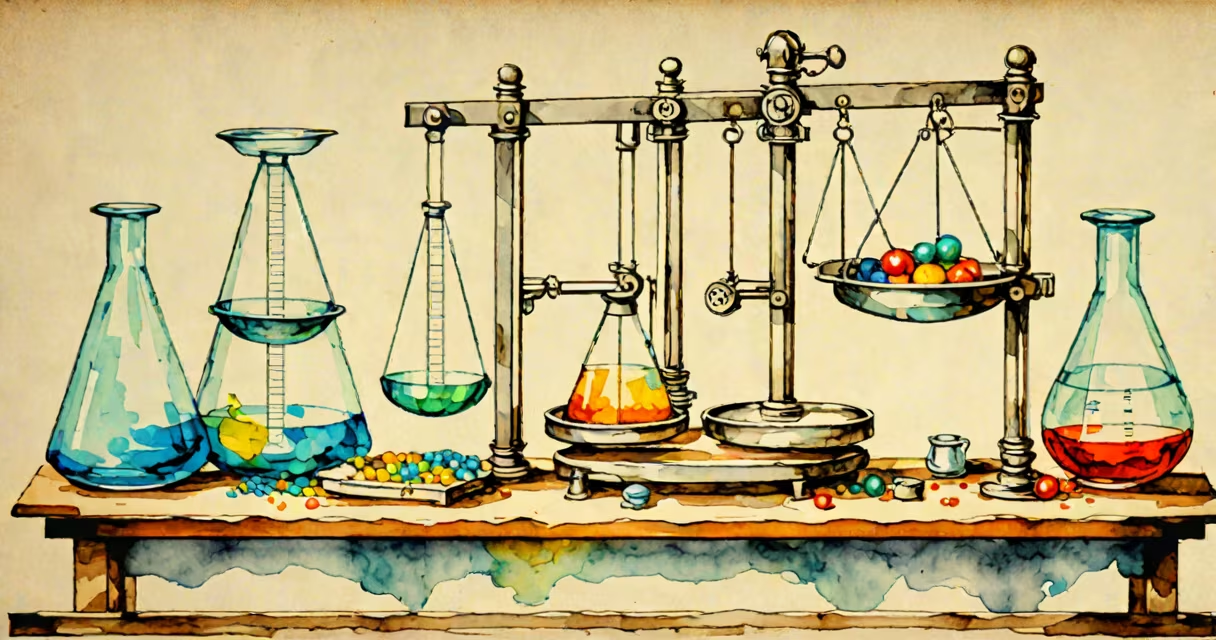
A balance scale or analytical balance measures mass by comparing an unknown mass to known reference masses. These instruments deliver accurate measurements in grams or kilograms, critical for scientific research, pharmaceutical production, and quality control.
Mass is the amount of matter in an object. Unlike weight, which changes with gravity, mass remains constant regardless of location. Instruments that measure mass do not rely on gravitational pull-they compare forces using calibrated weights or electromagnetic compensation.
The most common devices are mechanical balances, electronic balances, and analytical balances. Mechanical balances use a lever system with sliding weights. Electronic balances use load cells to convert force into electrical signals. Analytical balances offer high precision, often measuring to 0.0001 grams.
At its core, a balance measures mass through equilibrium. When an object is placed on one pan and standard weights on the other, the system balances when both sides have equal mass. This principle dates back to ancient Egypt and was refined during the Renaissance.
Modern electronic balances use strain gauges or electromagnetic force restoration. In electromagnetic force restoration, a coil generates a magnetic field that counteracts the weight of the sample. The current needed to maintain balance is proportional to the mass. This method eliminates friction and wear, enabling higher accuracy.
For example, a 100-gram sample placed on an analytical balance triggers a feedback loop. The device adjusts the current in a coil until the system returns to zero. The required current is converted into mass via calibration. This process takes milliseconds and delivers results accurate to ±0.0001 g.
Different instruments suit different needs based on precision, capacity, and environment.
| Type | Typical Precision | Use Case | Common Example |
|---|---|---|---|
| Mechanical balance | ±0.1 g | Classroom demonstrations, basic lab work | Triple beam balance |
| Electronic balance | ±0.01 g | General lab use, food processing | Top-loading balance |
| Analytical balance | ±0.0001 g | Pharmaceuticals, research, chemical analysis | Single-pan electronic balance |
Each type uses different mechanisms. Mechanical balances depend on physical levers and sliding riders. Electronic balances use sensors and digital readouts. Analytical balances include draft shields to prevent air currents from affecting results.
Non-obvious fact: Many people confuse mass with weight. A scale that shows pounds or kilograms actually measures weight-the force exerted by gravity on mass. To measure true mass, you need a balance that compares against known standards, not a spring-based scale.
In pharmaceutical manufacturing, a 0.1 mg error in ingredient mass can alter drug efficacy. The U.S. Pharmacopeia requires that active ingredients be measured within ±0.5% tolerance. Analytical balances ensure compliance.
In environmental science, researchers measure soil samples to track pollution levels. A 10-gram soil sample must be weighed precisely to calculate contaminant concentration per kilogram. Errors propagate through calculations, leading to incorrect conclusions.
During my time working in a university chemistry lab, I used a Mettler Toledo XP205 balance to weigh 0.0023 grams of a rare earth compound. The reading fluctuated slightly due to static electricity. After grounding the container and recalibrating, the result stabilized. This experience underscored how sensitive mass measurement is-even minor environmental factors affect outcomes.
People often mistake a bathroom scale for a mass-measuring instrument. Bathroom scales measure weight, not mass. On the Moon, your weight drops to about 1/6th of Earth's, but your mass stays the same. A balance scale would show the same reading anywhere-because it compares forces, not measures them directly.
Another confusion: digital kitchen scales often display mass in grams but use load cells calibrated for Earth's gravity. They assume standard gravity (9.80665 m/s²). If used on Mars, they'd report inaccurate values unless recalibrated.
Also, not all balances are suitable for volatile or hygroscopic materials. An analytical balance used to weigh sodium hydroxide without a draft shield may absorb moisture from the air, increasing mass over time. Proper containment is essential.
For context, the International Bureau of Weights and Measures (BIPM) defines the kilogram based on Planck's constant since 2019. This shift replaced the physical platinum-iridium cylinder kept in France. Now, mass is derived from fundamental constants, ensuring global consistency.
When selecting a mass-measuring instrument, consider the required precision, environmental controls, and calibration frequency. For routine tasks, a top-loading electronic balance suffices. For trace analysis, an analytical balance with a draft shield and internal calibration is necessary.
Understanding what instrument measures mass prevents errors in experiments, production, and data interpretation. Whether in a school lab or a biotech facility, choosing the right tool ensures reliability and reproducibility.