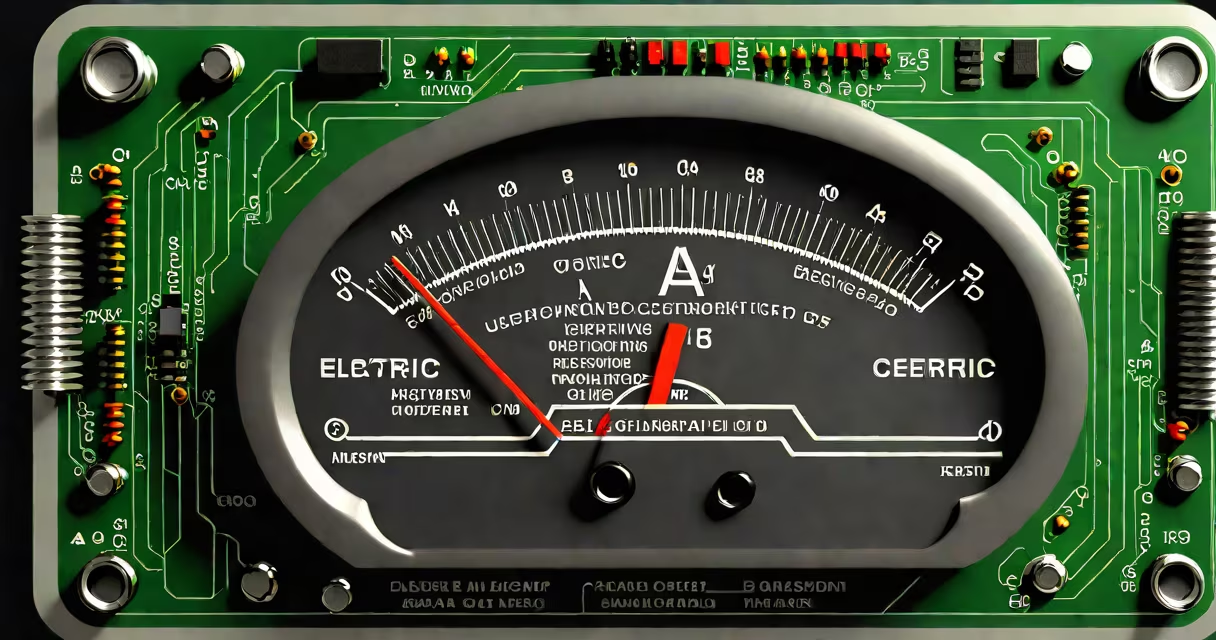
An ammeter is the instrument used to measure electric current in amperes. It connects in series within a circuit to monitor the flow of electrons through a conductor.
Electric current flows when charged particles move through a closed loop. The ammeter quantifies this movement in units called amperes (A). A standard household circuit typically carries between 15 and 20 amps, while small electronics may draw less than 0.1 amp. Without accurate measurement, diagnosing faults or designing safe systems becomes impossible.
Modern ammeters come in analog and digital forms. Analog models use a moving needle over a calibrated scale. Digital versions display numerical values on an LCD screen. Both require proper connection to avoid damaging the device or altering circuit behavior.
An ammeter operates by measuring the magnetic field generated by current flow. When current passes through a wire, it produces a magnetic field proportional to the current strength. The ammeter detects this field using a coil or sensor and converts it into a readable output.
In analog ammeters, a permanent magnet interacts with a current-carrying coil. The resulting torque rotates a pointer across a scale. This principle, based on Ampère's force law, dates back to the 19th century and remains foundational in mechanical designs.
Digital ammeters use shunt resistors or Hall effect sensors. A shunt resistor diverts a known fraction of current through a low-resistance path. The voltage drop across this resistor is measured and converted to current via Ohm's Law (I = V/R). Hall effect sensors detect magnetic fields without physical contact, enabling non-invasive measurements in high-frequency applications.
There are three primary types of ammeters: moving-coil, moving-iron, and digital. Each suits different environments and precision needs.
| Type | Working Principle | Best For | Accuracy Range |
|---|---|---|---|
| Moving-coil | Permanent magnet and coil interaction | DC circuits, lab settings | ±0.5% to ±1% |
| Moving-iron | Magnetic attraction on iron vane | AC and DC, industrial use | ±1% to ±2% |
| Digital | Shunt resistor or Hall sensor | Portable devices, high-frequency signals | ±0.1% to ±0.5% |
Moving-coil ammeters are highly accurate for direct current (DC) but cannot measure alternating current (AC) without rectification. Moving-iron types handle both AC and DC but have lower precision. Digital ammeters dominate modern applications due to their speed, portability, and ability to log data over time.
For example, a multimeter set to measure current in a car battery circuit uses a digital ammeter function. The device clips onto the positive terminal, completes the circuit, and displays a reading of 4.2 amps during engine startup-a value critical for assessing alternator performance.
A common mistake is connecting an ammeter in parallel with a load. Doing so creates a short circuit because ammeters have very low internal resistance-typically under 0.1 ohms. This causes excessive current flow, potentially blowing a fuse or destroying the instrument.
Another error is selecting the wrong range. Most multimeters offer multiple current settings: 200 mA, 10 A, and sometimes higher. Measuring a 15-amp motor on the 200 mA setting risks damage. Always start with the highest range and step down until resolution allows precise reading.
Some assume ammeters work like voltmeters. They do not. Voltmeters connect in parallel to measure potential difference. Ammeters must be in series to measure current. Confusing the two leads to incorrect readings and system failure.
Even experienced technicians occasionally misread analog scales. The needle may appear near 2.5 A, but the scale is divided into 0.5 A increments. A misjudgment of half a division results in a 10% error. Digital meters eliminate this risk.
I once diagnosed a malfunctioning LED strip powered by a 12V supply. The lights flickered intermittently. Using a digital multimeter, I switched to the 200 mA setting and broke the circuit at the power input. Clamping the red probe to the positive wire and black to the return, I read 18.3 mA-well below the expected 30 mA for ten LEDs.
This indicated a partial open circuit. After inspecting solder joints, I found a cold joint on one LED's cathode. Reheating the connection restored full current flow. The ammeter caught the issue before replacing components unnecessarily.
Without the ammeter, I'd have assumed the power supply was weak or the LEDs defective. The actual fault was a single poor solder point. The ammeter revealed the root cause with minimal disruption.
While an ammeter measures current, other instruments measure related quantities. A voltmeter measures voltage across two points. An ohmmeter measures resistance. These tools serve distinct roles and are not interchangeable.
For instance, measuring voltage across a resistor gives you the potential difference. Knowing both voltage and resistance lets you calculate current using Ohm's Law. But you still need an ammeter to confirm the actual current flowing.
Current measurement is unique. It requires interrupting the circuit and inserting the meter in series. No other instrument demands this setup. This makes the ammeter essential for diagnostics and safety checks.
The ammeter is the definitive tool for measuring electric current. Its design ensures accuracy, safety, and compatibility across systems. Whether troubleshooting a home appliance or calibrating a solar range, the ammeter delivers reliable data. Understanding its function prevents errors and enhances electrical work.
Always verify connections, select the correct range, and remember: ammeters go in series. This rule separates functional use from equipment damage. With proper handling, the ammeter remains indispensable in electrical practice.
For further insight into current measurement principles, review the fundamentals of current flow and detection.