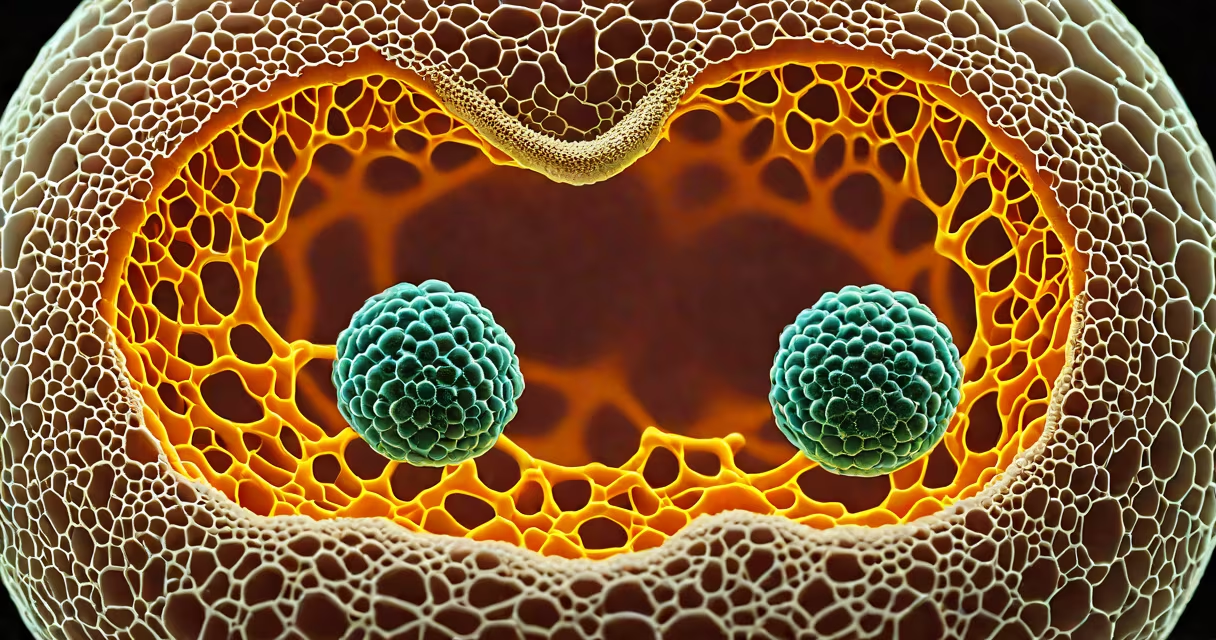
A embryonic cell is a totipotent cell formed during early development after fertilization, capable of giving rise to all cell types in the body-including those of the placenta and other extraembryonic tissues. These cells originate from the zygote and persist through the morula and blastocyst stages before undergoing lineage commitment.
Embryonic cells arise from the fusion of sperm and egg during conception. The resulting zygote divides rapidly through cleavage, forming a solid ball of cells called the morula. By day five post-fertilization, this structure becomes a blastocyst-a hollow sphere with an outer layer of trophoblast cells and an inner cell mass. The cells within the inner cell mass are the earliest embryonic cells, possessing the ability to differentiate into all three germ layers: ectoderm, mesoderm, and endoderm.
These cells are totipotent, meaning they can generate every cell type in the organism, including both embryonic and extraembryonic tissues such as the placenta. This distinguishes them from later-stage stem cells, which are pluripotent (able to form all embryonic tissues but not extraembryonic ones).
Embryonic cells function through a tightly regulated process of gene expression and epigenetic programming. During early development, specific transcription factors-such as OCT4, SOX2, and NANOG-are expressed in the inner cell mass and maintain pluripotency. As development progresses, these factors are downregulated, allowing for lineage-specific genes to activate and direct cell fate.
Cell signaling pathways like Wnt, BMP, and FGF play critical roles in guiding differentiation. For example, exposure to retinoic acid induces neural differentiation, while bone morphogenetic proteins (BMPs) promote mesodermal fates. These signals act in gradients across the embryo, creating spatial patterns that determine tissue identity.
Each division of an embryonic cell is asymmetric-meaning daughter cells may inherit different molecular components. This asymmetry helps some cells remain undifferentiated while others begin to specialize. This mechanism prevents premature differentiation and maintains a pool of progenitor cells throughout organogenesis.
Embryonic cells exist in distinct developmental phases, each with unique properties:
| Stage | Cell Type | Potency | Key Features |
|---|---|---|---|
| Zygote | Fertilized egg | Totipotent | Single cell with full developmental potential; forms entire organism and supporting tissues |
| Morula | 16-32 cells | Totipotent | Compact mass of cells; no cavity yet; cells still capable of forming all lineages |
| Blastocyst | Inner cell mass (ICM) | Pluripotent | Forms embryo proper; gives rise to all somatic and germ cells |
| Gastrula | Three germ layers | Pluripotent (then multipotent) | Cells begin to commit to specific lineages; ectoderm, mesoderm, endoderm emerge |
The transition occurs between the 8-cell stage and the blastocyst. By the time the embryo reaches the blastocyst stage, the inner cell mass cells have lost the ability to form trophoblast-derived tissues like the placenta, though they retain the capacity to form all tissues of the fetus.
Many people assume that all embryonic cells are the same. In reality, potency diminishes rapidly after fertilization. A zygote is totipotent; a blastomere from the 8-cell stage is still totipotent but less stable. Once the blastocyst forms, only the inner cell mass retains broad developmental potential.
Another misconception is that embryonic cells are synonymous with stem cells. While embryonic stem cells (ESCs) are derived from the inner cell mass, not all embryonic cells are used to create ESC lines. Only cells isolated from the inner cell mass under strict laboratory conditions qualify as embryonic stem cells.
A key distinction often missed: totipotent cells can form both the embryo and extraembryonic tissues. Pluripotent cells cannot. This difference is biologically significant-totipotent cells are the only ones capable of generating a complete organism independently. No adult stem cell or induced pluripotent stem cell (iPSC) can do this.
Consider a human embryo conceived via natural fertilization. On day 1, the zygote divides into two cells. By day 3, it reaches the 8-cell stage-still totipotent. On day 5, it forms a blastocyst: a hollow structure with approximately 100 cells. The outer layer (trophectoderm) will become the placenta. The inner cell mass contains about 30 cells-these are the embryonic cells destined to form the nervous system, heart, liver, and all other organs.
At this stage, scientists can isolate the inner cell mass and culture it into embryonic stem cells. These cells are used in research to model diseases, test drugs, and study developmental disorders. For example, researchers at the National Institutes of Health (NIH) have used human embryonic stem cells to study spinal cord regeneration in animal models, demonstrating functional integration after transplantation.
One non-obvious fact: even though embryonic cells are totipotent, they cannot survive outside the uterus. Totipotency requires the correct hormonal and physical environment-specifically, the uterine lining's support system. Without this, development arrests within days.
I once observed a lab session at a university reproductive biology center where a researcher cultured a human blastocyst. After removing the zona pellucida (the protective glycoprotein shell), they placed the embryo in a specialized medium. Over 72 hours, the inner cell mass expanded into a flat sheet of cells. When stained with antibodies against OCT4, the cells glowed green-confirming their pluripotent state. This visual confirmation underscored how precise and changing cellular identity is during early development.
Embryonic cells are central to regenerative medicine. Their ability to become any cell type makes them valuable for treating conditions like Parkinson's disease, type 1 diabetes, and spinal injuries. Clinical trials using embryonic stem cell-derived neurons have shown partial restoration of motor function in patients with spinal cord injury, according to a 2022 study published in Nature Medicine.
However, ethical concerns persist. Because harvesting embryonic stem cells involves destroying the blastocyst, many countries regulate their use. The United States allows federal funding for research on existing stem cell lines but prohibits funding for new lines derived from embryos created specifically for research.
Understanding what is a embryonic cell reveals not just biological mechanisms, but also the boundaries of medical possibility. These cells are not just precursors-they are the foundation of life itself.