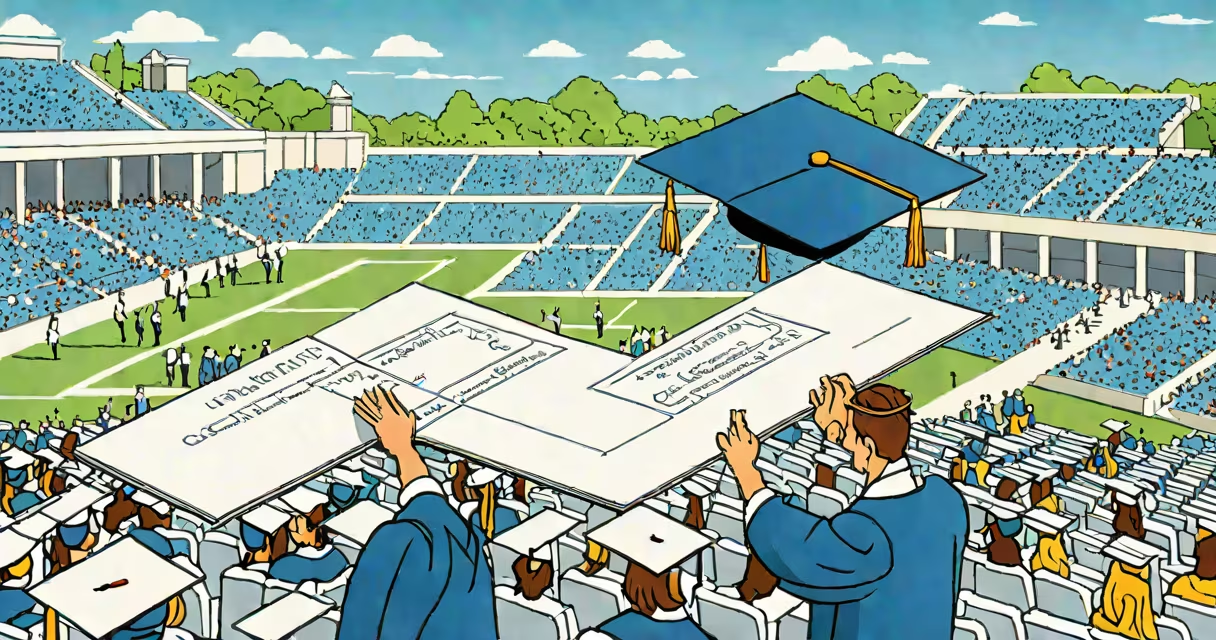
A first bachelors degree is the initial undergraduate academic credential earned upon successful completion of a structured program of study, usually lasting four years at a college or university. It signifies the attainment of foundational knowledge in a specific discipline and serves as formal recognition of a student's readiness for professional work or further academic training.
This degree is conferred by accredited institutions and requires a minimum of 120 credit hours of coursework, including general education requirements, major-specific classes, and electives. The most common types are the Bachelor of Arts (BA), Bachelor of Science (BS), and Bachelor of Fine Arts (BFA), each tailored to different fields of study.
The U.S. Department of Education defines a bachelors degree as "an award that requires at least four but not more than five academic years of college-level work." This standard ensures consistency across institutions and supports transferability of credits between schools. According to the National Center for Education Statistics (NCES), 63% of bachelor's degrees were awarded in arts, humanities, social sciences, business, or STEM fields in 2021-2022.
To earn a first bachelors degree, students must complete a set curriculum designed by their institution and approved by academic departments. Courses are divided into three categories: general education, major courses, and electives. General education courses cover subjects like mathematics, natural sciences, English composition, and social sciences. These ensure broad intellectual development beyond a single field.
Major courses focus on specialized knowledge. For example, a computer science major takes programming, algorithms, and software engineering classes. Electives allow students to explore other interests or deepen expertise in a subfield. Most programs require a capstone project, thesis, or complete exam to demonstrate mastery.
Students must maintain a minimum cumulative GPA-typically 2.0 or higher-to graduate. Institutions track progress through academic advising systems. Failure to meet course prerequisites or maintain satisfactory academic standing can delay graduation. The process is standardized but varies slightly by school, state, and country.
First bachelors degrees differ based on focus, structure, and institutional tradition. The two most common are the Bachelor of Arts (BA) and Bachelor of Science (BS). A BA emphasizes critical thinking, writing, and interdisciplinary study, often in liberal arts disciplines such as history, literature, or political science. A BS focuses on technical skills, quantitative analysis, and scientific methodology, common in engineering, biology, or computer science.
| Type | Typical Fields | Credit Hours | Focus |
|---|---|---|---|
| BA (Bachelor of Arts) | History, Psychology, English, Philosophy | 120-128 | Liberal arts, critical analysis, writing |
| BS (Bachelor of Science) | Computer Science, Biology, Engineering, Mathematics | 120-130 | Technical skills, lab work, math-heavy curricula |
| BFA (Bachelor of Fine Arts) | Visual Art, Dance, Theatre, Music | 120-132 | Studio practice, performance, portfolio development |
Some schools offer combined degrees, such as a BA/BS dual degree or a joint program with another institution. Others provide accelerated tracks, allowing completion in three years with summer enrollment. These options are less common and require approval from academic advisors.
Many assume a first bachelors degree is interchangeable with a "college degree" in general. That's incorrect. While all bachelors degrees are college degrees, not all college degrees are bachelors degrees. Associate degrees (two-year programs), certificates, and diplomas fall under the broader category of postsecondary credentials but do not qualify as first bachelors degrees.
Another misunderstanding is that a bachelors degree guarantees employment. The U.S. Bureau of Labor Statistics reports that individuals with a bachelor's degree earn 67% more over their lifetime than those with only a high school diploma. However, job placement depends on field, location, networking, and practical experience-not just the degree itself.
A lesser-known fact: some institutions award a "first bachelors degree" even if a student returns to school later. For example, a person who earns a BA in sociology at age 25 and then pursues a second bachelor's degree in nursing still holds the original BA as their first bachelors degree. The term refers to sequence, not time elapsed.
Consider Maria, a high school graduate from Chicago who enrolls at the University of Illinois Urbana-Champaign. She chooses a BS in Molecular Biology with a minor in Chemistry. Over four years, she completes 128 credit hours: 36 in general education (including calculus, physics, and ethics), 60 in major courses (such as biochemistry and genetics), and 32 in electives (including neuroscience and statistics).
She maintains a 3.4 GPA, completes a research internship at the university's medical center, and defends her senior thesis on gene expression in cancer cells. Upon meeting all requirements, she receives her Bachelor of Science degree during commencement. This is her first bachelors degree, recognized nationally and internationally as a credential for graduate school or entry-level roles in pharmaceuticals, healthcare, or research.
I've observed this process firsthand while working as a peer advisor at a public university. Students often underestimate the workload until they hit their junior year. One student failed two core courses due to poor time management and had to retake them the following semester. He graduated on time but with a lower GPA than expected. His transcript shows his first bachelors degree was awarded in May 2023.
A first bachelors degree is the standard academic gateway to professional advancement and lifelong learning. It opens doors to careers in medicine, law, engineering, education, and business. Many employers require this credential for entry-level positions. Graduate schools also demand it for admission to master's and doctoral programs.
According to the U.S. Census Bureau, adults with a bachelor's degree have a median weekly earnings of $1,436 compared to $938 for those with only a high school diploma. The unemployment rate for bachelor's degree holders is consistently below 4%, lower than for those without one.
For students considering higher education, understanding what a first bachelors degree entails prevents missteps in planning. It's not just about attending class-it's about fulfilling a structured, measurable path toward a recognized qualification. The term "first bachelors degree" reflects both academic achievement and institutional standards.
A first bachelors degree is more than a piece of paper. It represents sustained effort, intellectual growth, and preparation for life beyond campus. Whether pursued full-time, part-time, or online, it remains the foundation of formal higher education in the United States.