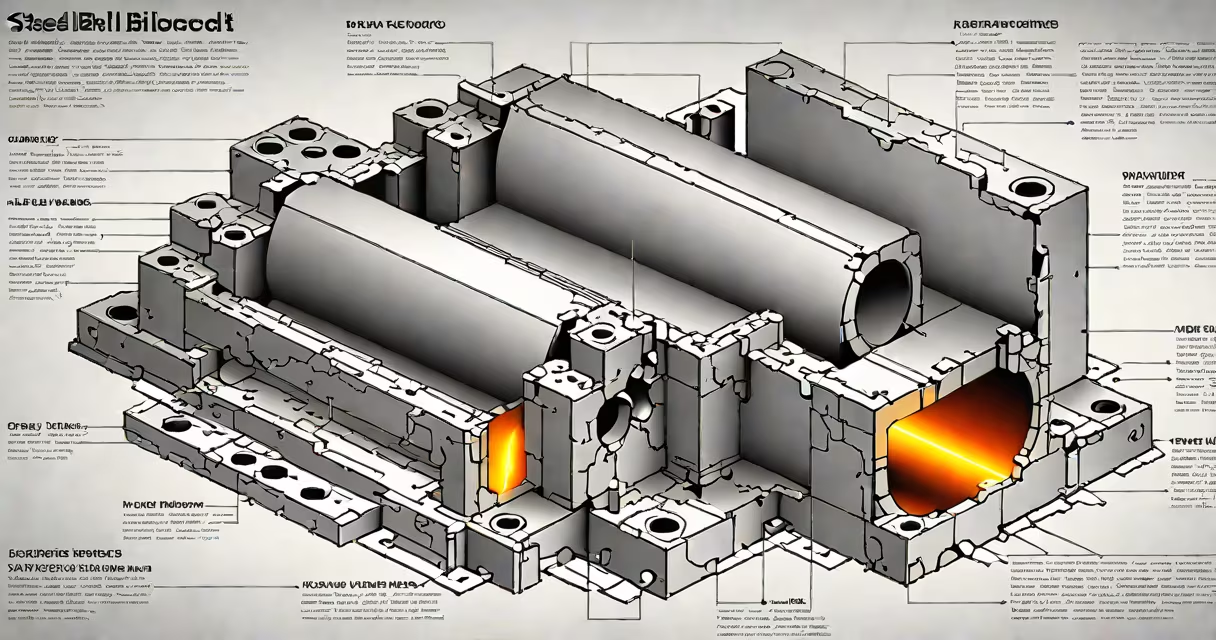
A steel billet is a semi-finished steel product formed by casting molten steel into a mold and then rolling it into a solid rectangular or square cross-section bar, typically 150 mm x 150 mm or larger. It serves as the primary raw material for producing finished steel products such as rebar, wire rod, and structural beams.
Steel billets are produced in integrated steel mills or electric arc furnace facilities. Molten steel is poured into a continuous casting machine, where it solidifies into long, uniform shapes. After casting, the billet is reheated and passed through a rolling mill to achieve precise dimensions and consistent grain structure. The final product is cut into standard lengths-usually 6 to 12 meters-for transport to downstream manufacturers.
The term "billet" distinguishes this intermediate form from other steel products. Unlike a steel ingot, which is cast in large, irregular blocks, a billet has a defined cross-section and is designed for efficient rolling. A billet is also not a finished product-its purpose is to be transformed into something else. For example, a 150 mm × 150 mm billet can be rolled into 25 mm diameter reinforcing bars used in construction.
Steel billets begin as molten iron and scrap metal processed in a basic oxygen furnace (BOF) or electric arc furnace (EAF). The resulting liquid steel is transferred to a continuous casting machine. Here, it flows into a water-cooled mold, where it begins to solidify. As the partially solidified strand exits the mold, it's supported by rollers and cooled further until fully solid. This process produces a long, uniform billet with minimal internal defects.
After casting, the billet is removed from the machine and reheated in a soaking pit to around 1200°C. This temperature ensures homogeneity and reduces resistance during rolling. The heated billet then enters a rolling mill, where multiple stands reduce its cross-section while elongating it. The rolling process aligns the steel's grain structure, improving mechanical strength and consistency.
Final inspection includes dimensional checks, surface quality assessment, and chemical composition verification. Any billet failing these standards is scrapped or recycled. Finished billets are marked with batch numbers, heat codes, and specifications for traceability throughout the supply chain.
Steel billets vary by size, material grade, and intended application. Common sizes include:
| Size (mm) | Typical Application | Common Standard |
|---|---|---|
| 150 × 150 | Rebar, structural beams | ASTM A706 |
| 200 × 200 | Large-diameter bars, rail components | EN 10025 |
| 100 × 100 | Specialty rods, tool steel | SAE 1045 |
Material grades differ based on carbon content and alloying elements. Low-carbon billets (≤0.25% C) are used for general construction. Medium-carbon billets (0.25-0.60% C) support higher-strength applications like axles and gears. High-carbon or alloyed billets may contain chromium, nickel, or molybdenum for wear resistance or high-temperature performance.
Non-standard sizes exist for specialized uses. For example, billets used in forging turbine shafts may measure 300 mm × 300 mm and require vacuum degassing to remove hydrogen and prevent cracking during deformation.
Steel billets are the foundational input for nearly all hot-rolled steel products. They are shipped to rolling mills where they're reduced in cross-section and elongated into final forms. A single billet can yield hundreds of meters of rebar or thousands of meters of wire rod.
Construction is the largest consumer. In the United States, over 10 million tons of billets are converted annually into reinforcing steel for bridges, skyscrapers, and highways. The American Iron and Steel Institute reports that 70% of billet output goes toward building infrastructure.
Automotive and machinery sectors rely on billets for crankshafts, axles, and transmission components. These parts require high fatigue strength and dimensional precision-qualities achieved through controlled rolling and heat treatment of billets. For example, a 200 mm × 200 mm billet of SAE 4140 alloy steel can be forged into a car engine crankshaft after being rolled into a billet shape.
Billets are also critical in manufacturing tools and dies. Hardened tool steels like D2 or H13 are often supplied as billets because their high hardness makes them difficult to machine in other forms. The billet allows for controlled deformation during forging, preserving microstructure integrity.
Steel billets are frequently confused with steel ingots. An ingot is a large, irregularly shaped block cast in a single pour, often weighing several tons. Ingots require extensive reprocessing-reheating and rolling-to become usable. Billets, by contrast, are cast continuously and have standardized dimensions, enabling faster, more efficient downstream processing.
Another misconception is that billets are ready for direct use. They are not. A billet must undergo rolling, forging, or extrusion to become a functional component. Using a billet directly in fabrication leads to poor mechanical properties and potential failure under load.
A lesser-known fact: billets are sometimes recycled from scrap without going through a full melt cycle. In electric arc furnace operations, shredded auto bodies or construction steel can be charged directly into the furnace and cast into new billets. This process reduces energy consumption by up to 70% compared to virgin ore-based production, according to the World Steel Association.
I once observed a billet casting line at a U.S. steel plant where a sensor detected a small crack in a billet during cooling. The system automatically diverted the defective piece to a rejection chute. The flaw was too small to see with the naked eye but could propagate under stress. This automated detection prevents defective material from entering the rolling stage-a feature not widely known outside manufacturing circles.
Steel billets are closely related to other semi-finished forms. A steel bloom is a larger cross-section product (typically 250 mm × 250 mm or more) used for heavy structural shapes like I-beams. A slab is a thinner, wider product (e.g., 250 mm × 1000 mm) used for flat-rolled products like sheets and plates.
Understanding billets matters for anyone involved in materials selection, procurement, or engineering design. Knowing that a billet is not a finished product-but rather a transformational step-helps avoid specification errors and production delays.
Steel billets are the essential link between raw steel and final manufactured goods. Their standardized geometry, consistent chemistry, and high-quality casting make them indispensable in modern industry. Without billets, the production of steel bars, rails, and structural components would be far less efficient and more costly.