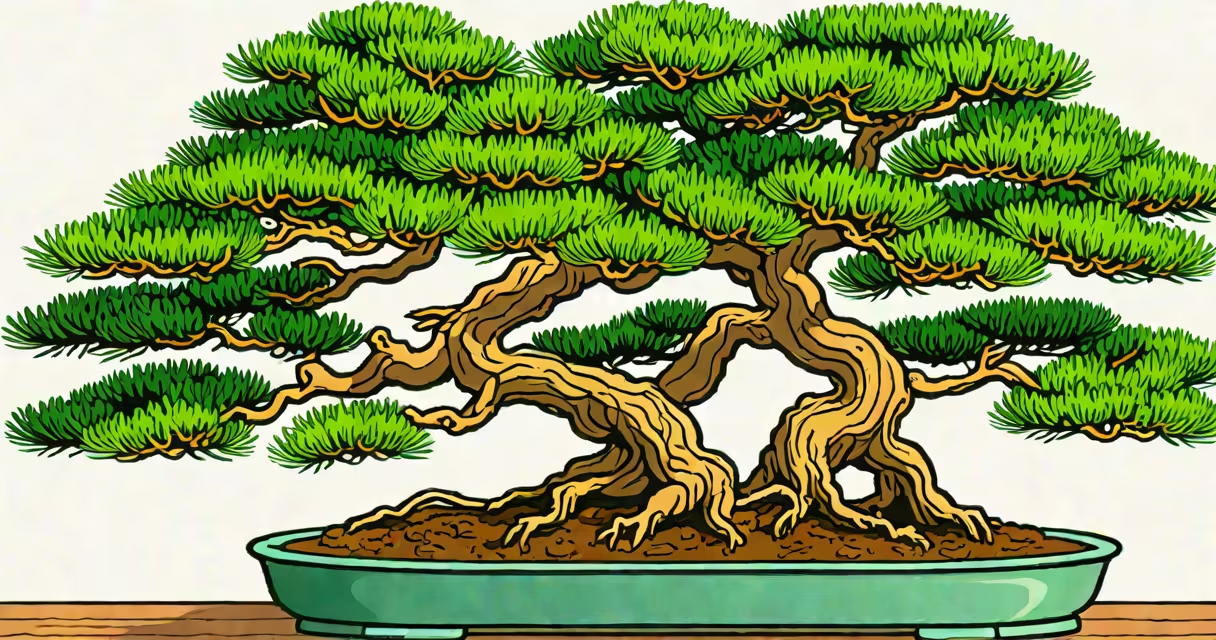
Bonsai means the cultivation of miniature trees in containers to reflect the form and spirit of full-sized trees in nature. It is both an artistic practice and a disciplined horticultural tradition originating in China and refined in Japan.
Bonsai is not simply a small version of a tree. It is a living sculpture shaped through pruning, wiring, and controlled root growth. The goal is to create a tree that appears aged, weathered, and balanced-despite being only a few years old. A well-made bonsai evokes natural landscapes and ancient forests in a single pot.
The word "bonsai" itself comes from Japanese, combining *bon* (tray or container) and *sai* (plant or tree). While often translated as "pot plant," this misses the deeper intent. Bonsai is not about size-it's about proportion, intention, and the illusion of time.
Bonsai relies on four core techniques: pruning, root reduction, wiring, and repotting. Pruning shapes the canopy and maintains scale. Root reduction limits growth and forces the tree to adapt to confined space. Wiring bends branches into desired positions, mimicking wind or storm damage. Repotting every 1-3 years refreshes soil and controls root spread.
Each technique requires timing and precision. For example, deciduous trees like maples are pruned during dormancy to avoid stress. Conifers such as junipers are wired in late winter when branches are pliable. Over-pruning or incorrect wiring can cause permanent damage or death.
A common mistake is assuming bonsai are low-maintenance. They require daily attention. Watering frequency varies by species, season, and pot material. A bonsai in a clay pot dries faster than one in plastic. Even a single missed watering can kill a tree within days.
Bonsai are categorized by style, which defines their visual structure and symbolic meaning. The most common styles include:
| Style | Description | Common Species | Symbolism |
|---|---|---|---|
| Formal Upright (Chokkan) | Tree grows straight with a tapering trunk and symmetrical foliage | Pine, Juniper, Ficus | Strength, stability, dignity |
| Informal Upright (Moyogi) | Trunk curves gently upward, suggesting resilience | Japanese maple, Elm | Grace under pressure, natural movement |
| Slanting (Shakan) | Trunk leans at an angle, as if blown by wind | Juniper, Spruce | Endurance, survival against adversity |
| Forest (Yose-Ue) | Multiple trees planted together to resemble a natural grove | Maple, Beech, Pines | Community, harmony, interconnectedness |
Each style reflects a different relationship between human design and natural form. The Forest style, for instance, uses multiple trees to simulate ecological balance-a concept deeply embedded in Japanese aesthetics.
Bonsai are cultivated worldwide, but their roots lie in Chinese and Japanese traditions. In Japan, bonsai became formalized in the 12th century among Buddhist monks who used them as meditative tools. By the Edo period (1603-1868), bonsai were displayed in homes and temples as symbols of peace and contemplation.
Today, bonsai appear in homes, offices, gardens, and public exhibitions. The National Bonsai & Penjing Exhibition in Washington, D.C., houses over 100 specimens from around the world. These trees are not decorative-they are living artifacts of cultural memory.
One notable example is the "Five-Point Pine" at the Brooklyn Botanic Garden. Planted in 1939, it stands 30 inches tall and weighs less than 10 pounds. Its trunk is twisted from decades of wiring, and its leaves are trimmed monthly. It represents the fusion of nature and human care.
Many assume bonsai are naturally small. In reality, they start as seedlings or cuttings. A 10-year-old bonsai may be 12 inches tall-but it took years of training to achieve that form. Some trees grow slowly; others, like ficus, respond quickly to shaping.
Another myth is that bonsai are fragile. While delicate, they are resilient. A well-cared-for bonsai can live over 100 years. The oldest known bonsai, a juniper at the Shōrin-ji Temple in Japan, is estimated to be over 1,200 years old.
Some confuse bonsai with dwarf plants or artificial trees. Unlike artificial ones, bonsai are alive. They photosynthesize, flower, and shed leaves. They respond to seasons. A bonsai in winter enters dormancy-its growth slows, and its leaves fall. This is not malfunction-it's biology.
Even the term "bonsai" is misused. People refer to any small potted plant as bonsai. But only trees trained through specific horticultural methods qualify. A jade plant in a pot is not bonsai. A bonsai must have a trunk-to-height ratio that mimics maturity, not just size.
I once attempted to shape a young Japanese black pine using aluminum wire. I wrapped the main branch too tightly. Within weeks, the tissue beneath the wire died. The branch split in half during a storm. I learned that bonsai are not about control-they're about listening. The tree communicates through leaf color, branch flexibility, and soil moisture. Ignoring those signals leads to failure.
That experience taught me that bonsai is not a hobby-it's a dialogue. Each pruning cut, each wire adjustment, is a conversation with a living organism. Success comes not from perfection, but from patience and humility.
"What is bonsai mean" points to a philosophy: creating life in miniature, honoring nature through careful artistry. It is not about shrinking trees-it is about revealing their essence. The practice demands respect for time, balance, and the quiet power of stillness.
For those drawn to the idea, start with a hardy species like the Ficus benjamina. It tolerates indoor conditions and responds well to pruning. Learn by doing, not by copying. Study the work of masters like Masahiko Kimura, whose 1980s-era pines are studied in horticultural programs worldwide.
Understanding bonsai begins with seeing it not as decoration, but as a living expression of place, time, and care. The art continues because it teaches us how to slow down, observe, and nurture.