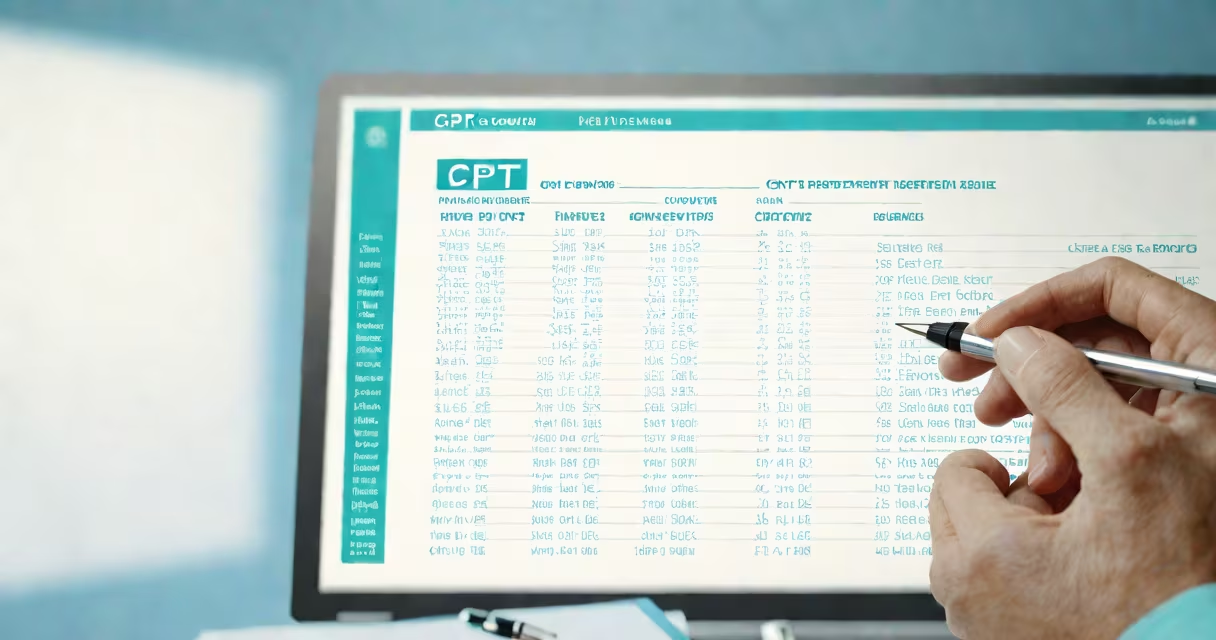
The "CPT code for" refers to a standardized five-digit numeric code assigned by the American Medical Association to identify specific medical, surgical, and diagnostic procedures performed by healthcare providers. These codes are used universally in the United States for billing, insurance claims, and tracking healthcare services.
CPT stands for Current Procedural Terminology. The system was developed to create consistency in how healthcare services are reported across providers, payers, and systems. Each code corresponds to a unique procedure, such as a blood test, MRI scan, or cardiac catheterization. When a provider performs a service, they assign the appropriate CPT code to document what was done, enabling accurate reimbursement.
For example, CPT code 99213 describes an established patient office visit with moderate complexity. A physician who sees a patient for a follow-up appointment involving history-taking, examination, and decision-making would report this code to bill the insurer. Without standardized codes like this, billing would rely on vague descriptions, leading to confusion, delays, and denials.
Healthcare providers use CPT codes during the billing process to communicate exactly which services were delivered. Insurers use these codes to determine coverage and payment amounts. The code itself doesn't specify cost-it only identifies the procedure. Pricing is determined separately through contracts between insurers and providers.
When a patient visits a clinic, the provider documents the encounter using clinical notes. Afterward, a medical coder reviews the notes and selects the correct CPT code based on the procedure performed. This code is then submitted with the claim form (such as CMS-1500) to the insurance company. The insurer checks the code against the patient's benefits and determines whether to approve payment.
For instance, a patient undergoing a colonoscopy with polyp removal would trigger multiple CPT codes. CPT 45380 covers the colonoscopy itself, while CPT 45385 adds the removal of a polyp. Using both codes ensures the provider receives full compensation for the work involved. Missing or misreporting a code can result in underpayment or claim denial.
CPT codes fall into three main categories: Category I, II, and III. Category I codes represent common, widely accepted procedures and are most frequently used in billing. They are updated annually by the AMA's CPT Editorial Panel.
Category II codes are supplemental tracking codes used for performance measurement and quality reporting. They do not support billing but help track outcomes. For example, CPT code 0000T tracks whether a patient received a flu vaccine during a visit.
Category III codes are temporary and track emerging technologies, procedures, and services. They are used to gather data before being moved to Category I. An example is CPT 0361T, which describes a new gene therapy technique still under evaluation.
| Type | Use Case | Example Code | Function |
|---|---|---|---|
| Category I | Standard medical procedures | 99213 | Billing for office visits |
| Category II | Performance tracking | 0000T | Documenting preventive care |
| Category III | Emerging tech | 0361T | Reporting experimental treatments |
One widespread misunderstanding is that CPT codes equate to pricing. They do not. A single CPT code may have different reimbursement rates depending on location, payer contract, and specialty. For example, CPT code 73700 (MRI of the knee) may be reimbursed at $600 in urban areas but only $420 in rural clinics due to regional fee schedules.
Another error is assuming that a code applies across all specialties. CPT code 58570 describes laparoscopic hysterectomy, but its use differs between gynecologists and general surgeons. The same code can be reported differently based on documentation and intent. Overcoding-using a higher-level code than justified-can lead to audits and penalties.
A lesser-known fact: CPT codes are not government-mandated. The U.S. Department of Health and Human Services adopted them through regulation, but the AMA owns and maintains the system. This means changes to codes require AMA approval, not federal rulemaking. The 2023 update included over 300 new and revised codes, mostly focused on telehealth, mental health, and oncology procedures.
Consider a patient with flank pain and suspected kidney stones. The physician orders a CT urogram-a non-invasive imaging study that evaluates the kidneys, ureters, and bladder. The correct CPT code for this procedure is 74270.
Here's how it works: The radiologist performs a contrast-enhanced CT scan of the abdomen and pelvis, capturing images in multiple phases. The report confirms a 4 mm stone in the left distal ureter. The provider documents the exam, including the reason, imaging parameters, and findings. The medical coder assigns CPT code 74270 to the claim.
Insurance processes the claim using this code. Medicare pays approximately $680 for this procedure, while private insurers may reimburse between $750 and $900 based on negotiated rates. If the coder had selected 74170 (CT of the abdomen without contrast), the claim would likely be denied due to incorrect coding.
I once reviewed a claim for a CT urogram that was rejected because the provider used 74275 instead of 74270. The difference? 74275 includes additional interpretation time and is reserved for complex cases with multiple abnormalities. The patient's scan showed only a single stone. Using the wrong code caused a delay in payment and required resubmission.
Always consult the official CPT code set published by the American Medical Association. The AMA updates the codebook annually, and access requires a license. Free online tools often contain outdated or inaccurate versions.
For detailed descriptions, use the AMA's CPT Assistant, a monthly publication that clarifies ambiguous codes. For example, CPT code 45380 has a detailed footnote explaining that it applies only when the colonoscopy is performed for screening or diagnosis-not for therapeutic intervention. Misinterpreting this can lead to improper billing.
Providers should also cross-check codes with payer-specific guidelines. Blue Cross Blue Shield, for instance, provides a searchable database of approved CPT codes and their associated reimbursement rates. Using a code without checking payer policies increases the risk of claim denial.
Understanding the "CPT code for" is essential for accurate medical billing and proper care documentation. These codes ensure transparency, standardization, and fairness in healthcare reimbursement across the U.S. system.