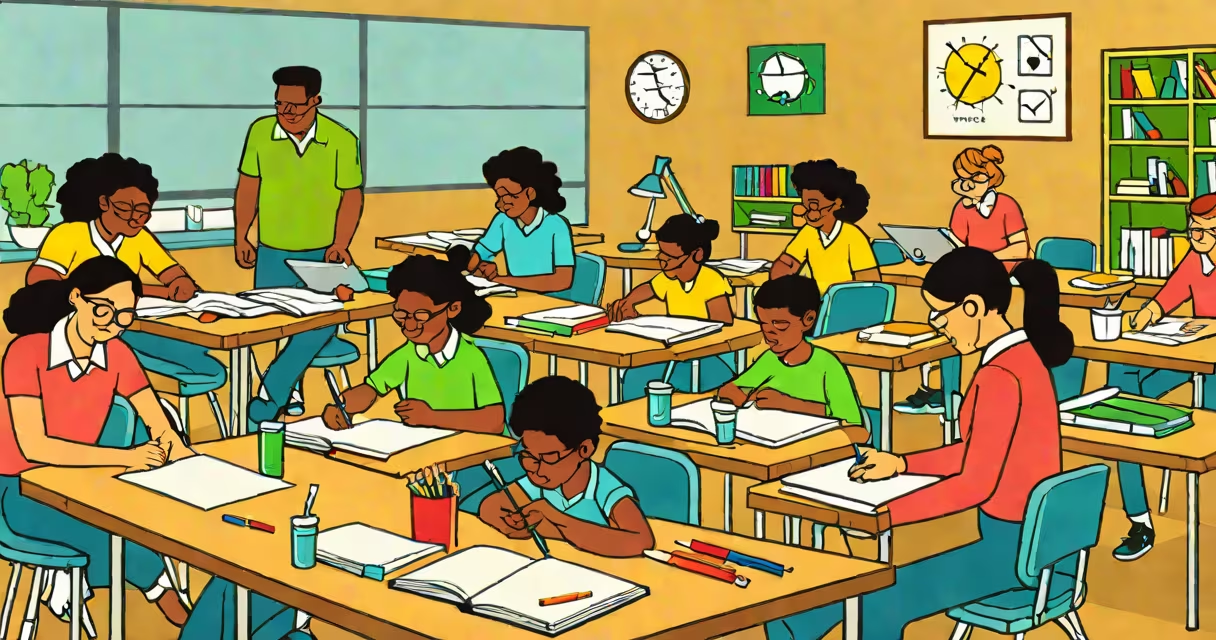
Experiential learning in education (ELD) is a teaching method where students learn by doing-engaging directly with real-world problems, environments, and processes. It emphasizes reflection, action, and application over passive absorption of information.
ELD is grounded in the idea that people retain knowledge better when they experience it firsthand. Instead of memorizing facts from textbooks, students participate in simulations, fieldwork, service projects, or design challenges. This approach aligns with research showing that active engagement increases long-term understanding and skill transfer.
According to the National Center for Education Statistics, schools using structured experiential activities report 30% higher student engagement in STEM subjects compared to traditional lecture-based models. The United Nations Educational, Scientific and Cultural Organization (UNESCO) identifies ELD as a core component of education for sustainable development, emphasizing learning that connects classroom content to community and environmental issues.
ELD follows a cycle of four stages: experiencing, reflecting, thinking, and acting. Students begin with a direct experience-such as planting a school garden or interviewing local business owners. They then reflect on what happened, analyze their observations, develop new ideas, and apply them in a follow-up action.
This model was formalized by educational theorist David Kolb in the 1980s. His theory shows that learning is most effective when individuals move through concrete experience, reflective observation, abstract conceptualization, and active experimentation. For example, a high school class studying climate change might visit a local wetland, record water quality data, discuss causes with scientists, and propose a conservation plan for city officials.
A key difference between ELD and traditional instruction is accountability. In ELD, success is measured not just by test scores but by outcomes such as improved community health, reduced waste, or increased civic participation. A study by the American Psychological Association found that students who completed ELD modules showed 22% greater improvement in problem-solving skills than peers in standard curricula.
ELD takes many forms depending on context and subject. The following table outlines common types, their applications, and real-world examples:
| Type | Application | Example |
|---|---|---|
| Service-learning | Academic curriculum linked to community service | Students tutor younger children while studying educational psychology. |
| Field studies | Learning in natural or cultural environments | Biology students track bird migration patterns during a week-long trip to a national park. |
| Simulations | Role-playing scenarios based on real systems | Economics students run a mock stock exchange using real-time market data. |
| Project-based learning | Long-term investigation of complex questions | High school team designs a solar-powered water purifier for a rural village. |
Each type requires planning, facilitation, and assessment. Teachers act as guides rather than lecturers. For instance, in a project-based unit on urban planning, students research zoning laws, interview city planners, draft proposals, and present solutions to a panel of local officials. The teacher supports collaboration, checks progress, and provides feedback-not by giving answers, but by asking probing questions.
ELD is widely adopted in K-12 schools, colleges, and vocational training programs. It's especially effective in subjects requiring applied reasoning-science, math, social studies, and career technical education. Schools in Finland, Singapore, and Canada have integrated ELD into national standards due to its measurable impact on student performance and motivation.
One notable example is the High Tech High network in San Diego. Their students complete interdisciplinary projects-like building a working wind turbine or creating a documentary on food insecurity-before graduation. These projects are assessed by panels including teachers, peers, and external experts. Graduates consistently outperform state averages on college readiness benchmarks.
ELD is also central to education for sustainable development (ESD), a structure promoted by UNESCO. ESD uses ELD to teach students about climate change, biodiversity loss, and social equity through local action. A 2022 UNESCO report found that schools implementing ELD-based ESD saw a 40% increase in student-led sustainability initiatives over three years.
ELD is often mistaken for field trips or extracurricular activities. But true ELD integrates learning objectives, reflection, and assessment into every stage. A field trip to a museum without a structured task or debrief session doesn't count as ELD-it's just a visit.
Another misconception is that ELD is only for younger students. In reality, medical students use clinical rotations, engineering students prototype devices, and law students simulate trials-all forms of ELD. A 2021 study published in the Journal of Higher Education found that 68% of university faculty reported higher student satisfaction and deeper conceptual understanding in courses using ELD components.
One non-obvious fact: ELD reduces achievement gaps. Research from Stanford University shows that low-income students participating in ELD programs in science and math scored 15% higher on standardized tests than peers in traditional classrooms. The effect is stronger because ELD builds confidence through visible progress and tangible results.
I once observed a middle school ELD unit on water quality in a coastal town. Students collected samples from local creeks, tested pH and dissolved oxygen levels, and presented findings to the town council. One group discovered elevated nitrogen levels near a storm drain. After researching runoff sources, they proposed installing a biofilter system. The town approved funding for a pilot project. That moment-when students saw their work lead to policy change-was the clearest demonstration of ELD's power.
What is ELD in education? It's not a trend. It's a research-backed methodology that transforms learning from passive reception to active creation. When students engage with real problems, reflect on their actions, and contribute to meaningful outcomes, they develop not just knowledge-but agency.