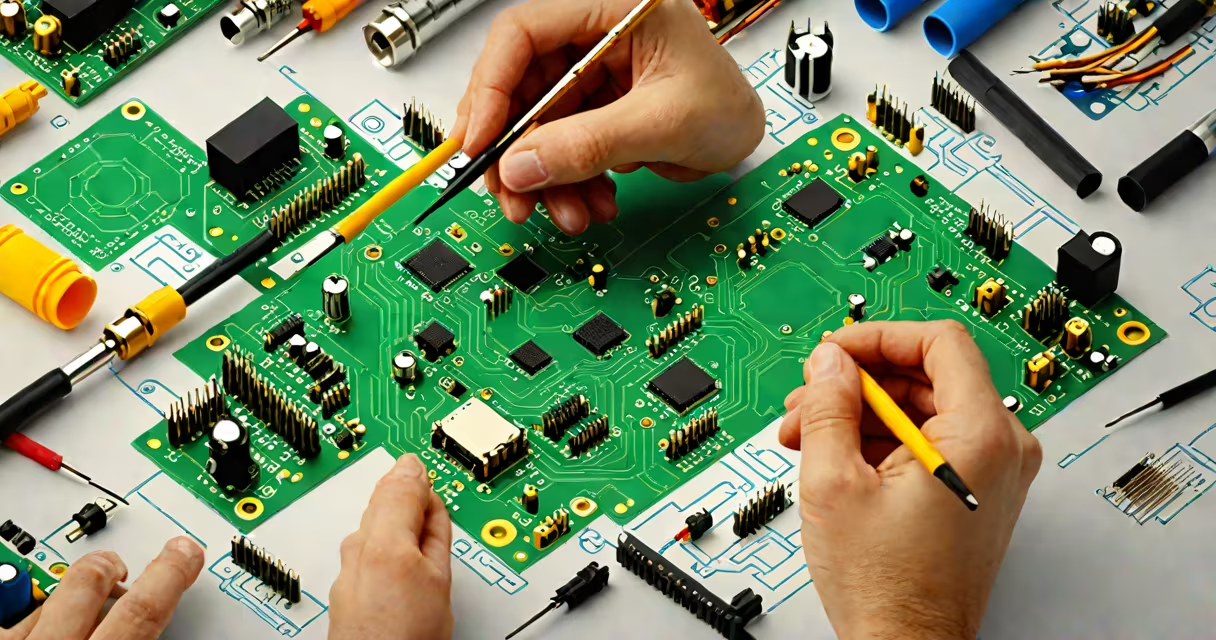
An embedded engineer is a specialist who develops software and firmware that runs on dedicated hardware within devices such as thermostats, automotive control units, and industrial sensors. They design systems that respond quickly and reliably to real-world inputs, often operating without user intervention.
These engineers work at the intersection of electronics and programming. Their tasks include writing low-level code that controls microcontrollers, configuring sensors and actuators, and ensuring system stability under tight timing and memory constraints. Unlike general-purpose software developers, embedded engineers focus on performance, power efficiency, and reliability in constrained environments.
The role demands understanding both hardware behavior and software logic. For example, an embedded engineer might program a microcontroller in a heart rate monitor to sample signals every 10 milliseconds, process them using a digital filter, and trigger an alarm if readings exceed safe thresholds-all while consuming less than 10 milliwatts of power.
Embedded engineers build systems that run on microprocessors or microcontrollers-small, dedicated computing units designed for specific functions. These systems typically lack keyboards, screens, or operating systems like Windows or Android. Instead, they execute a single task repeatedly and efficiently.
Development begins with selecting a processor based on speed, power draw, and peripheral support. The engineer then writes code in C or C++-languages that offer fine-grained control over memory and timing. This code compiles into machine instructions that run directly on the chip. Debugging involves connecting test probes to the device's pins to monitor voltage levels and signal timing.
For example, in a smart thermostat, the embedded engineer configures a temperature sensor to send data every 30 seconds. The microcontroller processes the input, compares it to user-set values, and activates heating or cooling via relays. All of this happens autonomously, with minimal human oversight.
Proficiency in C and C++ is essential. These languages allow direct manipulation of memory addresses and hardware registers. Engineers also use real-time operating systems (RTOS) like FreeRTOS when multiple tasks must run simultaneously, such as monitoring temperature, updating a display, and communicating over Wi-Fi.
Common tools include logic analyzers, oscilloscopes, and in-circuit debuggers. A logic analyzer captures sequences of digital signals across multiple wires, helping trace timing issues. An oscilloscope displays voltage changes over time-critical when debugging a faulty sensor signal.
Version control systems like Git track code changes. Continuous integration pipelines automate testing, ensuring new code doesn't break existing functionality. Many teams use hardware-in-the-loop simulation, where physical components are connected to a virtual model during testing.
Systems vary widely in complexity and application. Here are common categories:
| Type | Use Cases | Typical Components | Example |
|---|---|---|---|
| Simple Control | Appliance timers, basic sensors | 8-bit microcontroller, analog-to-digital converter | Refrigerator defrost cycle controller |
| Real-Time Monitoring | Industrial automation, vehicle diagnostics | 16/32-bit MCU, CAN bus interface | Engine control unit in a car |
| Complex Processing | Medical imaging, drones, smart cameras | ARM Cortex-A processor, GPU, high-speed RAM | Autonomous drone navigation system |
Each category requires different trade-offs between cost, speed, power, and reliability. A pacemaker uses a low-power 8-bit chip with strict safety standards. A self-driving car uses multi-core processors running complex algorithms under millisecond deadlines.
Industries rely heavily on embedded systems. Automotive manufacturers employ embedded engineers to develop engine management systems, airbag triggers, and infotainment interfaces. Medical device makers depend on them for life-support machines and diagnostic tools.
Consumer electronics also require embedded expertise. Smartwatches, fitness trackers, and home security systems all contain embedded processors. Even household appliances like washing machines and ovens use embedded controllers to manage cycles and detect faults.
According to the U.S. Bureau of Labor Statistics, employment in electronics engineering is projected to grow 2% annually through 2032, driven by demand for smarter, more efficient devices. The rise of the Internet of Things (IoT) has increased demand for engineers who can design secure, energy-efficient embedded systems.
Many assume embedded engineering is synonymous with robotics or AI. While some robotic systems use embedded components, most robotics involve higher-level decision-making handled by general-purpose computers. Embedded engineers focus on the foundational layer-the actual execution of commands on hardware.
Another misconception is that embedded systems are always simple. In reality, modern embedded systems can be highly complex. For instance, the flight control system in a commercial aircraft contains millions of lines of code, undergoes rigorous certification, and must operate flawlessly for decades.
A key distinction: embedded systems are not general-purpose computers. They don't run web browsers or word processors. They perform narrow, predefined tasks with predictable timing. This makes them ideal for applications where failure is unacceptable-like in surgical robots or nuclear plant controls.
I once worked on a project to replace a failing temperature sensor in a refrigerated transport unit. The original system used a 16-bit microcontroller with a custom protocol to report data every 15 seconds. When the sensor failed, the entire shipment risked spoiling.
After diagnosing the issue, I rewrote the firmware to handle error recovery and added a watchdog timer to reset the system if it hung. I also implemented checksum validation on incoming data. After deployment, the system ran for over 18 months without a single failure-proving that small, well-designed embedded systems can deliver long-term reliability.
Unlike software engineers who build apps for phones or desktops, embedded engineers must anticipate physical limitations. Memory may be limited to 64 kilobytes. Power sources might be batteries lasting years. Timing delays cannot exceed microseconds.
They also deal with real-world noise-electrical interference, temperature drift, mechanical wear. A sensor reading might fluctuate due to vibration. An algorithm must filter out false positives while still detecting actual changes.
One non-obvious fact: many embedded systems never receive updates. Once deployed, they may run unchanged for a decade. This means code must be correct the first time. There's no "patch later" option. That's why documentation, testing, and formal verification are critical parts of the workflow.
When choosing between a general-purpose software developer and an embedded engineer, consider the environment. If your product runs on a phone or server, a software engineer may suffice. But if it lives inside a car, a medical device, or a satellite, you need someone trained in embedded systems.
Understanding what is embedded engineer reveals a field rooted in precision, reliability, and deep technical integration. These professionals ensure that everyday devices-from smoke detectors to MRI machines-function correctly under pressure and over time.