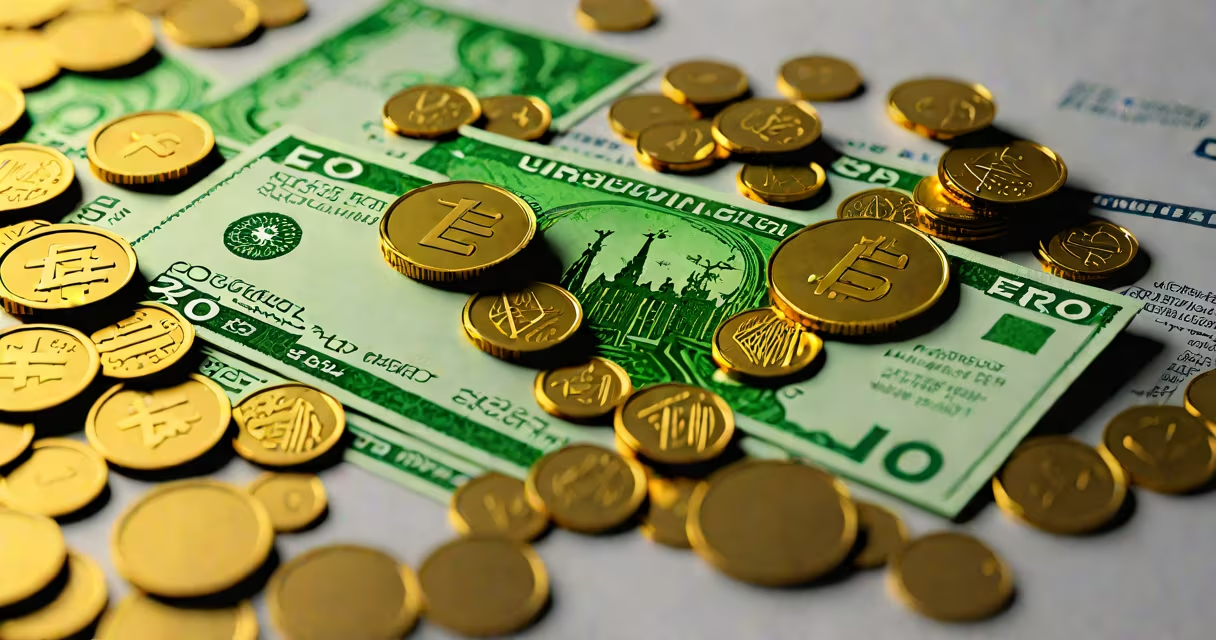
The euro (EUR) is the official currency of 20 member states within the European Union. It was introduced in 1999 as an electronic currency and began circulating as physical notes and coins in 2002. Today, it ranks among the most widely held currencies in global foreign exchange markets.
EUR is managed by the European Central Bank (ECB), which sets monetary policy for the Eurozone. The ECB's primary goal is price stability, defined as keeping inflation below but close to 2% over the medium term. This mandate guides interest rate decisions and liquidity operations across the region.
As of 2023, the euro is used by 20 EU countries, including Germany, France, Italy, Spain, and the Netherlands. These nations collectively form the Eurozone, a single economic area with coordinated fiscal and monetary policies. Not all EU members use the euro-countries like Sweden, Poland, and Denmark have opted out or delayed adoption.
When a business in Berlin sells goods to a customer in Athens, the transaction typically settles in euros. This eliminates the need for currency conversion between national currencies, reducing friction in cross-border trade. The euro functions as both a unit of account and a medium of exchange within the Eurozone.
Outside the Eurozone, EUR is traded on global foreign exchange (forex) markets. Exchange rates fluctuate based on supply and demand, influenced by central bank policy, inflation data, economic growth, and geopolitical events. For example, during the 2022 energy crisis, the euro weakened against the U.S. dollar due to concerns about inflation and energy dependence.
Exchange rates are quoted in pairs-for example, EUR/USD. A rate of 1.08 means one euro buys 1.08 U.S. dollars. Traders, banks, and multinational corporations rely on these rates to manage risk and plan international transactions. The euro is the second most-traded currency globally, behind the U.S. dollar, according to the Bank for International Settlements (BIS).
The euro exists in two forms: physical and digital. Physical euro currency includes banknotes and coins issued by national central banks under ECB oversight. Notes come in seven denominations: €5, €10, €20, €50, €100, €200, and €500. Coins are minted in eight values: 1, 2, 5, 10, 20, and 50 cents, and €1 and €2.
Each country may design the national side of the coin, while the common side features a map of Europe and the denomination. The European Central Bank ensures uniformity in security features such as watermarks, holograms, and microprinting.
| Currency Type | Denominations | Issuer | Usage Example |
|---|---|---|---|
| Banknotes | €5 to €500 | National central banks under ECB authority | Purchasing a train ticket in Rome |
| Coins | 1c to €2 | National mints (EU member states) | Paying for a coffee in Vienna |
| Digital EUR | Account balances, transfers | Banks, payment systems | Transferring funds |
Electronic euro transactions occur through banking networks, payment platforms like SEPA (Single Euro Payments Area), and digital wallets. SEPA enables instant, low-cost transfers between Eurozone countries using a single set of standards. A transfer from a German account to a French account typically settles within one business day and costs less than €0.50.
Many assume the euro is the currency of all 27 EU member states. That is incorrect. Countries like Sweden, Poland, and Denmark do not use the euro. Even within the Eurozone, some territories like French Guiana and the Canary Islands use the euro despite being part of the EU but not part of the Schengen Area.
Another misconception is that the euro is backed by gold. It is not. The euro is fiat money-its value derives from trust in the issuing institutions and the economic strength of the Eurozone. Unlike the U.S. dollar, which has historical ties to gold reserves, the euro's backing rests solely on the credibility of the ECB and the collective fiscal discipline of member states.
A lesser-known fact: the €500 note remains legal tender but is rarely used. The ECB reported in 2022 that fewer than 20 million €500 notes were in circulation, down from a peak of over 100 million in 2008. The note's size and high denomination make it vulnerable to misuse in illicit finance, prompting the ECB to limit its production.
In 2021, I traveled and paid for a hotel stay in euros. The front desk accepted a €100 bill and gave me change in smaller denominations. Later, I used my bank card to pay for a meal at a restaurant in Valencia. The transaction processed instantly via SEPA, and the amount was deducted in euros without any conversion fee.
Back home, I checked the EUR/USD exchange rate on a financial website. On that day, it stood at 1.0625. I had $1,000 to spend on a purchase in Germany. Converting that amount to euros gave me €941.18. The difference reflects the exchange rate and a small processing fee charged by my bank.
This example illustrates how EUR functions in daily life: as a stable, widely accepted currency for travel, commerce, and investment. Its role extends beyond borders-many non-Eurozone countries peg their currencies to the euro or hold euro reserves as part of foreign exchange strategy.
The euro is more than a currency-it is a symbol of European integration. Its existence reflects decades of political and economic cooperation among member states. While challenges remain-such as divergent fiscal policies and debt levels-the euro continues to serve as a foundation for regional stability and cross-border trade.