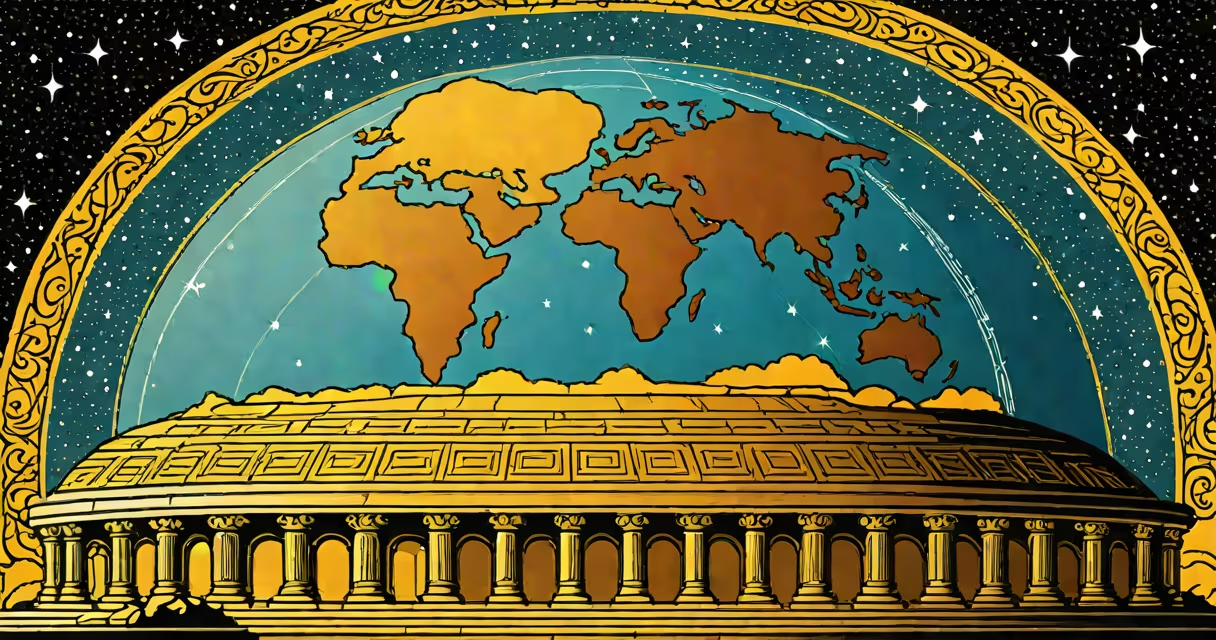
The firmament in the Bible is a solid, vaulted structure described in Genesis 1:6-8 as a barrier separating the waters above from those below, forming the boundary between Earth and the heavens. This concept reflects ancient Near Eastern cosmology, not modern scientific understanding.
According to Genesis 1:6-7, God said, "Let there be a firmament in the midst of the waters, and let it divide the waters from the waters." The Hebrew word used is *rāqîa'*, derived from *rāqa'*, meaning "to beat out" or "to spread out," suggesting a hammered metal surface. This implies a rigid, extended structure rather than a fluid or atmospheric layer.
Early translators rendered *rāqîa'* as "firmament" in the King James Version (KJV), which influenced centuries of Christian interpretation. The term evokes a physical ceiling over the Earth, holding back celestial waters. This view persisted in medieval art and theology, where the firmament was often depicted as a crystalline dome.
Ancient people viewed the cosmos through a three-tiered model: Earth as the center, the firmament as a solid dome above, and the heavens beyond. Water existed both above and below the Earth. The firmament prevented the upper waters from flooding the world, maintaining cosmic order.
This model appears in other ancient texts. The Babylonian *Enuma Elish* describes a cosmic battle where Marduk creates the world by splitting the body of the goddess Tiamat into sky and earth. Similarly, the Hebrew account uses divine command to establish order: God speaks, and the firmament forms.
Modern readers may find this imagery strange, but it served a purpose. In a pre-scientific age, the firmament explained natural phenomena-rain came from the upper waters, clouds were part of the firmament's structure, and the sun and stars moved within it. It was a way to make sense of the visible universe.
The Bible does not specify the material of the firmament. However, the Hebrew root *rāqa'* suggests a hammered metal or bronze-like substance. In Ezekiel 1:22-26, the prophet sees a firmament described as "like the appearance of the throne of God... like the color of the awesome crystal." This indicates a translucent, possibly luminous, material.
Some scholars distinguish between the firmament in Genesis and later references. In Genesis, it is a structural divider. In Psalm 19:1, the firmament is linked to praise: "The heavens declare the glory of God; the firmament shows His handiwork." Here, it becomes a poetic symbol of divine creation.
| Biblical Reference | Context | Interpretation |
|---|---|---|
| Genesis 1:6-8 | Creation Day 2 | Divides upper and lower waters; establishes order |
| Ezekiel 1:22-26 | Prophet's vision of God's throne | Crystal-like, glowing surface; symbolic of divine presence |
| Psalm 19:1 | Poetic declaration of God's glory | Firmament as witness to God's work; metaphorical |
The firmament is never described as a cloud layer or atmosphere. It is not a meteorological feature. The distinction matters: modern readers sometimes misread it as weather or air, but the original context is theological and cosmological.
Many Christians interpret the firmament literally, believing it to be a physical structure. But mainstream biblical scholarship, including resources from the British and Foreign Bible Society and Bible Project, emphasizes that the Genesis account uses symbolic language to convey theological truths-not scientific facts.
A common mistake is equating the firmament with the sky or atmosphere. The firmament is not air. It is not clouds. It is not even space. It is a conceptual boundary in a worldview that predates astronomy. To treat it as a scientific claim is to misunderstand its function.
Another misconception is that the firmament implies a flat Earth. While the ancient model did place Earth at the center, it did not necessarily mean flatness. The Hebrew word *'erets*, translated as "earth," refers to land or territory, not a geometric plane. The firmament's role was structural, not topographical.
In 2018, I studied a 16th-century illuminated manuscript of the Book of Genesis at the Bodleian Library in Oxford. The image showed God creating the firmament as a golden dome with stylized water droplets above and a green Earth below. The artist used gold leaf to depict the firmament's solidity-a visual representation of its perceived rigidity.
This artwork illustrates how deeply the firmament shaped religious imagination. It wasn't just a text-it was a mental model. Even today, some evangelical schools teach the firmament as a literal dome, though most theologians reject this as anachronistic.
The firmament is not a planet, a star, or a galaxy. It is not the atmosphere, clouds, or outer space. It is not a spiritual area or heaven itself. Heaven in the Bible is a separate concept-often described as a place of God's presence, not a physical structure.
Even the term "heaven" in Genesis 1:8 is not synonymous with the firmament. The verse says, "God called the firmament Heaven." This naming is symbolic: the firmament becomes the domain of God's rule. It is not a location but a designation of sacred space.
When reading "what is firmament in the Bible mean," remember: it's a cultural artifact of ancient thought. It reflects how early Israelites understood the cosmos-not as a scientific model, but as a story of creation, order, and divine power.