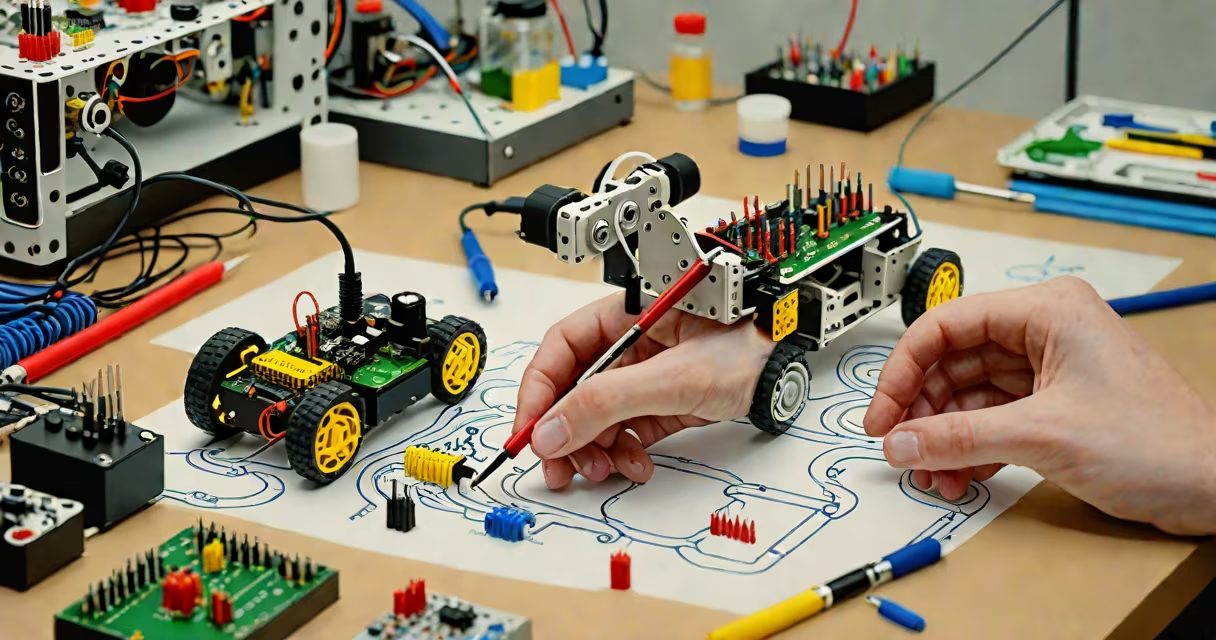
Stem stands for science, technology, engineering, and mathematics-four academic disciplines that are often taught together in educational programs and form the basis for many modern careers. The term describes both a curriculum model and a workforce category focused on analytical thinking, problem solving, and innovation.
Stem originated in U.S. education policy in the early 2000s as a response to declining performance in math and science among American students. The National Science Foundation (NSF) promoted stem as a structure to strengthen national competitiveness in technology and research. Today, stem represents a coordinated approach to teaching and learning across subjects traditionally studied in isolation.
When educators refer to stem, they mean an integrated method where students apply concepts from multiple disciplines to solve real-world problems. For example, a high school class might design a solar-powered vehicle using physics principles, computer programming, mechanical design, and cost analysis-all within a single project. This interdisciplinary structure distinguishes stem from traditional subject-based instruction.
Stem education emphasizes hands-on learning and project-based tasks. Students don't just memorize formulas or theories-they build, test, and iterate. A typical stem activity involves identifying a problem, researching solutions, designing a prototype, testing results, and refining the design based on feedback.
For instance, a middle school group might be tasked with creating a water filtration system for a community affected by pollution. They'd use chemistry to understand contaminants, biology to assess health impacts, engineering to construct filters, and math to measure flow rates and efficiency. This process mirrors how professionals work in fields like environmental engineering or public health technology.
Research from the U.S. Department of Education shows that students engaged in stem programs demonstrate higher retention in science and math courses and are more likely to pursue related careers. A 2021 study found that 68% of high school students who completed at least one stem course reported increased interest in science-related jobs.
Stem is often misunderstood as being limited to advanced math and coding. While those are key elements, stem includes all four pillars equally:
| Discipline | Focus Areas | Real-World Application Example |
|---|---|---|
| Science | Biology, chemistry, earth sciences | Developing vaccines or analyzing climate change data |
| Technology | Software, robotics, data systems | Designing apps for medical diagnostics |
| Engineering | Structural design, automation, materials science | Building bridges or optimizing energy grids |
| Mathematics | Algebra, statistics, calculus | Modeling disease spread or predicting stock market trends |
A common error is treating stem as synonymous with computer science. While tech and coding are central, stem encompasses physical sciences and applied design. A student studying plant genetics in a greenhouse is engaging in stem just as much as one writing code for a drone.
Another misconception is that stem is only for elite institutions. In reality, stem programs exist in rural schools, vocational colleges, and after-school clubs. The U.S. Department of Education reports that over 70% of public high schools offer at least one stem course, including career and technical education (CTE) tracks.
Stem fields drive advancements in healthcare, transportation, energy, and communications. The World Economic Forum identifies stem skills as critical for 85% of future job roles. By 2030, the U.S. Bureau of Labor Statistics projects a 14% growth in stem occupations-twice the average rate for all other jobs.
Healthcare provides a clear example. During the 2020 pandemic, stem-trained professionals developed rapid antigen tests, modeled virus transmission using mathematical simulations, designed ventilator prototypes, and managed large-scale vaccine distribution logistics. These efforts combined biology, data modeling, engineering, and software systems.
Even non-technical roles rely on stem literacy. Marketing analysts use statistical models to predict consumer behavior. Urban planners apply geographic information systems (GIS) to map population density and traffic patterns. Financial advisors analyze risk using probability theory and algorithmic forecasting.
One non-obvious fact: stem isn't always about new inventions. Many stem careers involve maintenance, optimization, and adaptation. For example, a civil engineer may spend more time inspecting bridge integrity and updating safety codes than designing new structures. The field values continuous improvement as much as breakthrough innovation.
Stem is frequently confused with "stem cells" or "stemming the tide"-both are unrelated. Stem cells are biological units capable of developing into various cell types. "Stemming the tide" is a metaphor meaning to stop a negative trend. These uses share no connection with the academic acronym.
Also, stem is not interchangeable with "STEM education." While related, the former refers to the subject areas themselves, while the latter describes pedagogical approaches. A course in algebra is part of stem; teaching algebra through interactive simulations is stem education.
I once observed a high school robotics team struggle because they treated their project as a collection of isolated tasks-someone coded, someone built the frame, another handled power distribution. When we restructured the workflow around shared goals and cross-disciplinary collaboration, their robot performed 40% better in competitions. That shift reflected core stem principles: integration, iteration, and teamwork.
Understanding what is meant by stem begins with recognizing it as a changing, interconnected set of disciplines. It's not a list of subjects-it's a mindset focused on inquiry, design, and impact. Whether in classrooms, labs, or boardrooms, stem shapes how society solves complex challenges.