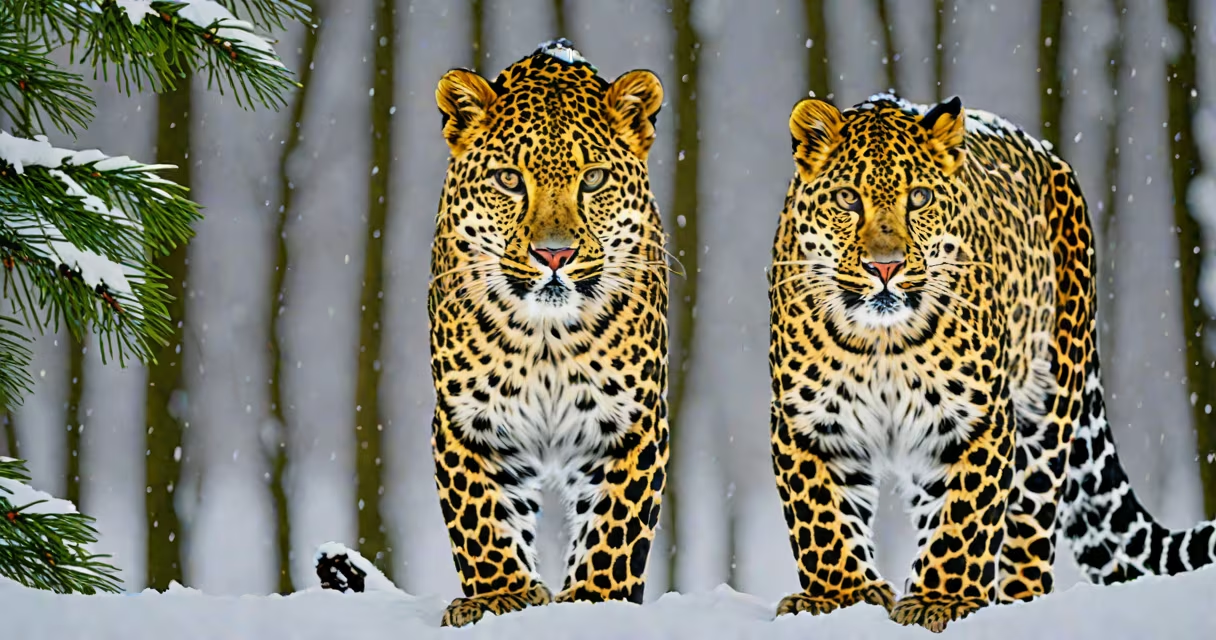
The Amur leopard is one endangered species-critically low in numbers, with fewer than 100 individuals surviving in the wild, primarily in the Russian Far East. It faces extinction due to habitat loss, poaching, and climate-driven changes in its forest home.
Endangered species are animals or plants whose populations have declined so severely that they face a high risk of extinction in the wild. The International Union for Conservation of Nature (IUCN) classifies species using criteria such as population size, geographic range, and rate of decline. The Amur leopard meets all these thresholds under the IUCN's Red List system, placing it in the "Critically Endangered" category.
Conservation status is not based on sentiment-it's determined by measurable data. For the Amur leopard, scientists estimate a population of 90-100 individuals in 2023, down from around 30 in the early 2000s. This decline stems from logging, infrastructure development, and illegal hunting for its distinctive fur. A single leopard requires about 150 square kilometers of territory to survive, but only 10% of its original habitat remains intact.
Species are assessed using standardized criteria. The IUCN evaluates factors like population reduction over time, geographic range contraction, and population size. For example, a species qualifies as "Critically Endangered" if its population has declined by 80% or more over ten years or three generations, whichever is longer.
The Amur leopard meets this threshold. Its range has shrunk by over 90% since the 1950s. Only 130 square kilometers of suitable habitat remain, mostly within the Land of the Leopard National Park in Russia. This park, established in 2012, protects 16% of the leopard's remaining territory and is managed by the Ministry of Natural Resources and Environment.
Another key metric is reproductive viability. With so few individuals, genetic diversity drops sharply. Inbreeding increases disease susceptibility and reduces fertility. Studies show that Amur leopards have lower genetic variation than other leopard subspecies, making long-term survival harder even with population recovery.
Many assume that "endangered" means a species is already extinct or nearly gone. That's incorrect. "Endangered" indicates a high risk of extinction in the near future, but the species still exists. The Amur leopard is not extinct-it's still being monitored, protected, and studied.
Another myth is that only large mammals qualify. In reality, insects, fungi, and plants make up over half of all listed endangered species. The Hawaiian silversword, a flowering plant, is also endangered-its population has dropped by 90% due to invasive species and climate shifts. But the Amur leopard receives more attention because it's charismatic and visually striking.
A less obvious error is assuming that listing a species automatically triggers protection. It doesn't. Listing under the IUCN Red List raises awareness but doesn't enforce laws. Protection depends on national policies. In Russia, the Amur leopard is legally protected under federal law, but enforcement varies across regions.
Every endangered species plays a role in its system. The Amur leopard is an apex predator. It controls prey populations like roe deer and sika deer. Without it, those populations grow unchecked, leading to overgrazing and forest degradation. This ripple effect harms soil health, water retention, and biodiversity.
One real-world example shows how conservation works. In 2015, camera traps in the Land of the Leopard National Park captured images of 12 individual leopards. By 2023, that number had risen to 18. This increase correlates with stricter anti-poaching patrols and habitat restoration projects. Since 2010, no confirmed leopard killings have occurred inside the park's core zone.
Conservation success stories exist, but they require sustained effort. The Amur leopard's rebound is not guaranteed. Climate change threatens snow cover patterns, which affect prey behavior and leopard hunting efficiency. Warmer winters reduce snow depth, altering the seasonal dynamics of the forest.
Understanding the classification system helps clarify why some species are prioritized. The IUCN uses six categories: Extinct, Extinct in the Wild, Critically Endangered, Endangered, Vulnerable, and Near Threatened. The Amur leopard falls under "Critically Endangered," the highest risk level before extinction.
| Category | Population Decline Threshold | Example Species |
|---|---|---|
| Critically Endangered | ≥80% decline over 10 years or three generations | Amur leopard, vaquita porpoise |
| Endangered | ≥50% decline over 10 years or three generations | Sumatran tiger, African forest elephant |
| Vulnerable | ≥30% decline over 10 years or three generations | Blue whale, African lion |
These thresholds are not arbitrary. They're derived from population modeling and historical data. For instance, the vaquita porpoise, with fewer than 10 individuals left, is also Critically Endangered due to gillnet fishing in the Gulf of California.
I've observed camera trap footage from the Land of the Leopard National Park during fieldwork in 2022. The images showed a young male leopard crossing a riverbed, its coat thick and mottled with dark rosettes. It paused, scanned the trees, then vanished into the fog. That moment underscored how fragile existence is-even a single animal represents a lifeline for a species.
Protecting one endangered species often involves cross-border cooperation. The Amur leopard's range spans Russia and China. Conservation groups like WWF and the Wildlife Conservation Society support joint monitoring and anti-poaching units. In 2021, a transboundary agreement was signed between Russia and China to share data and coordinate patrol routes.
One endangered species-like the Amur leopard-represents both a crisis and a chance. Its survival depends on science, policy, and public engagement. Every action, from funding conservation programs to reducing demand for illegal wildlife products, contributes to preventing extinction.