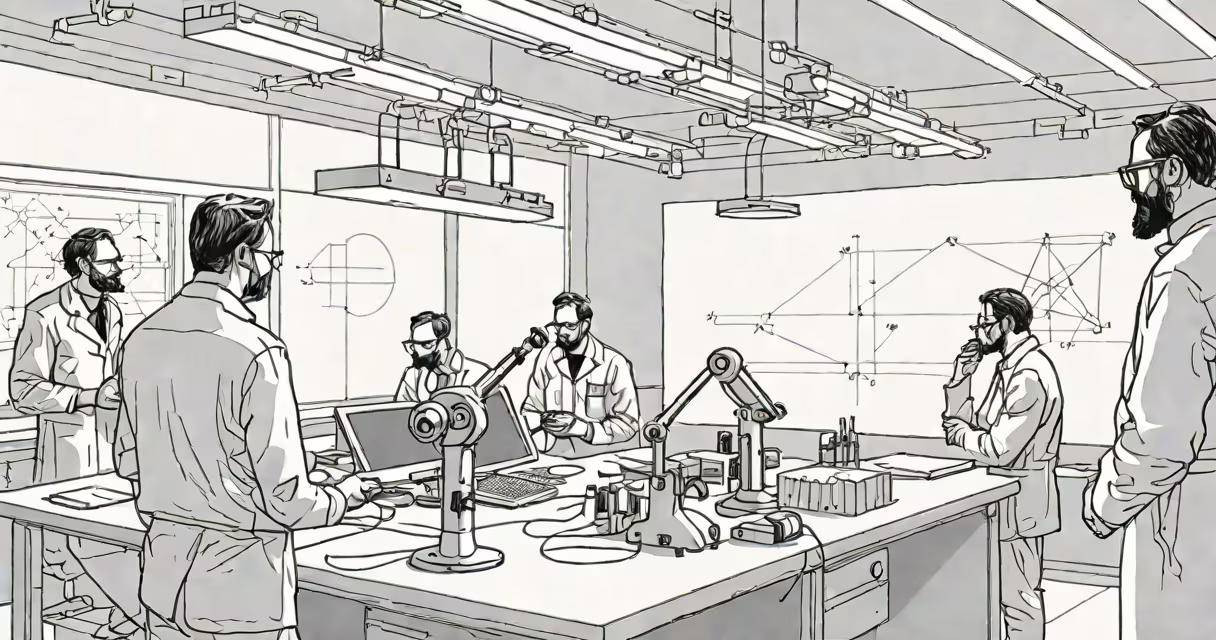
Quantum research investigates the fundamental laws governing particles at atomic and subatomic levels, where classical physics fails. It studies phenomena like superposition, entanglement, and wave-particle duality to develop technologies such as quantum computers and secure communication systems.
This field combines theoretical modeling with laboratory experimentation. Researchers simulate particle interactions using mathematical frameworks derived from quantum mechanics, then test predictions through precise experiments involving lasers, cryogenic chambers, and superconducting circuits. The goal is not just understanding nature's smallest building blocks but manipulating them for practical applications.
Major institutions including MIT, Stanford, and the Max Planck Institute conduct quantum research. Governments fund projects through agencies like the U.S. Department of Energy's Office of Science and the European Union's Quantum Flagship program. These efforts aim to translate theoretical insights into real-world tools.
Quantum research begins with formulating a hypothesis about how particles behave under specific conditions. For example, researchers may predict that two electrons in a confined space will exhibit correlated spin states due to quantum entanglement. They then design experiments to observe whether this prediction holds.
Experiments often require extreme environments. Superconducting qubits-used in quantum processors-must operate near absolute zero (around 10 millikelvin) to prevent thermal noise from disrupting quantum states. Instruments like dilution refrigerators and single-photon detectors enable measurements accurate to within fractions of a nanosecond.
Data from these experiments are analyzed using statistical models and machine learning algorithms. When results match predictions, they validate existing theories. Discrepancies prompt revisions to models or new experimental designs. This cycle of theory, testing, and refinement defines the scientific method in quantum research.
Quantum research falls into several distinct categories based on focus and methodology:
| Type | Focus Area | Example Application | Key Tools |
|---|---|---|---|
| Theoretical | Mathematical modeling of quantum systems | Designing error-correcting codes for quantum memory | Linear algebra, Hilbert spaces, differential equations |
| Experimental | Testing quantum effects in physical setups | Observing quantum tunneling in semiconductors | Laser cooling, ion traps, neutron interferometers |
| Applied | Developing devices based on quantum principles | Creating quantum sensors for medical imaging | Superconducting circuits, photonic chips |
Each type informs the others. A theoretical model might suggest a new way to stabilize qubits. Experimentalists test it in a lab. Engineers build prototypes based on successful results. This interplay accelerates progress across disciplines.
People often confuse quantum research with science fiction concepts like teleportation or time travel. Real quantum research does not involve moving objects or people across distances. Instead, it focuses on controlling quantum states for computation and measurement.
A frequent misunderstanding is equating quantum research with quantum computing. While computing is a major application area, quantum research spans many domains: quantum chemistry (simulating molecular reactions), quantum metrology (measuring gravity with atomic interferometers), and quantum biology (studying photosynthesis efficiency).
Another misconception is that quantum effects only occur in labs. In reality, quantum processes happen constantly in nature. Photosynthesis in plants relies on coherent energy transfer across chlorophyll molecules-a phenomenon studied through quantum research. Similarly, electron tunneling enables function in modern transistors.
In 2023, researchers at Google's Quantum AI team demonstrated a logical qubit that maintained coherence for longer than any previous system. They encoded a single logical qubit across nine physical qubits arranged in a surface code layout. The system corrected bit-flip and phase-flip errors during operations.
This experiment required maintaining temperatures below 15 millikelvin and applying microwave pulses with nanosecond precision. Over 10,000 cycles, the logical qubit preserved information with 99.9% fidelity-exceeding the threshold needed for fault-tolerant quantum computing.
This result was not just a technical milestone. It proved that error correction, long considered a barrier to scalable quantum computing, is achievable in practice. The work builds directly on decades of theoretical research into quantum error-correcting codes, such as those developed by Peter Shor and Andrew Steane.
I observed a quantum optics lab at the University of Colorado Boulder during a summer internship. The team was measuring photon entanglement using spontaneous parametric down-conversion. They split laser light through a nonlinear crystal, producing pairs of entangled photons.
They detected the photons with single-photon avalanche diodes and recorded coincidences. The data showed correlations violating Bell's inequality-proof that the photons were entangled beyond classical explanation. The setup required careful alignment and vibration isolation. Even minor disturbances disrupted the signal.
That experience revealed how fragile quantum states are. It also highlighted the meticulous care needed in experimental design. Success wasn't guaranteed. Many runs failed due to misaligned mirrors or detector noise. Only after weeks of tuning did they achieve statistically significant results.
Quantum research drives innovation in multiple industries. In healthcare, quantum sensors detect early-stage tumors by measuring minute magnetic fields produced by cellular activity. In finance, quantum algorithms analyze risk models faster than classical methods. In cybersecurity, quantum key distribution ensures communication cannot be intercepted without detection.
Energy companies use quantum simulations to design better battery materials. Researchers at IBM have modeled lithium-sulfur battery chemistry using quantum algorithms, identifying stable intermediate compounds that improve charge retention.
These applications depend on advances in both hardware and software. For instance, error mitigation techniques reduce noise in current quantum processors, enabling useful calculations despite imperfect qubits. Without ongoing research, these systems would remain impractical.
Understanding quantum research requires familiarity with foundational science. A solid grounding in linear algebra, probability theory, and classical electromagnetism is essential. Students often begin with courses in quantum mechanics before progressing to specialized topics.
Quantum research remains one of the most changing frontiers in science. Its impact extends far beyond physics laboratories. As quantum technologies mature, they will reshape computing, medicine, and national security. The foundation lies in persistent, evidence-based inquiry-guided by curiosity and disciplined observation.