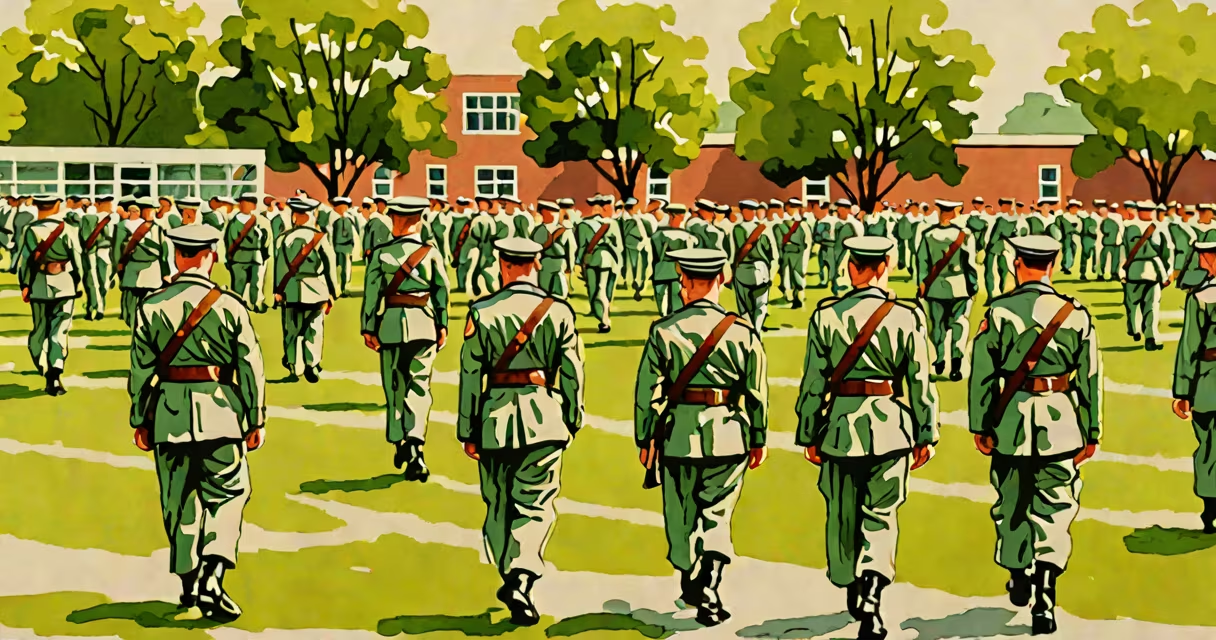
ROTC, or Reserve Officers' Training Corps, is a college program that trains students to become commissioned officers in the U.S. Army, Navy, Air Force, or Marine Corps. Participants receive military instruction, leadership training, and financial support-including scholarships-for their education while earning a bachelor's degree.
ROTC cadets attend regular classes alongside other undergraduates but also complete mandatory military training sessions, physical fitness tests, and leadership labs. The program spans four years, with cadets progressing through phases based on rank and responsibility. By graduation, most cadets have completed leadership exercises, tactical simulations, and field training events.
While ROTC is often associated with intense physical conditioning and strict discipline, it also emphasizes academic success, teamwork, and personal growth. Cadets are expected to maintain a minimum GPA, pass biannual physical fitness assessments, and participate in weekly training sessions. The goal is to develop leaders who can serve effectively in military roles after commissioning.
ROTC operates under the Department of Defense and is offered at over 1,000 colleges and universities across the United States. Each branch-Army, Navy, Air Force, and Marine Corps-has its own ROTC program with distinct curricula and timelines. Cadets enroll during their freshman year and progress through four phases: Basic Camp (Year 1), Advanced Camp (Year 3), and commissioning (Year 4).
During the first two years, cadets take courses in military science, leadership theory, and national security. They also attend weekly lab sessions focused on small-unit tactics, map reading, and decision-making under pressure. Physical training occurs twice weekly, including running, calisthenics, and strength conditioning. Cadets must meet the Army Combat Fitness Test (ACFT) standards, which require 30 push-ups, 60 sit-ups, and a 2-mile run in under 15 minutes.
In the third year, cadets attend Advanced Camp-a five-week intensive training event held at Fort Knox, Kentucky, or another designated military installation. This camp evaluates leadership skills through simulated combat scenarios, navigation challenges, and team-based problem solving. Only those who pass are selected for commissioning. The Army ROTC Advanced Camp has a selection rate of approximately 85%, meaning about 15% of cadets do not advance.
Each service branch offers ROTC with different structures, scholarship levels, and career paths. The following table outlines key differences:
| Branch | Scholarship Coverage | Training Focus | Commissioning Path |
|---|---|---|---|
| Army ROTC | Tuition, fees, books, and a monthly stipend ($500-$600) | Leadership, infantry tactics, logistics, engineering | Commissioned as 2nd Lieutenant in the Army |
| Navy ROTC | Tuition, fees, books, and a $2,000 annual allowance | Naval operations, seamanship, nuclear power, aviation | Commissioned as Ensign in the Navy or Marine Corps |
| Air Force ROTC | Tuition, fees, books, and a $500 monthly stipend | Aerospace science, flight training, cyber operations | Commissioned as 2nd Lieutenant in the Air Force |
| Marine Corps ROTC | Tuition, fees, books, and a $1,000 monthly allowance | Infantry, amphibious warfare, command structure | Commissioned as Second Lieutenant in the Marine Corps |
Cadets in the Army and Marine Corps ROTC programs typically wear the same uniforms and follow similar daily routines. However, Navy and Air Force ROTC cadets may wear different dress uniforms and participate in specialized training such as flight simulators or submarine orientation.
ROTC is used to recruit and prepare future military officers from civilian college campuses. It serves as a pipeline for the armed forces to access educated, trained, and motivated candidates. According to the U.S. Department of Defense, ROTC produced over 6,000 commissioned officers annually between 2018 and 2022, with 70% of those officers serving in active duty roles.
Many cadets join ROTC to reduce student debt. Full-tuition scholarships cover up to $80,000 over four years, depending on the branch and institution. The Army ROTC Scholarship Program, administered by the U.S. Army Cadet Command, provides funding for cadets in STEM fields, nursing, and other high-demand specialties.
One non-obvious fact: ROTC cadets are not required to serve in combat zones unless they volunteer or are assigned. Most early-career officers begin in administrative, logistical, or training roles. For example, a 2021 study by the Center for Strategic and Budgetary Assessments found that 68% of new Army officers were assigned to non-combat roles during their first three years of service.
Many people assume ROTC is only for those planning to fight in war. That's incorrect. While military service is part of the mission, ROTC prepares cadets for diverse roles-from managing supply chains to leading cyber defense units. A cadet studying computer science might be commissioned into the Army Cyber Command, not infantry.
Another misconception is that ROTC requires immediate enlistment. Cadets can leave the program at any time before commissioning without penalty. The Army ROTC program allows withdrawal during the first semester of the sophomore year with no obligation. However, cadets who accept scholarships must repay funds if they withdraw after the junior year.
I once observed a cadet at a university ROTC field day who had just switched majors engineering. He was still completing his ROTC requirements and was scheduled to attend Advanced Camp. His story illustrates that ROTC supports academic exploration-not just military preparation. He told me, "I didn't join to be a soldier. I joined to lead."
Consider Alex, a sophomore at the University of Texas at Austin. Alex is majoring in mechanical engineering and participates in Army ROTC. His week includes:
Alex earns a $500 monthly stipend and has his tuition covered through a four-year Army ROTC scholarship. He plans to commission as a 2nd Lieutenant and serve in the Army Corps of Engineers. His schedule reflects the balance ROTC demands: academic rigor, physical endurance, and leadership development.
What is ROTC like? It's structured, demanding, and deeply rewarding. Cadets gain leadership experience, financial support, and a clear path to commissioning-all while earning a degree. The program is not just about preparing for war. It's about developing responsible, capable leaders ready to serve in complex environments.