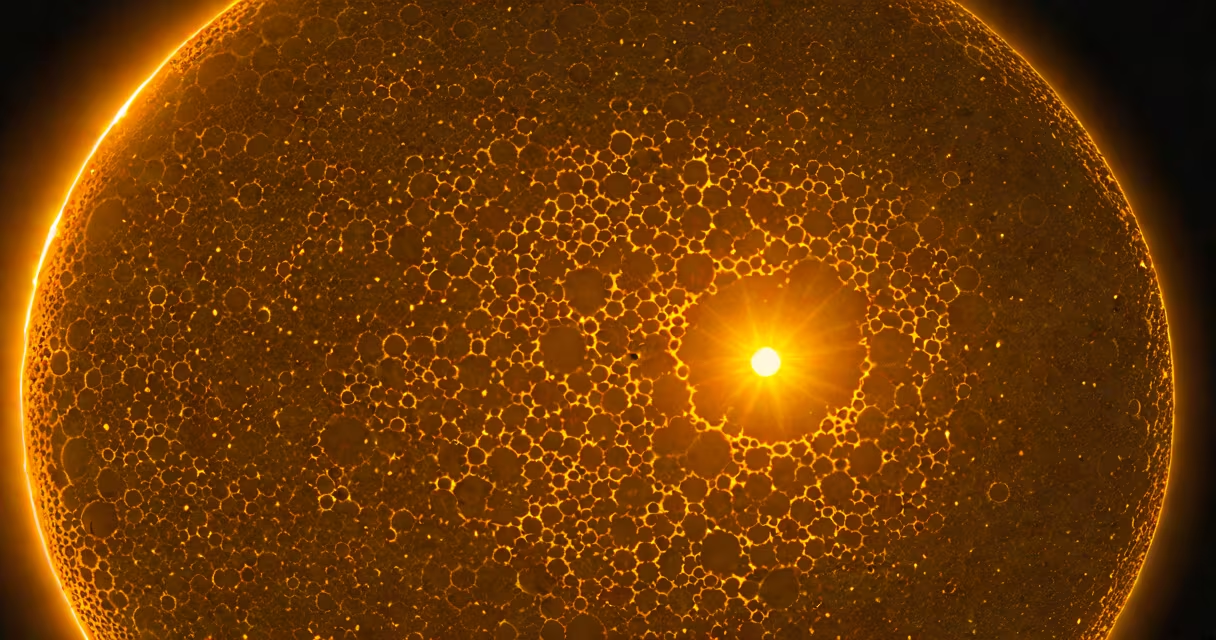
The diameter of the sun is approximately 1.39 million kilometers (864,000 miles), making it about 109 times wider than Earth. This measurement represents the distance across the sun's visible surface, known as the photosphere.
Astronomers determine the sun's diameter using angular size and distance. The sun spans about 0.5 degrees in the sky. With a known average Earth-sun distance of 149.6 million kilometers (1 astronomical unit), trigonometry yields the physical diameter. Modern observations from space-based instruments like NASA's Solar Dynamics Observatory refine this value.
For context, if Earth were a marble 2.4 centimeters wide, the sun would be a ball nearly 2.7 meters in diameter-large enough to fit over 1 million Earths side-by-side within its volume. The sun's diameter varies slightly due to rotation and magnetic activity, but changes are less than 0.1% over time.
Direct measurement relies on imaging the sun's edge against the blackness of space. Instruments such as the Daniel K. Inouye Solar Telescope capture high-resolution images of the solar limb. Scientists identify the point where brightness drops sharply-the limb-then calculate diameter based on pixel scale and known distance.
Historically, astronomers used transits of Venus across the sun's disk to estimate the Earth-sun distance, which indirectly informed the sun's size. Today, radar ranging and spacecraft telemetry provide far greater precision. For example, the Parker Solar Probe's trajectory calculations depend on accurate solar radius values.
A key challenge lies in defining the "edge" of the sun. Unlike solid objects, the sun is a plasma sphere with no sharp boundary. The photosphere-the layer where sunlight becomes visible-is used as the reference surface. This convention ensures consistency across decades of observation.
Scientists distinguish between several related metrics:
| Measurement Type | Value (km) | Description |
|---|---|---|
| Photospheric diameter | 1,391,000 | Standard reference; measured at the visible surface |
| Effective diameter | 1,392,000 | Used in radiative models; accounts for atmospheric opacity |
| Limb-darkened diameter | 1,393,000 | Accounts for reduced brightness at the edge; larger due to light scattering |
These differences arise because the sun's atmosphere scatters light unevenly. The limb-darkening effect makes the edges appear dimmer, requiring adjustment when calculating total luminosity.
Many assume the sun's diameter is constant. In reality, it fluctuates slightly due to internal dynamics. Solar cycles lasting ~11 years correlate with small expansions and contractions in the photosphere, though these changes remain below 1,000 km-less than 0.1% of the total diameter.
Another error is equating diameter with mass. The sun's mass is about 1.989 × 10³⁰ kg-over 330,000 times Earth's-but density averages only 1.4 g/cm³, less than water. This low density reflects the sun's gaseous composition, not its size.
Some confuse angular size with physical size. The sun appears roughly the same size as the moon during eclipses-about half a degree-but the sun is 400 times farther away and 400 times wider. This coincidence enables total solar eclipses.
Accurate solar diameter values are essential for calibrating climate models. Variations in solar output affect Earth's energy balance. The Total Solar Irradiance (TSI) satellite measurements rely on precise sun size to convert observed flux into absolute power.
In astrophysics, the sun serves as a benchmark for other stars. A star's radius is often reported in solar radii (R☉). For example, Betelgeuse has a radius of about 900 R☉-over 1.2 billion kilometers. Without a stable reference, comparing stellar sizes would be inconsistent.
I once observed a solar eclipse through a telescope equipped with a proper filter. The sun's edge appeared fuzzy, not sharp. That visual mismatch illustrates why astronomers define the photosphere as the standard boundary-it's the level where photons escape freely, not where they scatter.
Understanding the sun's diameter supports planetary science, space weather forecasting, and mission planning. For instance, the Parker Solar Probe's closest approach occurs at 6.1 million kilometers from the sun's center-just 8.5 solar radii above the photosphere. Knowing the sun's size allows engineers to predict extreme heat and radiation exposure.
According to the National Solar Observatory, the accepted value for the sun's equatorial diameter is 1,391,400 kilometers, with a margin of error under ±100 km. The International Astronomical Union (IAU) maintains this standard for global scientific consistency.
When studying exoplanets, scientists use the sun's diameter as a baseline. A planet orbiting a star twice the sun's diameter would receive different insolation. Accurate scaling prevents misinterpretation of habitability zones.