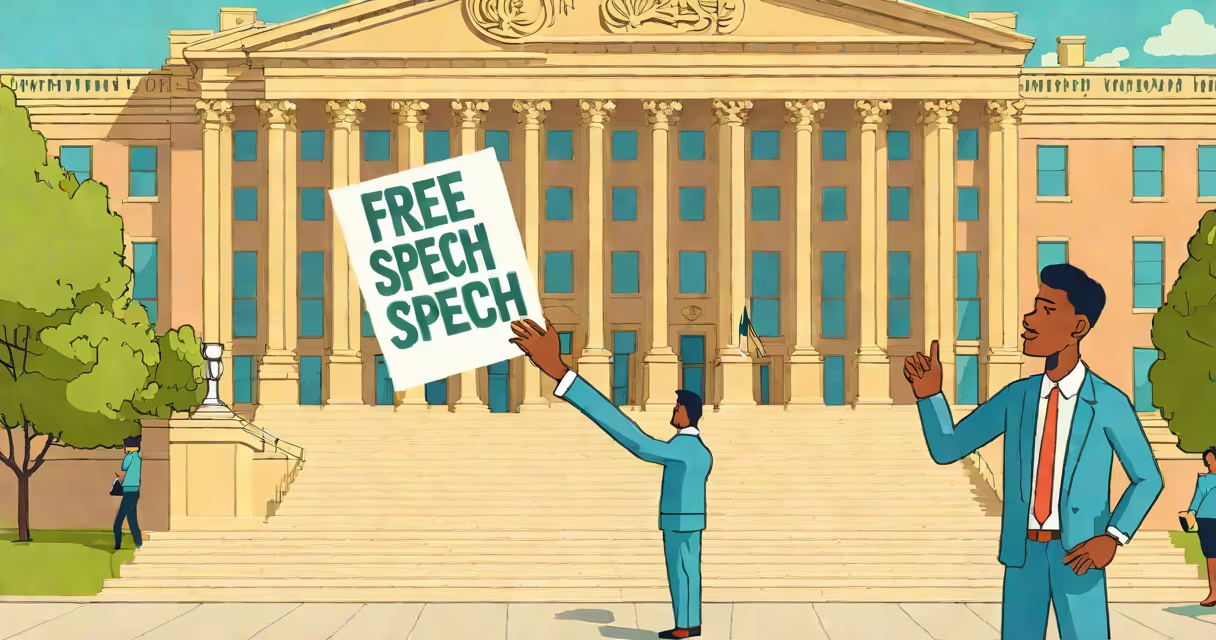
Freedom of speech is the legal right to express ideas, opinions, and beliefs without government censorship or punishment, protected under the First Amendment to the U.S. Constitution. This right applies to spoken words, written texts, art, protests, and digital communication.
The First Amendment states: "Congress shall make no law... abridging the freedom of speech." This clause limits federal power but does not prohibit all restrictions. The Supreme Court has interpreted this protection through decades of rulings, balancing individual expression against public order, national security, and other rights.
Freedom of speech does not mean unlimited expression. The government may restrict speech that incites violence, constitutes defamation, involves fraud, or presents a clear and present danger to public safety. For example, falsely shouting "fire" in a crowded theater is not protected because it creates imminent harm.
Legal protection begins at the federal level with the First Amendment, which prohibits Congress from passing laws that ban or punish speech. State constitutions often provide similar or stronger protections. Courts evaluate whether a restriction violates the principle of free expression using tests like the "imminent lawless action" standard established in Brandenburg v. Ohio (1969).
Speech is evaluated based on context. A protest march, a political cartoon, a social media post criticizing a public official, and a university lecture all fall under free expression-but courts assess each based on intent, audience, and potential consequences. For instance, threatening a judge online during a trial may be deemed a credible threat and thus unprotected.
Public spaces such as parks, sidewalks, and government buildings are traditional forums for speech. However, time, place, and manner regulations can apply if they serve a significant government interest and leave open ample alternative channels. A city may require permits for large gatherings but cannot deny them based on the message being conveyed.
Not all forms of expression receive equal protection. The following table outlines key categories:
| Type of Expression | Protected? | Reason |
|---|---|---|
| Political protest in a public park | Yes | Core political speech; essential to democracy |
| False advertising claiming a product cures cancer | No | Commercial speech with deceptive claims; regulated under FTC rules |
| Inciting immediate violence at a rally | No | Clear and present danger test; not protected under Brandenburg |
| Satirical news commentary on a TV show | Yes | Parody and satire are protected under core First Amendment values |
Even symbolic acts like flag burning are protected as expressive conduct. In Texas v. Johnson (1989), the Supreme Court ruled that burning the American flag during a political demonstration was a form of protected speech because it conveyed a political message.
Many assume freedom of speech means anyone can say anything anywhere. That's incorrect. Private employers, schools, and social media platforms are not bound by the First Amendment. A company can fire an employee for offensive posts on personal accounts, even if those posts criticize the company.
Another misconception is that hate speech is illegal under U.S. law. While hateful rhetoric may be morally repugnant, the Supreme Court has consistently ruled that mere offensiveness or advocacy of hatred does not lose protection unless it crosses into threats or incitement. In R.A.V. v. City of St. Paul (1992), the Court struck down a city ordinance targeting bias-motivated speech because it selectively punished certain viewpoints.
A lesser-known fact: the First Amendment originally applied only to Congress. It wasn't until the 20th century that the Supreme Court began applying it to state and local governments through the Fourteenth Amendment's due process clause. This process, known as incorporation, expanded the reach of free speech rights nationwide.
In 1971, the New York Times published classified documents revealing government deception about the Vietnam War. The Nixon administration sought a court injunction to stop further publication. The Supreme Court ruled 6-3 in favor of the newspaper, affirming that prior restraint-government blocking of speech before publication-is unconstitutional except in extreme cases involving national security.
This decision, New York Times Co. v. United States (1971), remains a landmark precedent. It confirmed that the press has broad leeway to publish information of public concern, even when the government claims secrecy is necessary. The ruling reinforced that freedom of speech includes the right to inform the public, especially about government misconduct.
I once attended a student-led protest at a state university over campus surveillance policies. When administrators tried to shut it down citing "disruption," we cited the Supreme Court's recognition of student speech rights in Tinker v. Des Moines Independent Community School District (1969). The protest continued after legal consultation. The experience showed how constitutional principles apply even in informal settings.
Freedom of speech is foundational to democratic governance. It enables public debate, holds leaders accountable, and allows marginalized voices to be heard. Without it, dissent becomes dangerous, and policy decisions lack transparency.
International organizations like the United Nations recognize free expression as a human right under Article 19 of the Universal Declaration of Human Rights. But unlike many countries, the U.S. constitutionally embeds this right in a written document with judicial enforcement.
Despite its strength, freedom of speech faces ongoing challenges. Online disinformation, algorithmic amplification of extreme views, and coordinated suppression of minority narratives test the resilience of free expression in the digital age. The balance between protecting speech and preventing harm remains a live issue in courts and legislatures.
Understanding the definition of freedom of speech requires recognizing both its breadth and its limits. It is not absolute, but it is deeply embedded in American law and culture. Its protection helps individuals can challenge authority, share ideas, and participate in civic life without fear of punishment.