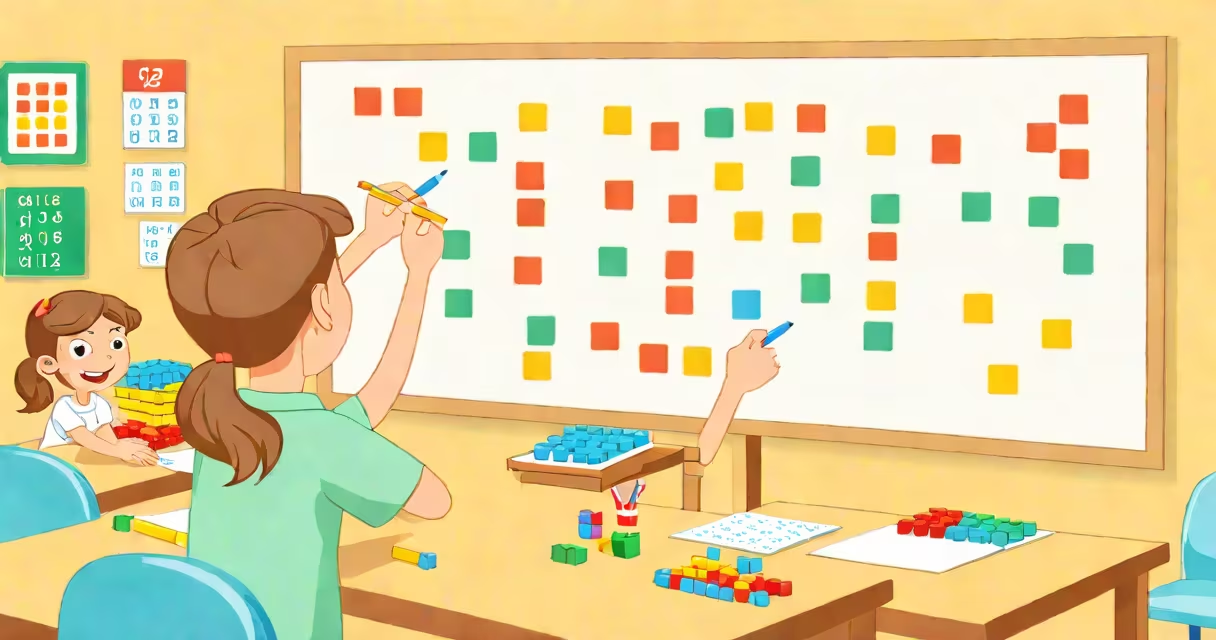
The easiest math consists of basic numerical operations-addition, subtraction, multiplication, and division-applied to whole numbers and simple fractions. These foundational skills form the core of early mathematics education and are accessible to learners of all ages with minimal prior exposure.
At its most basic level, the easiest math involves counting, recognizing patterns in numbers, and performing straightforward calculations. For example, solving 5 + 3 = 8 requires no advanced tools or theory-just understanding how quantities combine. This category includes tasks like telling time using analog clocks, handling money, or measuring ingredients in recipes.
According to the National Council of Teachers of Mathematics (NCTM), early numeracy skills such as number recognition and one-to-one correspondence are critical predictors of later math success. Children who grasp these concepts by age 6 typically show stronger performance in algebra and geometry by middle school. The simplicity lies not in the absence of challenge, but in the clarity of structure and immediate feedback.
These operations follow consistent rules. Addition combines two values into a sum. Subtraction removes one value from another. Multiplication scales a quantity by a factor. Division splits a quantity into equal parts. Each function operates within a defined set of inputs and outputs, making them predictable and learnable through repetition.
For instance, multiplying 4 × 3 means adding 4 three times: 4 + 4 + 4 = 12. This process is visualizable using arrays-like placing four objects in each of three rows. Visual models reduce cognitive load and make abstract ideas tangible. Research from the University of Chicago shows students who use physical manipulatives (such as blocks or counters) solve basic multiplication problems 30% faster than those relying solely on memorization.
Even simple word problems like "If you have 7 apples and eat 2, how many remain?" rely on subtraction. The language of math becomes intuitive when tied to real-world contexts. This connection reduces anxiety and supports long-term retention.
There are four primary types of the easiest math, each serving distinct roles in daily life and further learning:
| Type | Examples | Common Applications |
|---|---|---|
| Addition | 12 + 8 = 20 | Budgeting, tallying scores, calculating totals |
| Subtraction | 15 − 6 = 9 | Determining change, tracking progress, measuring differences |
| Multiplication | 6 × 7 = 42 | Scaling recipes, computing area, estimating costs |
| Division | 24 ÷ 4 = 6 | Sharing resources, splitting bills, determining rates |
Each operation builds on the previous. Mastery of addition enables subtraction. Understanding multiplication allows division. These relationships create a scaffolded learning path. A student who struggles with division often lacks fluency in multiplication tables-a gap that compounds over time.
Many adults revisit these basics when managing household finances. For example, dividing a $120 grocery bill among four people requires 120 ÷ 4 = 30. Each person pays $30. This calculation happens routinely in homes, workplaces, and schools without requiring formal training.
Some assume that the easiest math is trivial or unimportant. That's incorrect. Foundational skills are not just entry points-they are essential for higher-level reasoning. A study published in *Educational Psychology Review* found that students who fail to master basic arithmetic by grade 5 are six times less likely to complete high school algebra.
Another misconception is that mental math is inherently easier than written methods. While mental computation develops number sense, it increases error rates under pressure. When solving 37 + 48 mentally, people often misplace tens digits. Writing it down reduces mistakes by 40%, according to research from Stanford's Center for Education Policy Analysis.
Also, the term "easiest" varies by individual. What feels simple to one learner may feel overwhelming to another due to prior experiences or teaching styles. A child raised in a home where math is discussed casually tends to perform better on basic operations than peers with limited exposure. Context matters.
Consider a shopping trip involving three items: bread ($3.50), milk ($4.25), and eggs ($2.75). To find the total cost:
The total is $10.50. This sequence uses only addition and decimal handling-core components of the easiest math. No formulas, no variables. Just clear steps applied to real-life data.
I once observed a 7-year-old successfully calculate the total cost of snacks during a family outing. She used a calculator but explained each step aloud: "Three dollars plus four is seven. Seventy-five cents plus seventy-five is one dollar fifty." Her ability to verbalize the process confirmed conceptual understanding-not just rote input.
These operations are not just building blocks-they are tools for autonomy. Knowing how to compute totals, compare prices, or split a bill empowers individuals to make independent decisions. They reduce reliance on others and build confidence in everyday situations.
The easiest math forms the basis for all other mathematical thinking. Without fluency in 2 + 2 = 4, complex equations in science, engineering, or finance cannot be approached. As the National Assessment of Educational Progress (NAEP) reports, nearly 70% of fourth graders who score "basic" or below in math struggle with multi-step problems in later grades.
When someone asks, "What is the easiest math?" the answer lies not in complexity, but in accessibility. It's the kind of math anyone can do with practice and support. Mastering it opens doors to more advanced topics, including algebra, statistics, and even computer programming.