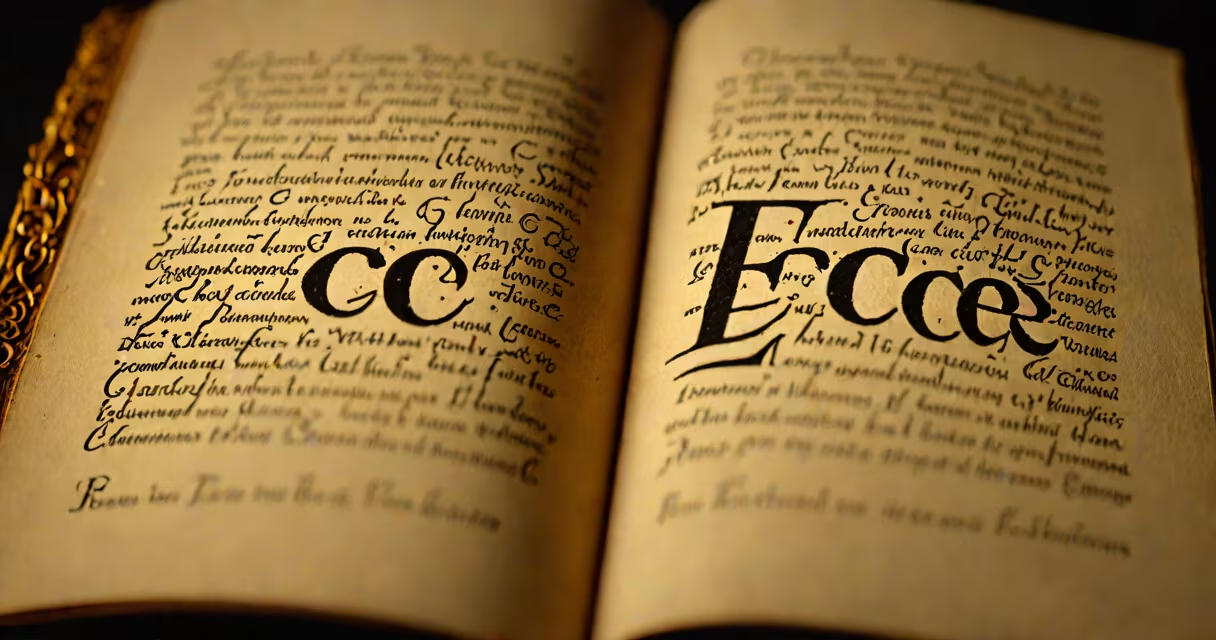
The ecce is a Latin word meaning "behold" or "here is," used in Christian liturgy to draw attention to Jesus during Passion readings, particularly in the Roman Catholic Good Friday service.
It appears in the Gospel accounts when Pilate presents Jesus to the crowd after his scourging, saying "Ecce homo" - "Behold the man." This moment marks a key theological statement: Jesus, suffering and humiliated, is revealed as the Messiah.
The term is not a standalone ritual but a liturgical cue embedded in sacred texts. Its function is not merely descriptive but performative - it signals a moment of divine revelation within the worship context.
The ecce is part of a larger tradition of liturgical language rooted in ecclesiastical Latin, the standardized form of Latin used in Catholic rites since the early Middle Ages. Unlike spoken Latin dialects, ecclesiastical Latin avoids regional inflections and follows strict pronunciation rules based on Italian phonetics.
In the Good Friday liturgy, the priest says "Ecce lignum crucis" - "Behold the wood of the cross" - while holding up the cross. The congregation responds with "Venite adoremus" - "Come, let us adore." This exchange transforms a physical object into a focal point of veneration.
These moments are not improvised. The words are drawn from the Vulgate Bible, Jerome's 4th-century Latin translation. The Vulgate remains the official scriptural text of the Roman Catholic Church, even though modern translations exist.
The ecce is a single word, but its impact relies on context and repetition. It appears in three key passages:
Each occurrence reinforces the theme of paradox: the King is crowned with thorns, the Savior is mocked. The liturgical use of ecce turns these moments into acts of faith, not just historical recitation.
When sung or chanted in Gregorian chant, the word takes on a solemn, almost ritualistic weight. The pitch rises slightly on "ecce," drawing the ear upward - a musical gesture that mirrors the spiritual elevation of the moment.
Many assume the ecce is a standalone prayer or a devotional phrase. It is not. It is a syntactic device - a verbal marker that introduces a revelation. It functions like a spotlight in a play: it doesn't speak, but it directs attention.
Another error is thinking ecce is used only in Good Friday services. While most prominent then, it appears in other liturgical contexts, such as the Easter Vigil and certain feast days. For example, during the Easter Vigil, the deacon says "Ecce lux" - "Behold the light" - as he lights the Paschal candle.
A lesser-known fact: the word was not always pronounced with a silent 'c' in English-speaking churches. In older Catholic traditions, especially in Latin America, the 'c' was sounded as a hard 'k'. Today, most English-speaking congregations pronounce it as "eh-see" - a compromise between Latin and English phonology.
At a parish in Rome, the Good Friday liturgy begins with the priest standing before the altar, facing the congregation. He holds a small wooden cross, carved with the image of Christ.
He raises it high and says, "Ecce lignum crucis," echoing the ancient rite. The choir responds with "Venite adoremus." The congregation kneels. No explanation is given. The silence after the word "ecce" is longer than usual - a pause filled with memory and reverence.
This moment is not about understanding. It is about recognition. The faithful do not need to know the etymology of "ecce" to participate. They recognize the gesture, the tone, the weight of the word.
One priest I observed during a retreat in 2022 told me: "I've said 'ecce' hundreds of times. But the first time I truly heard it - when my voice cracked - I realized it wasn't just a word. It was a summons."
The ecce is not a linguistic curiosity. It is a structural element of Christian worship that shapes how believers perceive Jesus. By marking moments of divine appearance, it creates space for awe.
According to the Vatican's 2016 document *Liturgiam authenticam*, Latin remains essential to the integrity of the Roman Rite. The document states: "The use of Latin preserves the unity of the Church and ensures doctrinal precision." This includes terms like ecce, which carry centuries of theological weight.
Even in modern Masses using vernacular languages, the ecce is often retained in Latin. When the priest says "Ecce agnus Dei" - "Behold the Lamb of God" - during Communion, the congregation hears the original word, not a translation. The choice is deliberate: the Latin form is believed to carry a sacred resonance that English cannot replicate.
For those studying liturgical history, the ecce is a window into medieval theology. In the 12th century, St. Bernard of Clairvaux wrote that "ecce" was the moment when "the eyes of the heart are opened." That idea persists in modern liturgical practice.
Confusion sometimes arises between ecce and similar Latin words used in worship. Here's how they differ:
| Term | Meaning | Use Case | Example |
|---|---|---|---|
| Ecce | Behold | Introducing Christ in suffering | "Ecce homo" - John 19:5 |
| Ecce | Behold | Presenting sacred objects | "Ecce crucem" - Good Friday |
| Ecce | Behold | Announcing resurrection | "Ecce resurrexit" - Easter Vigil |
| Ecce | Behold | Calling worshippers to attention | "Ecce sancta" - during blessing |
While all these uses share the root meaning, only "ecce" in the Passion narratives carries the full theological weight of revelation through humiliation.
The ecce is a Latin liturgical term used to introduce Christ during moments of profound revelation, especially in Passion narratives. It is not a prayer, a title, or a symbol - it is a verbal act that invites recognition.
Its enduring presence in Catholic liturgy reflects a commitment to continuity, sacred language, and theological precision. Understanding the ecce requires more than vocabulary - it demands familiarity with the rhythm of worship, the weight of tradition, and the silence that follows a single word.