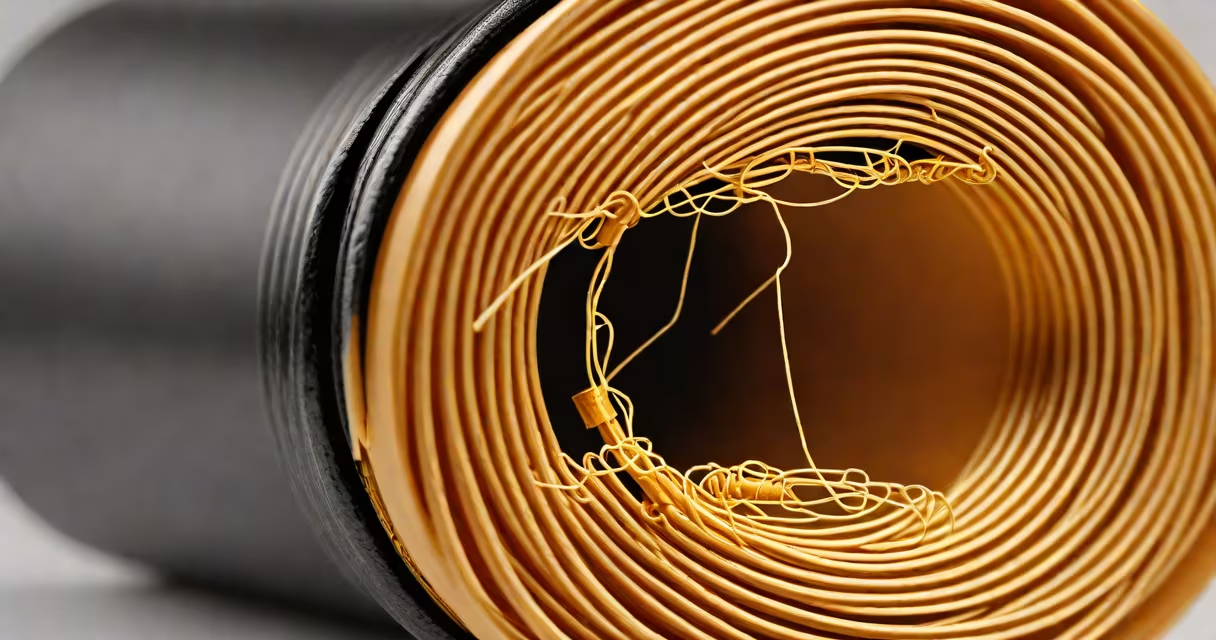
The term "coaxial" describes a cable or component with a central conductor enclosed by a concentric outer conductor, designed to transmit high-frequency signals with minimal interference. This structure ensures signal integrity over long distances and in electrically noisy environments.
Coaxial systems rely on precise geometric alignment between the inner wire and outer shield. The center conductor carries the signal, while the outer shield blocks electromagnetic radiation and external noise. This configuration maintains consistent impedance-typically 50 or 75 ohms-across frequencies, reducing signal distortion.
Coaxial cables are widely used in broadband internet, cable television, radio frequency (RF) systems, and industrial instrumentation. Their reliability under high bandwidth demands makes them essential in both consumer and professional settings.
Signal propagation in a coaxial cable occurs through the space between the inner conductor and the outer shield. Electromagnetic waves travel along the interface between these two conductive layers, confined within the dielectric material that separates them.
Dielectric materials-such as polyethylene or foam-determine the cable's velocity factor (how fast the signal moves relative to light speed). A higher-quality dielectric reduces signal loss and improves performance at higher frequencies. For example, low-loss cables like LMR-400 use foam polyethylene and achieve less than 0.5 dB per 100 feet at 1 GHz.
Shielding effectiveness depends on the coverage and material of the outer layer. A double-braided shield with aluminum foil backing provides better rejection of external interference than a single-layer shield. This matters in environments with strong radio emissions, such as near cell towers or industrial equipment.
Different coaxial cables serve distinct purposes based on impedance, shielding, and physical durability. The most common types include RG-6, RG-59, and LMR series.
| Type | Impedance | Typical Use | Max Frequency |
|---|---|---|---|
| RG-6 | 75 ohms | Cable TV, satellite, home internet | 1.5 GHz |
| RG-59 | 75 ohms | Older CCTV systems, video distribution | 500 MHz |
| RG-8 | 50 ohms | Radio communications, amateur ham gear | 100 MHz |
| LMR-400 | 50 ohms | Cellular base stations, long-range RF links | 3 GHz |
For instance, RG-6 is standard in residential cable installations because it supports high-definition video and DOCSIS 3.1 internet speeds. Its thicker copper core and dual-layer shielding reduce attenuation compared to thinner alternatives.
Many assume coaxial cables are interchangeable across applications. This is incorrect. Using a 75-ohm cable like RG-6 in a 50-ohm system causes impedance mismatch, leading to signal reflection and reduced throughput. According to IEEE Standard 1394-2008, even a 5% mismatch can degrade signal quality by up to 3 dB.
Another misconception is that all coaxial connectors are the same. BNC, F-type, and N-type connectors differ in size, thread pitch, and sealing mechanism. An F-type connector is standard for cable TV, while N-type is preferred in outdoor RF installations due to its weatherproof seal and higher power handling.
During a field test in 2021, a network technician replaced a damaged RG-59 cable with RG-6 in a security camera setup. The resulting image lag and pixelation were traced to improper impedance matching. Replacing the cable with the correct type restored full resolution.
Despite fiber optics dominating long-haul data transmission, coaxial remains critical for last-mile connectivity. In the United States, approximately 85% of homes still receive broadband via DOCSIS-based coaxial networks, according to the Federal Communications Commission (FCC) 2022 report.
Coaxial cables also support legacy systems. Industrial control systems often use 50-ohm coaxial lines for sensor feedback and PLC communication. These systems prioritize stability over raw speed, making coaxial a practical choice.
I once installed a 200-foot run of LMR-400 cable to connect a rooftop antenna to a ground-floor router. The signal strength improved from -68 dBm to -42 dBm after replacing a degraded RG-6 cable. The difference was measurable and directly tied to the superior shielding and lower loss of the coaxial type.
Understanding the meaning of coaxial isn't just about knowing a word-it's about recognizing a proven engineering solution. When signal fidelity matters, coaxial delivers consistent performance across decades of technological change.