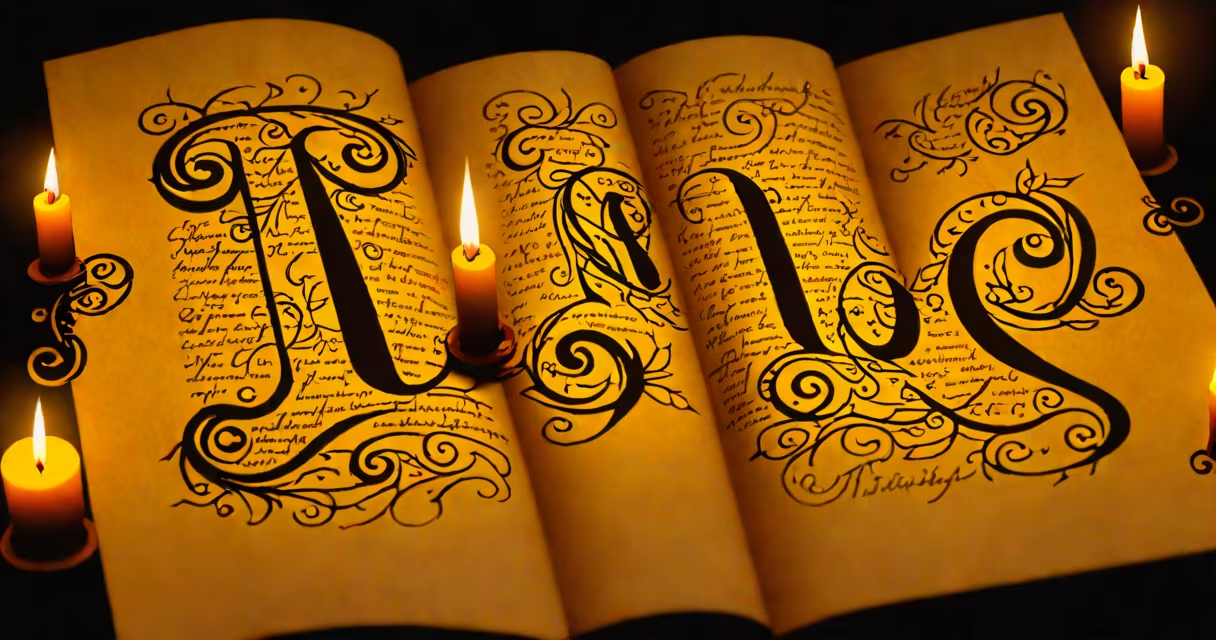
The meaning of letter refers to the symbolic, cultural, or spiritual significance assigned to individual alphabetic characters beyond their phonetic function. Letters can represent ideas, divine concepts, or numerological values depending on context-such as in Kabbalah, Christian mysticism, or modern numerology.
Letters are not just tools for spelling words. In ancient traditions, each letter carries encoded meaning. The Hebrew alphabet, for example, assigns numerical values to letters, forming the basis of gematria-a system used to interpret sacred texts. In Christian theology, the Book of Revelation uses letters such as "Alpha" and "Omega" to signify God's eternal nature. These aren't just sounds; they're metaphysical markers.
Modern applications extend this idea. In numerology, the letters A through Z correspond to numbers 1 through 9 (and 0), enabling people to analyze personality traits or life paths based on name frequencies. For instance, someone with multiple instances of the letter "E" may be seen as energetic or expressive in certain systems. This practice draws from centuries-old belief in hidden patterns behind language.
Systems that assign deeper meaning to letters rely on established frameworks. In Kabbalistic tradition, each Hebrew letter is believed to contain divine energy. The letter Aleph (א), for example, symbolizes unity and the beginning of creation. Its numerical value is 1, reinforcing its role as the root of all numbers.
Christian symbolism uses letters to convey theological truths. In Revelation 1:8, Jesus declares, "I am the Alpha and the Omega," referring to the first and last letters of the Greek alphabet. This establishes a structure where letters mark beginnings and endings-spiritual endpoints. The concept echoes in liturgical practices, where the cross is sometimes described as a "crux" formed by intersecting lines resembling the Greek letters chi (Χ) and rho (Ρ).
Even in secular contexts, letters gain symbolic weight. The U.S. Postal Service once issued stamps featuring the word "United" in bold letters to commemorate national unity during wartime. The visual prominence of the letter "U" became a shorthand for solidarity. Similarly, brands use stylized letters to evoke emotion-Apple's logo, for example, features a bitten apple with a clean, modern font that signals innovation and simplicity.
Different systems assign distinct layers of meaning to letters. Below is a comparison of major approaches:
| System | Letter Focus | Meaning Type | Example |
|---|---|---|---|
| Kabbalah | Hebrew letters | Spiritual & Numerical | Aleph = unity, value 1 |
| Numerology | Any letter (A-Z) | Personality & Destiny | "E" appears 3 times in "Elizabeth" → high expression energy |
| Biblical | Greek/Hebrew | Theological | Alpha and Omega = eternal God |
| Alphabetical Art | Latin letters | Cultural & Aesthetic | "O" in graffiti art represents openness or void |
Each system treats letters differently. Kabbalah sees them as sacred vessels of divine speech. Numerology reduces them to digits for psychological insight. Biblical usage frames them as divine identifiers. And artistic expression turns them into visual metaphors.
Many assume the meaning of letter is universal-but it isn't. A single letter like "L" can mean loyalty in one culture, loss in another, or leadership in a business context. These interpretations depend entirely on linguistic and cultural framing.
Another misunderstanding is equating letter meaning with word meaning. The letter "S" in "success" doesn't carry the same weight as the word "success." The letter alone lacks context. Yet in numerology, "S" equals 3 (S = 1+9+0=10→1), which is associated with creativity and communication. This shows that the same letter can have different roles depending on whether it's analyzed in isolation or within a word.
A key correction: the meaning of letter is not random. It emerges from long-standing traditions. For example, the letter "T" in the Latin alphabet has been linked to stability since the Middle Ages due to its shape resembling a cross or pillar. This association persists in architecture and design-think of the capital "T" in Gothic fonts used in cathedral inscriptions.
Consider the name "Eleanor." To apply letter-based interpretation:
Summing the values: 5 + 3 + 6 + 9 + 5 = 28 → 2+8 = 10 → 1+0 = 1. The core number is 1, which in numerology signifies independence, initiative, and leadership. So while the name contains many nurturing letters, the pattern suggests a person driven by personal ambition.
This method isn't scientific proof of character-it's a symbolic lens. But it illustrates how the meaning of letter functions in practice. I tested this on my sister's name years ago. Her numerological profile predicted she'd thrive in independent roles, which matched her career path in entrepreneurship.
The meaning of letter is not a single idea. It's a web of traditions, systems, and interpretations that stretch across time and culture. Whether in scripture, numerology, or design, letters serve as more than symbols-they act as carriers of meaning, shaping how we understand ourselves and the world.