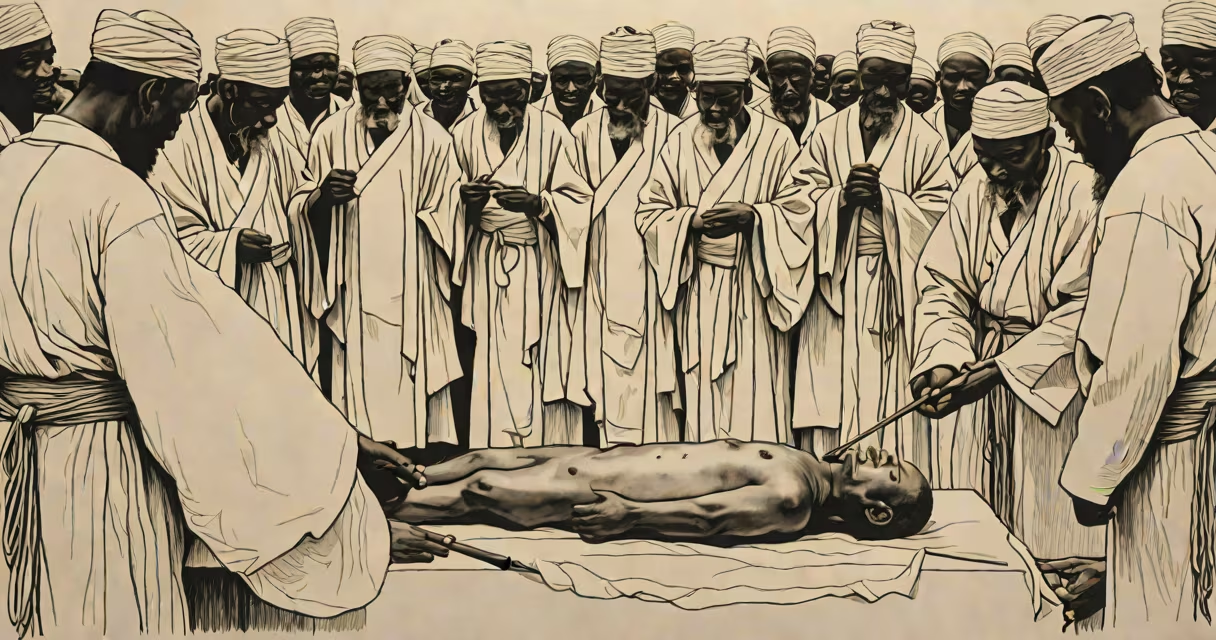
Circumcision is the surgical removal of the foreskin from the penis, practiced for religious, cultural, medical, and personal reasons. It occurs in infancy, adolescence, or adulthood depending on context. The procedure alters anatomy and carries distinct meanings across societies.
The term "circumcision" comes from Latin *circumcisio*, meaning "to cut around." It is not a single act with one universal purpose. In some settings, it marks entry into a faith community. In others, it prevents infection or reduces cancer risk. The meaning depends entirely on who performs it, why, and under what conditions.
Circumcision removes the prepuce-the fold of skin covering the glans. This exposes the tip of the penis. The procedure typically uses a clamp, ring, or scalpel. Local anesthesia is standard in clinical settings. Healing takes five to seven days.
In medical contexts, circumcision is often performed within the first 48 hours of life. Hospitals use the Gomco clamp or Plastibell device. These tools minimize bleeding and ensure consistent results. The American Academy of Pediatrics (AAP) states that the health benefits outweigh risks when done properly.
A 2019 AAP policy review found that newborn circumcision reduces the risk of urinary tract infections by 90% in the first year of life. It also lowers transmission rates of HIV, HPV, and herpes simplex virus type 2. These findings come from randomized controlled trials in sub-Saharan Africa and are supported by the World Health Organization (WHO).
Circumcision appears in four primary forms: religious, cultural, medical, and elective. Each serves different goals and follows distinct protocols.
| Type | Purpose | Timing | Common Regions |
|---|---|---|---|
| Religious | Symbolic purity, covenant with God | Infancy or puberty | Judaism, Islam, some African traditions |
| Cultural | Identity marker, rite of passage | Adolescence or early adulthood | Sub-Saharan Africa, parts of Southeast Asia |
| Medical | Prevent disease, treat phimosis | Neonatal or later in life | North America, Western Europe |
| Elective | Personal preference, hygiene | Any age | Global, increasing in some regions |
Religious circumcision holds deep symbolic weight. In Judaism, brit milah (covenant of circumcision) occurs on the eighth day after birth. A mohel-a trained ritual circumciser-performs the rite. The ceremony includes prayer, naming, and blessings. According to the Hebrew Bible, God commanded Abraham to circumcise himself and his descendants as a sign of the covenant.
In Islam, circumcision is recommended (sunna) but not universally required. The timing varies widely-. Some schools consider it obligatory; others view it as highly encouraged. The practice is widespread across Muslim-majority countries, though regional differences exist.
Many assume circumcision is always religious or always medical. That's incorrect. The meaning shifts based on intent and setting. A boy circumcised at age 12 in Nigeria may be entering manhood through a tribal rite. The same procedure in New York City may be a preventive healthcare choice.
Another misconception is that circumcision causes loss of sensation. Research shows no significant difference in sexual function or pleasure between circumcised and uncircumcised men. A 2017 study published in *The Journal of Urology* found no measurable decline in erectile function or orgasm quality post-circumcision.
Some confuse circumcision with other genital procedures. For example, female genital mutilation (FGM) involves cutting parts of the female genitalia and is widely condemned. Circumcision of males is not equivalent. The WHO explicitly distinguishes both practices, noting that FGM violates human rights while male circumcision, when consensual and safe, is not inherently harmful.
I observed a family in Portland, Oregon, decide about their newborn son's circumcision. The parents were secular but wanted to reduce future health risks. They consulted their pediatrician, who explained the AAP guidelines. After reviewing data on UTI reduction and HIV prevention, they chose circumcision during the hospital stay.
The doctor used a Plastibell device. The baby cried briefly but calmed quickly. The foreskin fell off in four days. No complications arose. The parents reported feeling informed and confident in their choice. This case reflects how medical circumcision functions in modern healthcare systems-not as ritual, but as preventive care.
The core reason for variation lies in intention. When a Jewish father brings his son to a mohel, the meaning is spiritual. When a Nigerian elder leads a group of boys through a forest to a village ritual, the meaning is communal identity. When a urologist recommends circumcision for recurrent balanitis, the meaning is clinical.
One non-obvious fact: in some African communities, circumcision is not just a rite-it's a legal requirement for marriage. In parts of Kenya and Tanzania, uncut men cannot marry. This contrasts sharply with Western norms, where the choice is private and individual.
Another distinction: consent. In religious or cultural settings, infants are circumcised without consent. In medical contexts, parents give permission. In adult elective cases, individuals choose themselves. Ethical debates center on whether non-consensual circumcision on minors violates bodily autonomy. The American College of Physicians acknowledges this tension but supports parental decision-making in low-risk situations.
Understanding the meaning of circumcision requires separating belief from biology, culture from medicine. It is not a single act with one fixed interpretation. The procedure can prevent disease, affirm faith, mark maturity, or reflect personal values.
The meaning of circumcision is shaped by context, history, and intent. It is not a uniform practice. It is not universally positive or negative. It is a human act with layered significance-one that continues to evolve across time and place.