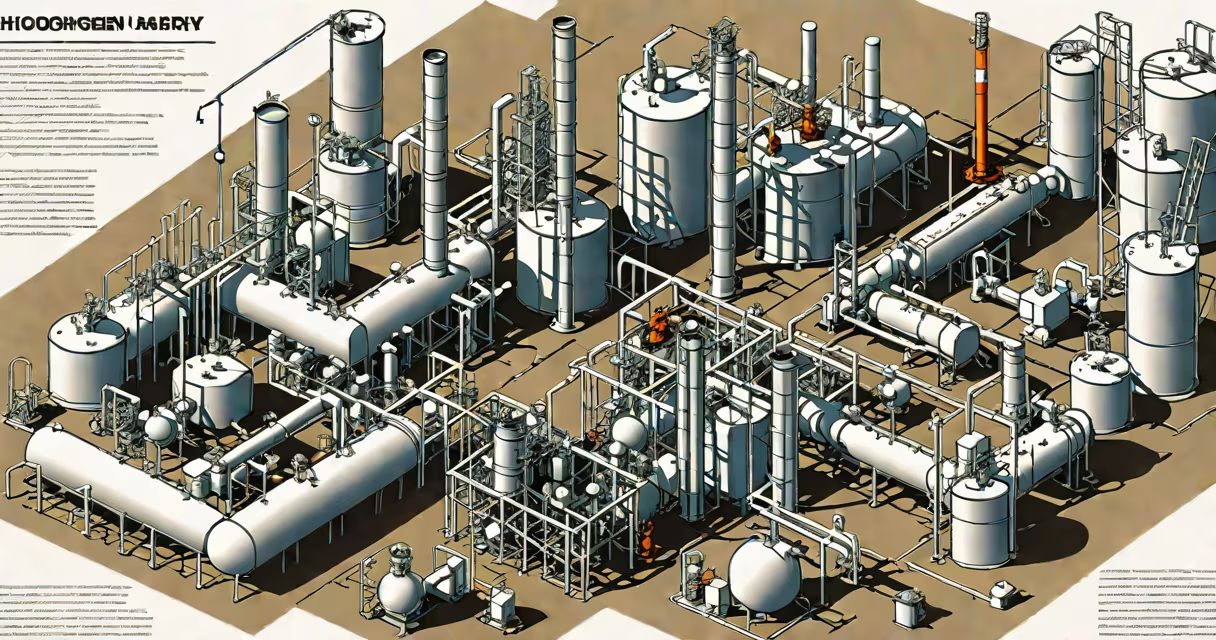
Hydrogen gas (H₂) serves as a critical industrial feedstock, a clean-burning fuel, and a key enabler in emerging low-carbon technologies. It powers fuel cells, refines crude oil, synthesizes ammonia for fertilizers, and supports advanced manufacturing processes.
Hydrogen gas consists of two hydrogen atoms bonded together. It is colorless, odorless, and highly flammable. When burned, it produces only water vapor-making it a zero-emission energy carrier when derived from renewable sources. Its versatility stems from high energy density by weight and compatibility with existing infrastructure when converted into other forms like ammonia or liquid hydrogen.
Hydrogen gas is produced primarily through steam methane reforming (SMR), which uses natural gas and accounts for about 95% of global supply. Green hydrogen, made via electrolysis powered by renewables, is growing but still represents less than 1% of current output. The International Energy Agency (IEA) estimates that hydrogen could meet 18% of global final energy demand by 2050 if policies support scaling.
Hydrogen gas functions as both a reactant and an energy carrier. As a reactant, it participates in chemical reactions essential to industry. As an energy carrier, it stores and delivers energy when needed, especially in sectors hard to electrify.
In refining, hydrogen removes sulfur from crude oil during hydrotreating. A single large refinery may consume 100,000 kg of hydrogen daily. In ammonia synthesis, hydrogen combines with nitrogen in the Haber-Bosch process-a method responsible for feeding nearly half the world's population through synthetic fertilizers.
When used in fuel cells, hydrogen reacts with oxygen across a membrane to generate electricity and water. Fuel cell electric vehicles (FCEVs) such as the Toyota Mirai achieve ranges over 650 km on a single tank. The U.S. Department of Energy reports that hydrogen-powered buses in California have reduced emissions by 80% compared to diesel models.
Hydrogen is categorized by production method, often described by color codes:
| Type | Production Method | Emissions Level | Global Share |
|---|---|---|---|
| Gray | Steam methane reforming (SMR) | High | ~95% |
| Blue | SMR with carbon capture | Moderate | <1% |
| Green | Electrolysis using renewable power | Near-zero | ~0.5% |
Blue hydrogen captures CO₂ from SMR plants. Norway's Mongstad project demonstrated 90% carbon capture efficiency in pilot operations. Green hydrogen requires significant electricity-about 50 kWh per kilogram of H₂-and is most viable where solar or wind resources exceed 2000 hours annually.
Hydrogen gas can also be stored as compressed gas (350-700 bar), liquefied at -253°C, or absorbed in metal hydrides. Liquefaction consumes 30% of the input energy, making it costly for long-term storage. Compressed gas remains the most common form in transportation and industrial sites.
Hydrogen gas is not a primary energy source-it is an energy carrier. It must be produced using another energy source. Confusing it with a fuel like gasoline overlooks this fundamental distinction. Unlike batteries, hydrogen does not store energy indefinitely; it degrades over time due to permeation and reactivity.
A common error is assuming all hydrogen is environmentally neutral. Gray hydrogen emits 9-12 kg of CO₂ per kg of H₂. The European Commission's Hydrogen Strategy mandates that only green or blue hydrogen qualify for subsidies under the EU's Clean Hydrogen Certification scheme.
One non-obvious fact: hydrogen embrittlement damages steel components in high-pressure systems. In 2019, a hydrogen pipeline failure in Texas occurred due to microcracks formed over time by hydrogen diffusion into grain boundaries. This led to updated standards requiring materials with lower hydrogen solubility.
During a visit to a hydrogen refueling station in California, I observed a pressure regulator fail after 18 months of service. The cause was trace moisture reacting with hydrogen to form hydroxyl radicals, accelerating corrosion. This highlights that purity and system design matter as much as the gas itself.
Industries use hydrogen gas because it enables processes that cannot easily switch to direct electricity. Heavy transport, steelmaking, and chemical manufacturing require high-temperature heat and continuous energy flow-conditions where hydrogen excels.
Steel production accounts for 7% of global CO₂ emissions. Using hydrogen instead of coal in direct reduced iron (DRI) processes cuts emissions by up to 95%. Sweden's HYBRIT project successfully produced steel using 100% hydrogen at a pilot plant in Luleå, achieving 1 million tons of annual capacity by 2026.
For energy storage, hydrogen offers seasonal scalability. Pumped hydro and lithium-ion batteries handle short-duration storage. Hydrogen allows storing excess solar energy for months. Germany's "Power-to-Gas" initiative converts surplus wind power into hydrogen, injected into the natural gas grid at 10% blending levels.
Hydrogen gas is also used in semiconductor manufacturing. High-purity hydrogen prevents oxidation during wafer annealing. A single chip fabrication plant may use 50,000 m³ of ultra-high-purity hydrogen monthly. Impurities above 1 ppm can cause defects in transistors.
Hydrogen gas differs from electricity, batteries, and fossil fuels in key ways:
| Feature | Hydrogen Gas | Electricity | Batteries | Gasoline |
|---|---|---|---|---|
| Energy Density (by mass) | 120 MJ/kg | 0.0001 MJ/kg | 0.5-1.5 MJ/kg | 44 MJ/kg |
| Storage Duration | Months (in salt caverns) | Minutes (grid) | Days (stationary) | Weeks (tanks) |
| Infrastructure Compatibility | Existing gas networks (with upgrades) | Grid-dependent | Requires charging stations | Widespread |
Hydrogen gas outperforms batteries in long-haul freight and aviation. The Airbus ZEROe concept aircraft uses hydrogen combustion engines and aims for commercial service by 2035. Battery-electric planes face limitations beyond 500 km range due to battery weight.
Hydrogen gas is not interchangeable with natural gas. While both are combustible, hydrogen burns faster and has a wider flammability range (4-75% in air). This increases explosion risk in confined spaces. Safety protocols mandate leak detection within 10 seconds and automatic shutoff valves.
The use of hydrogen gas spans energy, industry, and transportation. It enables decarbonization in sectors where direct electrification is impractical. Green hydrogen is central to climate goals, while gray and blue hydrogen remain dominant today. Understanding its role requires distinguishing between production methods, applications, and safety constraints.