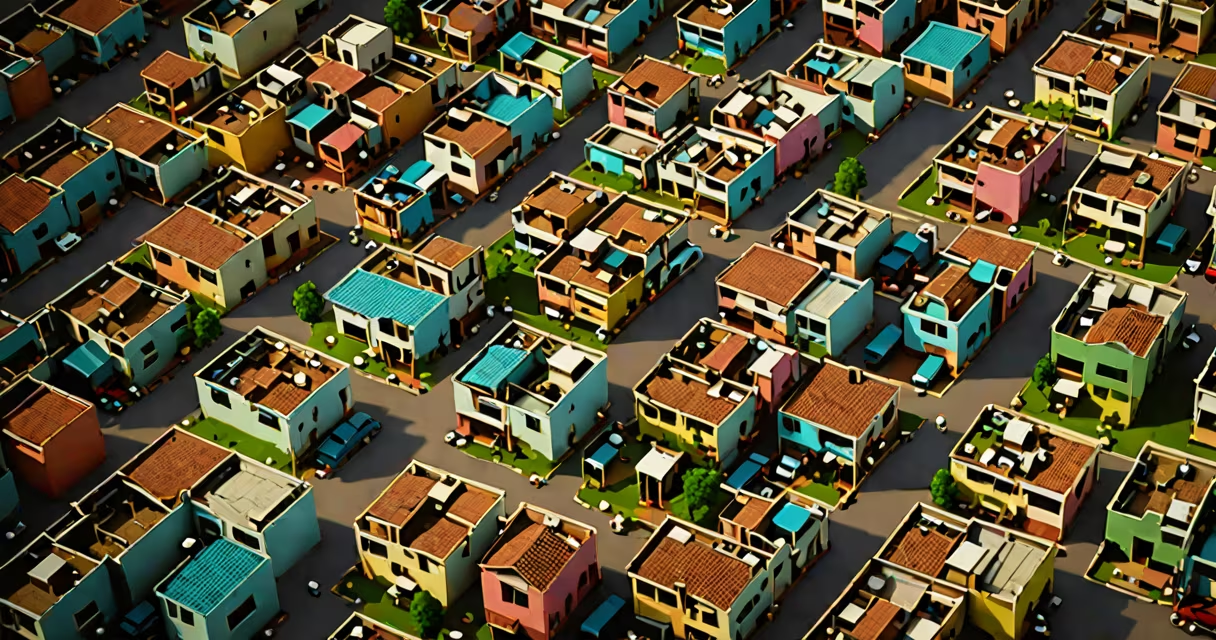
The urban poor are individuals and families living in cities who earn too little to afford stable housing, nutritious food, healthcare, or education. They exist in both developed and developing nations, often concentrated in overcrowded neighborhoods with inadequate infrastructure.
According to the United Nations, over 1 billion people worldwide live in urban slums-areas marked by overcrowding, unsafe buildings, and lack of clean water and sanitation. These conditions define the lived reality of the urban poor, even in economically advanced countries.
Urban poverty arises when wages fail to keep pace with rising costs of living in cities. Rent, transportation, utilities, and childcare consume most of a low-wage worker's income. A single parent working two part-time jobs may still fall below the federal poverty line in major U.S. cities.
In Nairobi, Kenya, over 60% of residents in informal settlements like Kibera survive on less than $1.90 per day. These areas lack formal land titles, making residents vulnerable to eviction. Yet they remain essential to the city's economy-cleaning streets, delivering goods, and providing domestic labor.
Even in affluent nations, the urban poor face systemic barriers. In New York City, 1 in 5 children lives in poverty. Many rely on food pantries, public transit, and emergency shelters. The city's median rent exceeds $3,000 per month, forcing families to spend 50% or more of their income on housing.
The term covers diverse groups: migrant workers, single mothers, disabled persons, elderly people on fixed incomes, and youth without stable employment. Not all are homeless-many live in overcrowded apartments or share rooms with relatives.
Types of urban poor include:
| Type | Description | Example |
|---|---|---|
| Informal settlers | People living in unregistered housing without legal rights to land | Residents of Dharavi, Mumbai, who build homes from scrap materials |
| Working poor | Those employed but earning below subsistence level | A warehouse worker in Los Angeles earning $15/hour, covering rent and bills with difficulty |
| Homeless | Individuals without shelter, often cycling through shelters and streets | People sleeping under bridges in Seattle during winter months |
These categories overlap. A person may start as a working poor individual, lose a job due to illness, and end up homeless-all within a year.
Urban poor populations cluster in specific zones: near industrial zones, along rail lines, or in areas historically excluded from investment. Redlining practices in the U.S. during the 20th century deliberately restricted home loans to Black and Latino communities, creating long-term disparities.
Today, gentrification accelerates displacement. In San Francisco, rising property values have pushed out long-term residents-mostly people of color-while tech workers move in. Between 2000 and 2019, the city lost 30% of its low-income housing units.
Climate change compounds risk. Flooding in Jakarta's informal settlements displaces thousands annually. In Dhaka, Bangladesh, monsoon rains destroy makeshift homes built on floodplains. These events don't affect all city dwellers equally-the urban poor bear the brunt.
Many assume the urban poor are "lazy" or "unmotivated." Research from the World Bank shows that 80% of urban poor in low-income countries work daily-often in physically demanding or precarious jobs. Their struggle is structural, not personal.
Another misconception is that urban poverty is disappearing. The UN reports that urban population growth outpaces housing construction in 70% of global cities. In Lagos, Nigeria, the city grows by 200,000 people per year-yet only 10,000 new homes are built annually.
Crucially, the urban poor are not a homogenous group. A young woman in Manila working as a domestic helper earns more than her mother did-but still cannot afford rent. Her situation differs from a man in Rio de Janeiro surviving on street vending, who lacks access to social protection programs.
In Chicago, the South Side has a median household income of $38,000-below the national average of $78,000. Over 30% of residents live below the poverty line. Public schools receive less funding per student than those in wealthier districts.
One resident, Maria Lopez, works two shifts at a hospital cleaning unit. She earns $17.50/hour but pays $1,200/month in rent for a one-bedroom apartment. After taxes and expenses, she has $400 left for groceries, transportation, and medical care.
She uses a food pantry twice a week. Her daughter attends a school with outdated textbooks and no computer lab. Maria applies for housing assistance but is denied due to a backlog of 12,000 applications.
This case illustrates how systemic failures-not individual failure-define urban poverty. Access to services depends on zip code, not merit.
The urban poor are not synonymous with homelessness. While some are unhoused, many live in unstable housing-doubling up with relatives, renting rooms, or staying in temporary shelters. The U.S. Department of Housing and Urban Development (HUD) defines "homeless" as lacking a fixed, regular, and adequate nighttime residence. The urban poor often fall into a gray zone between housed and homeless.
They are also not a recent phenomenon. Urban poverty emerged in the 19th century during industrialization. In London, the East End was known for overcrowded tenements and child labor. Today's urban poor face similar challenges-just in different forms.
I once spent a week volunteering at a community center in Detroit's North End. I met a family of four living in a basement apartment with no heat during winter. The father worked night shifts at a factory, earning $11/hour. He said he couldn't afford a car, so his children walked 45 minutes to school in snow. The family used a shared laundry room because their building had no washer. This wasn't anecdotal-it reflected patterns seen in HUD reports.
The World Bank states that 33% of the global urban population lives in slums or informal settlements. The United Nations Human Settlements Programme (UN-Habitat) confirms that urban poverty rates are rising faster than rural ones in sub-Saharan Africa and South Asia.
According to the U.S. Census Bureau, 15.5% of Americans lived below the poverty line in 2022. Among them, 41% resided in urban areas-despite cities having higher average wages than rural regions.
"Urban poor" is not interchangeable with "poor." The term specifies location and context. Rural poor may lack roads, electricity, or clinics. Urban poor face different challenges: high rents, traffic congestion, surveillance, and exclusion from decision-making processes.
It's also distinct from "low-income households," which is a broader category. Not all low-income households are urban. Not all urban residents are poor. But the urban poor occupy a unique intersection of geography, economics, and policy failure.
Recognizing this distinction matters. Policies targeting urban poverty must address housing affordability, public transit access, and inclusive zoning laws-not just cash transfers.