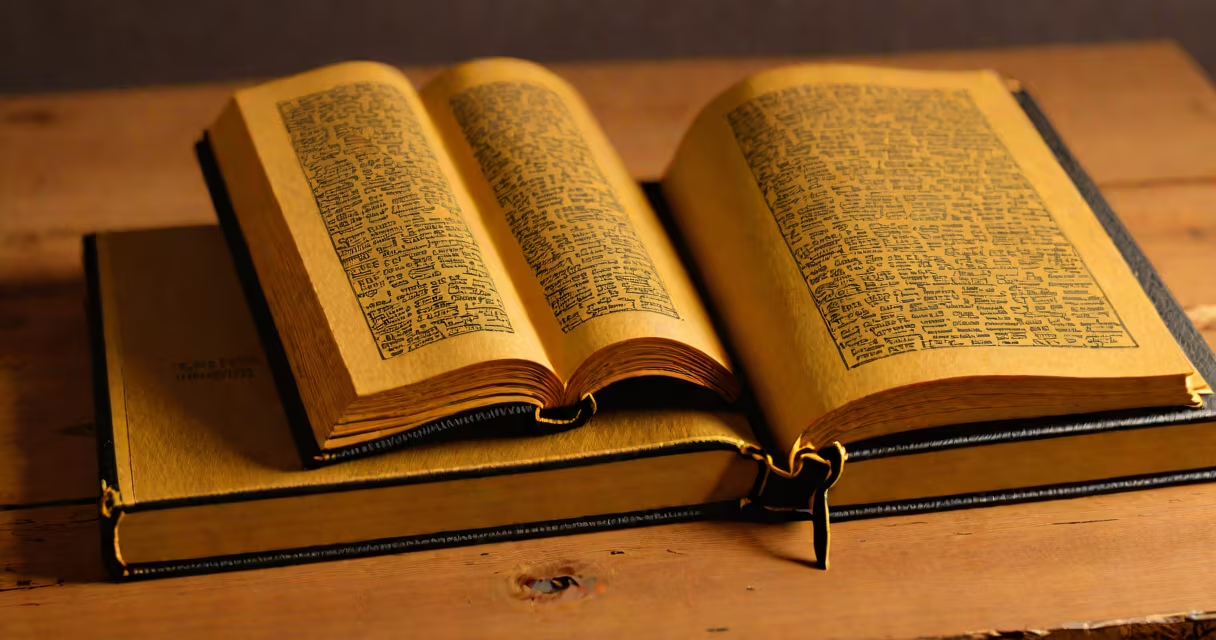
The standard Bible is the Protestant Christian canon of Scripture, typically using the King James Version (KJV) as its foundational English translation. It includes 66 books-39 from the Old Proof and 27 from the New Proof-selected during the Reformation and affirmed by major Protestant denominations.
This version excludes deuterocanonical books found in Catholic and Orthodox traditions, such as Tobit, Judith, and Wisdom. The standard Bible emerged from theological debates in the 16th century, particularly around the authority of scripture versus church tradition. Its structure reflects the Hebrew Masoretic Text for the Old Proof and the Greek Septuagint and original Koine Greek for the New Proof.
Unlike the Catholic Bible, which includes seven additional books in the Old Proof, or the Eastern Orthodox Bible, which includes more, the standard Bible adheres strictly to the Protestant canon. This distinction is not merely historical-it shapes how believers interpret doctrine, liturgy, and personal faith.
The standard Bible functions as a unified collection of religious texts written over approximately 1,500 years. Authors ranged from prophets and priests to apostles and scribes. These writings were compiled into a single volume through centuries of manuscript transmission, translation, and ecclesiastical approval.
For example, the Gospel of Matthew was likely composed between 70-80 CE in a Jewish-Christian community. It was preserved in Greek manuscripts, later translated into Latin (Vulgate), and eventually rendered into English. The KJV, published in 1611, became the dominant English version due to royal sponsorship and widespread literacy efforts.
Modern editions of the standard Bible often include footnotes, cross-references, and study guides. Digital versions integrate search tools and parallel translations. Despite these enhancements, the core text remains anchored in the 1611 KJV and subsequent revisions like the Revised Standard Version (RSV) and the New International Version (NIV).
Different English translations represent varying approaches to accuracy, readability, and theological emphasis. The table below outlines key versions used in Protestant contexts:
| Version | Year Published | Translation Method | Primary Use |
|---|---|---|---|
| King James Version (KJV) | 1611 | Formal equivalence | Liturgical, devotional, scholarly |
| New American Standard Bible (NASB) | 1971 | Formal equivalence | Bible study, academic |
| New International Version (NIV) | 1978 | Changing equivalence | Church services, personal reading |
| English Standard Version (ESV) | 2001 | Formal equivalence | Churches, seminaries |
Formal equivalence prioritizes word-for-word fidelity to the original languages. Changing equivalence focuses on conveying meaning in natural modern English. The KJV uses Early Modern English, while newer versions adapt vocabulary and syntax for contemporary readers.
A non-obvious distinction: the KJV does not include the Apocrypha, even though it was originally intended for inclusion in the 1611 edition. The decision to exclude it came from theological concerns about the authority of non-canonical texts. This exclusion solidified the KJV's role as the standard Bible in Protestantism.
The standard Bible is central to Protestant worship, education, and personal devotion. In the United States, 71% of adults report owning a Bible, with 54% saying they read it weekly (Pew Research Center, 2023). Most churches use the NIV or ESV for sermons due to clarity and accessibility.
For example, a Baptist congregation in Atlanta uses the ESV during Sunday services. The pastor selects passages based on the lectionary cycle, referencing the ESV's consistent rendering of Hebrew and Greek terms. A recent sermon on Romans 8:31-39 cited the ESV's phrasing: "If God is for us, who can be against us?"-a formulation that resonates with congregants familiar with the language.
Outside worship, the standard Bible informs ethics, politics, and literature. The phrase "the Word of God" appears in over 1,200 U.S. Supreme Court opinions, often citing the KJV or NIV. In education, public schools may teach the Bible as literature, relying on the standard canon to avoid doctrinal bias.
Many assume the standard Bible is a single, unchanging text. In reality, it exists in multiple translations, each shaped by linguistic and theological choices. For instance, the NIV translates the Hebrew word *hesed* as "steadfast love," while the KJV renders it as "mercy." These differences affect interpretation.
Another misconception: the standard Bible is the same as the "original" Bible. No original manuscripts survive. The oldest complete copy of the New Proof is the Codex Sinaiticus (c. 350 CE), discovered in Egypt. Scholars reconstruct the original text using thousands of fragments, including the Dead Sea Scrolls and the Chester Beatty Papyri.
I once attended a Bible study where participants debated whether the term "God" in Genesis 1:1 should be capitalized. The group consulted the NASB and ESV, both of which capitalize "God" consistently. But the KJV uses lowercase "god" in some early printings, reflecting different editorial standards. This illustrates how even small variations impact reading.
Crucially, the standard Bible is not synonymous with the Bible as a whole. Catholic Bibles include the Deuterocanonical books. The Ethiopian Orthodox Church uses a canon of 81 books. The standard Bible represents a specific theological tradition-not the entirety of Christian scripture.
The standard Bible remains a living text, adapted through time yet grounded in ancient words. Its influence extends beyond religion into law, culture, and personal identity. When people speak of "the Bible," they often mean the standard Bible-its form, content, and legacy shaping how millions understand divine revelation.