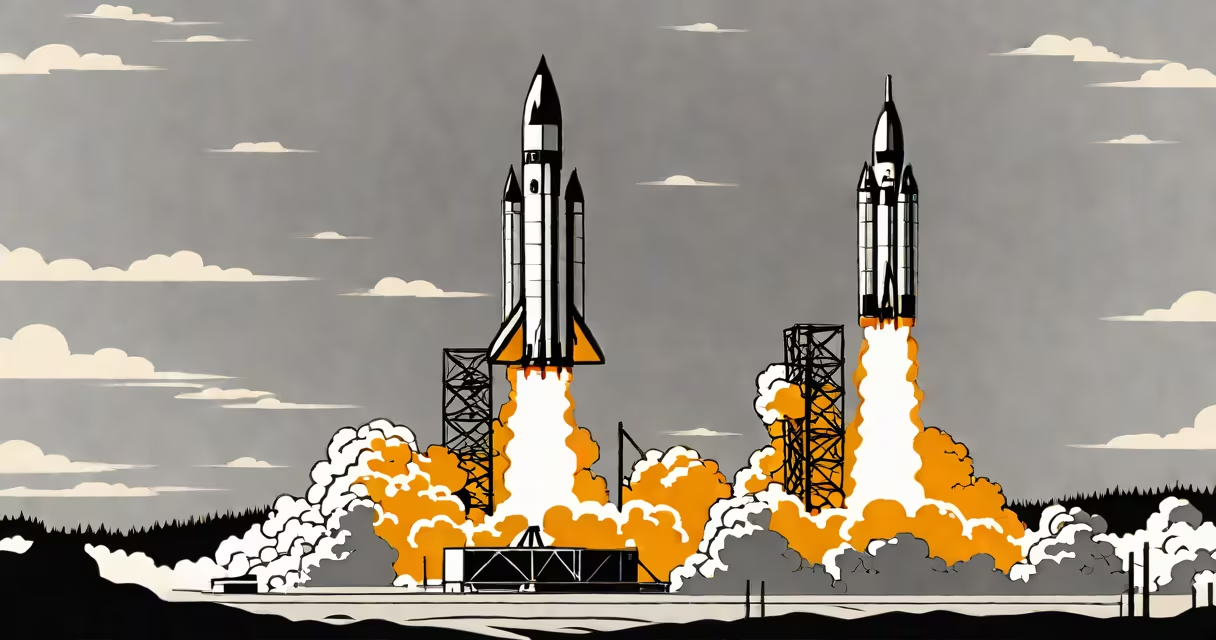
The first successful rocket launch happened on October 3, 1942, when Nazi Germany's V-2 rocket reached an altitude of 84 kilometers (52 miles), becoming the first human-made object to cross the boundary of space.
This event marked the beginning of practical rocketry and laid the foundation for modern spaceflight. The V-2 was developed under the direction of Wernher von Braun and his team at the Peenemünde Army Research Center. It was the first liquid-fueled rocket to achieve suborbital flight, using ethanol and liquid oxygen as propellants.
Unlike earlier experimental rockets such as Robert H. Goddard's 1926 launch, which flew only 12.5 meters high and lasted 2.5 seconds, the V-2 achieved sustained thrust, controlled flight, and altitudes beyond the Kármán line-the internationally recognized edge of space at 100 kilometers. Its success proved that rocket-powered flight could reach space, even if it was initially weaponized.
The V-2 (Vergeltungswaffe 2, or "Retaliation Weapon 2") used a single engine burning ethanol and liquid oxygen. It had a thrust of 26,000 kilograms-force and accelerated to over Mach 3 during ascent. Guidance came from an analog inertial navigation system, which adjusted the rudder and fin control surfaces mid-flight.
Flight duration was about 65 seconds. The rocket reached peak altitude at around 84 km, then fell back to Earth, impacting near the Baltic Sea. The trajectory was stable, and telemetry confirmed the vehicle operated within design parameters. This was not a test of a prototype-it was a fully functional, guided missile.
Despite being designed as a weapon, the V-2's engineering achievements were unmatched at the time. It demonstrated the viability of liquid-propellant systems, guidance control, and atmospheric reentry-all critical components of later orbital launch vehicles.
The V-2's structure was primarily constructed from duralumin, a lightweight aluminum alloy. The fuselage measured 14 meters long and 1.65 meters in diameter. The engine, called the A4-V2, produced 25 tons of thrust and burned fuel at a rate of 120 liters per second.
Key components included:
After the 1942 test, 1,400 V-2s were produced and launched against Allied cities during World War II. Over 1,400 people died in London alone from V-2 attacks. The rocket's destructive power stemmed from its speed-over 3,500 km/h-and its ability to strike without warning.
The V-2 launch in 1942 is the direct ancestor of every modern rocket. NASA's Redstone and Jupiter-C rockets, which launched America's first satellite Explorer 1 in 1958, were derived from V-2 designs. Von Braun himself later led the development of the Saturn V rocket, which sent astronauts to the Moon.
Without the V-2's success, the space race might have been delayed by decades. The U.S. and Soviet Union both captured German engineers and blueprints after the war. The U.S. brought 1,600 German scientists-including von Braun-to White Sands Proving Grounds in New Mexico under Operation Paperclip.
A lesser-known fact: the V-2's flight path was tracked by British radar and confirmed via photographic evidence from a Royal Air Force aircraft. The data showed the rocket crossed 80 km altitude-well above the 80 km threshold often cited as the start of space. This confirms the V-2 as the first verified man-made object to enter space.
Many assume the first successful rocket was the Soviet Sputnik 1 launch in 1957 or the American Mercury-Redstone in 1961. These were milestones in space exploration, but they built on the V-2's foundation. The V-2 was not just a precursor-it was the first operational rocket capable of reaching space.
Another confusion arises from Goddard's 1926 launch. While it was the first liquid-fueled rocket, it only reached 12.5 meters and flew for 2.5 seconds. It lacked guidance, sustained thrust, and altitude. It was a proof-of-concept, not a successful launch in the technical sense.
Even the term "successful" is sometimes misapplied. A "successful" rocket launch requires not just lift-off, but stable flight, controlled trajectory, and achievement of intended performance. The V-2 met all criteria. Goddard's 1926 rocket did not.
| Rocket | Year | Max Altitude | Propellant Type | Control System | Space Entry? |
|---|---|---|---|---|---|
| V-2 (A4) | 1942 | 84 km | Liquid ethanol & LOX | Analog inertial guidance | Yes |
| Goddard's 1926 rocket | 1926 | 12.5 m | Liquid oxygen & gasoline | None | No |
| Sputnik 1 booster (R-7) | 1957 | ~200 km | Kerosene & LOX | Inertial guidance | Yes |
| Mercury-Redstone | 1961 | 187 km | RP-1 & LOX | Onboard computer | Yes |
Each entry shows a progression in capability. Only the V-2 achieved spaceflight before the Cold War era.
I once visited the Deutsches Museum in Munich and stood in front of a restored V-2 engine. The precision of the turbine and the compactness of the combustion chamber stunned me. You could see the wear patterns from the intense heat and pressure. That engine wasn't just a machine-it was a prototype of everything that followed. The same principles still power modern rockets like SpaceX's Falcon 9.
According to NASA's historical records, the V-2's flight data was analyzed extensively by American engineers in the 1950s. Their findings confirmed that the rocket exceeded 80 km altitude-meeting the standard for spaceflight set by the Fédération Aéronautique Internationale (FAI). The FAI officially recognizes the V-2 launch as the first human-made object to reach space.
The first successful rocket took off in 1942. That launch was not just a technological breakthrough-it was the beginning of humanity's process beyond Earth.