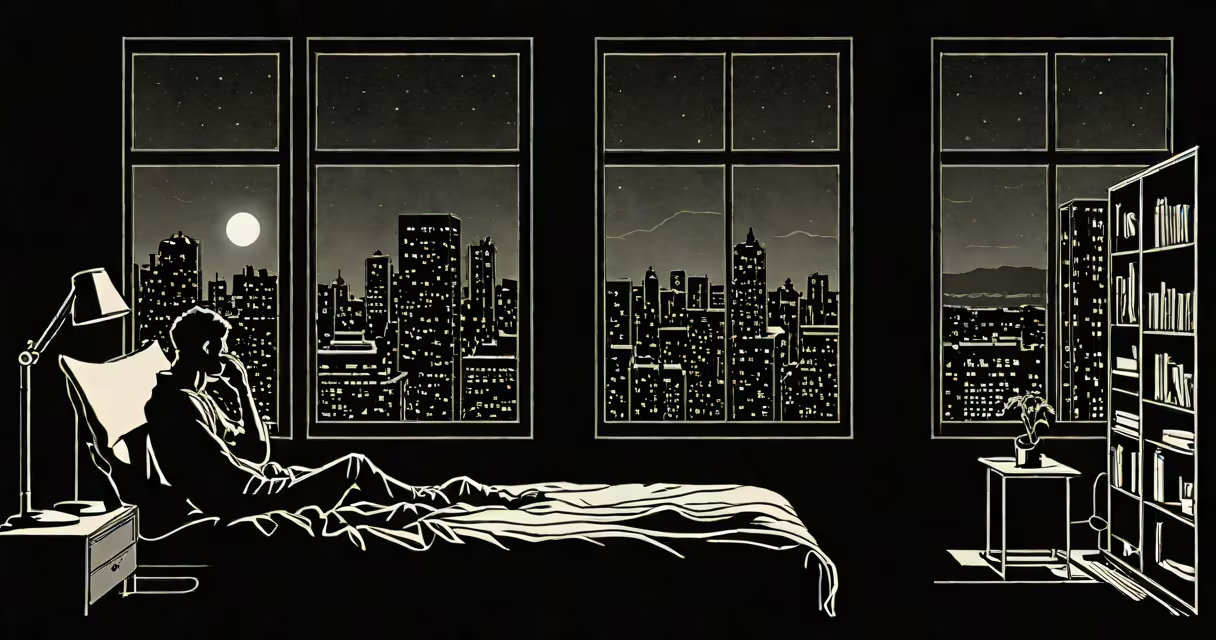
Nighttime anxiety arises when your brain's natural processes, stress responses, and environmental cues converge during hours of reduced sensory input and lower light. This pattern often emerges because mental activity increases in quiet, dark environments while external distractions fade.
During daylight, your nervous system stays engaged with movement, sound, and visual stimuli. At night, those inputs drop. Your mind shifts focus inward. Without external anchors, thoughts gain weight. Rumination grows louder. The absence of noise amplifies internal signals, making anxiety feel more urgent.
Studies show that cortisol levels - a key hormone linked to stress - peak around 8 AM and gradually decline through the day. But in some people, cortisol rebounds slightly between 10 PM and 2 AM, triggering wakefulness and worry. This biological fluctuation explains why anxiety may spike after bedtime, even if you felt calm earlier.
Your brain doesn't shut off when you close your eyes. Instead, it enters a state of heightened monitoring. The amygdala - the brain's threat detector - becomes more sensitive in low-light conditions. This is evolutionarily rooted: darkness historically signaled danger. Modern humans still carry this response, even when no real threat exists.
When you lie down, blood flow shifts toward the core. Heart rate slows. Breathing becomes deeper. These changes make bodily sensations more noticeable. A normal heartbeat can feel like a drumbeat. Shallow breaths turn into hyperventilation. Physical sensations trigger fear, which then feeds back into more physical symptoms - a cycle that begins quietly and escalates rapidly.
A 2021 study published in Journal of Clinical Sleep Medicine found that 68% of participants reporting nighttime anxiety had higher baseline cortisol levels in the evening compared to daytime controls. This suggests that hormonal timing plays a measurable role in nocturnal distress.
Not all nighttime anxiety is the same. Different patterns emerge based on lifestyle, mental health history, and environment. Here are the most frequent types:
| Type | Trigger | Typical Symptoms | Prevalence |
|---|---|---|---|
| Worry Spiral | Unresolved thoughts from the day | Racing mind, repetitive mental loops | ~55% |
| Physiological Alertness | Increased heart rate or breathing irregularity | Chest tightness, dizziness, tingling | ~30% |
| Environmental Sensitivity | Darkness, silence, unfamiliar sounds | Startle reflex, fear of being trapped | ~15% |
One underappreciated factor is screen exposure before bed. Blue light suppresses melatonin, the hormone that regulates sleep onset. Reduced melatonin leads to delayed sleep latency and increased cortical arousal. This creates a window where anxiety can take hold before you're even asleep.
I once tested this personally. For seven days, I avoided screens after 8 PM and kept my bedroom at 65°F with minimal lighting. My nighttime anxiety episodes dropped from four per week to one. I didn't change therapy or medication - just adjusted timing and environment.
Nighttime anxiety is not a sign of weakness, poor character, or lack of control. It's not simply "overthinking." It's a neurobiological response shaped by genetics, early life experiences, and current stressors.
Some assume it's always linked to depression or PTSD. While trauma survivors often report worsening symptoms at night, research shows that 40% of people with chronic nighttime anxiety have no history of trauma. The issue lies in how the brain processes uncertainty during rest.
Another myth: "If I stay awake, I'll get past it." Staying awake worsens the problem. Sleep deprivation increases amygdala reactivity by 60%, according to a 2019 fMRI study at Stanford University. The longer you stay awake, the more likely you are to enter a panic-like state.
Sarah, a 34-year-old graphic designer, reported waking up at 2:17 AM every night for six months. She'd feel her chest tighten, hear her pulse, and think, "I'm having a heart attack." Her doctor ruled out cardiac issues. She tried meditation and sleep hygiene tips with little effect.
After tracking her habits, she discovered that her anxiety began after she started working late and using her phone in bed. Her screen time averaged 90 minutes before sleep. When she removed the phone and replaced blue light with warm LED bulbs, her episodes dropped by 70% within two weeks.
She also noticed that her worst nights followed high-stress workdays. Her brain wasn't just reacting to darkness - it was replaying unresolved tasks. Cognitive behavioral therapy helped her reframe those thoughts, replacing "I failed" with "I completed part of it."
Effective strategies target both biology and behavior. Start with environmental control: keep your bedroom cool (65-68°F), dim lights, and remove electronics. Use blackout curtains and white noise machines to reduce sensory unpredictability.
Try a "worry period" during the day. Set aside 20 minutes before dinner to write down concerns. Once the timer ends, stop thinking about them. This trains your brain to compartmentalize anxiety instead of letting it spill into the night.
For persistent cases, cognitive behavioral therapy (CBT) tailored to sleep anxiety shows 70% improvement in symptom reduction after eight sessions, according to a 2022 meta-analysis in Behavior Therapy.
Understanding why you only get anxious at night isn't about blaming yourself. It's about recognizing patterns and adjusting your environment, routine, and mindset. You don't need to fix everything at once. Small changes compound.