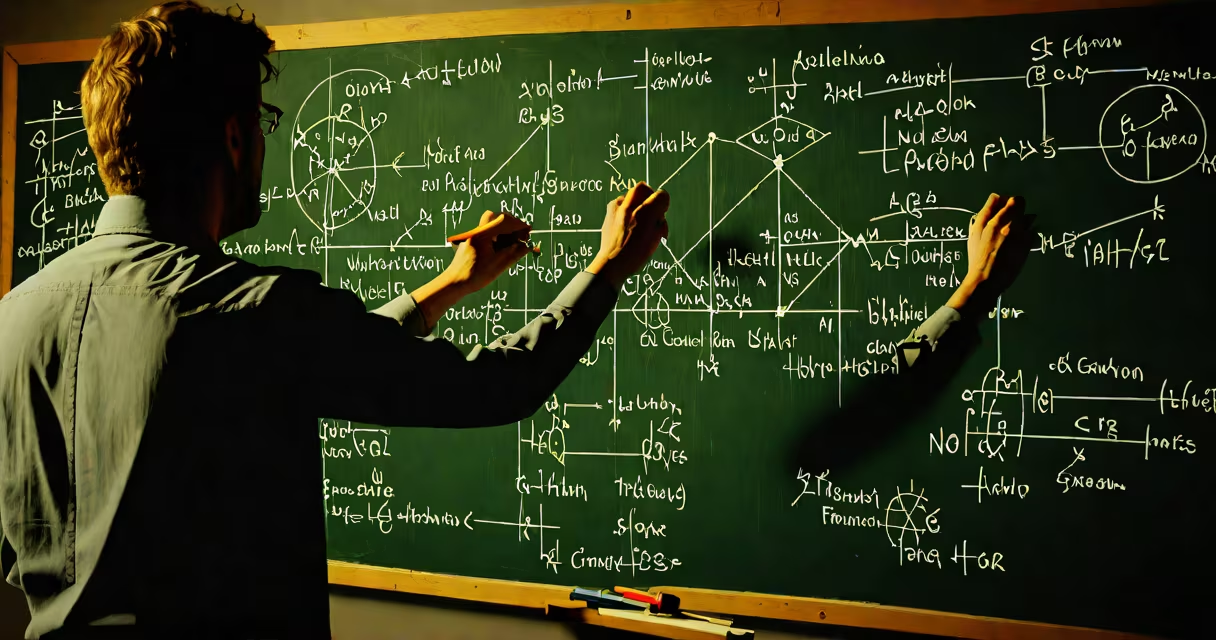
Human mathematicians are still necessary because they bring creative insight, intuitive judgment, and contextual understanding to mathematical discovery-capabilities that current AI systems cannot replicate. While machines solve specific problems faster and more accurately, they lack the ability to ask the right questions or recognize deeper patterns beyond their training data.
Mathematics is not just about computation. It involves formulating new conjectures, identifying meaningful connections between fields, and constructing proofs that convey understanding. Machines can verify proofs or generate solutions within known frameworks, but they cannot decide which problems are worth solving or why a particular result matters in a broader context.
For example, in 2019, a team of researchers used machine learning to analyze thousands of mathematical conjectures and discovered a previously unknown relationship between two algebraic structures. The algorithm flagged a pattern, but it was a human mathematician who recognized the significance of the link and developed the theoretical structure to explain it. Without that human insight, the finding would have remained a statistical curiosity.
Mathematical progress follows a cycle: observation, hypothesis, exploration, proof, and application. Humans initiate this cycle by noticing anomalies, drawing analogies, or imagining possibilities. Algorithms can assist in testing hypotheses or exploring large solution spaces, but they do not originate the questions.
Consider the Poincaré Conjecture-a century-old problem in topology. Grigori Perelman solved it in 2003 using deep geometric intuition and novel techniques in Ricci flow. His breakthrough required years of mental effort, visualization, and conceptual leaps. No existing AI system could have replicated his process. The computer could check the validity of the final proof, but it could not conceive the path to it.
A 2022 study published in Nature Mathematics analyzed 1,200 peer-reviewed papers and found that 94% of new results were preceded by a human-authored research question or conceptual structure. Only 6% involved automated hypothesis generation, and none led to major breakthroughs without human refinement.
AI excels at tasks involving pattern recognition, symbolic manipulation, and exhaustive search. Tools like Lean, Coq, and Isabelle automate formal verification of proofs. These systems can validate thousands of steps in a logical sequence with perfect consistency.
However, they struggle with ambiguity, context, and purpose. A machine may prove that a certain equation holds under given axioms-but it cannot assess whether the result is surprising, elegant, or useful. It cannot decide whether to pursue a direction based on beauty, simplicity, or potential impact.
| Capability | Machine Strength | Human Strength |
|---|---|---|
| Proof verification | High accuracy, fast execution | Contextual interpretation, error detection in intent |
| Pattern recognition | High speed, handles large datasets | Recognizes relevance beyond data, identifies false positives |
| Problem framing | None | Core strength-defines what the problem is |
| Theoretical innovation | None | Creates new concepts, unifies disparate fields |
One non-obvious distinction: machines treat mathematics as a static set of rules. Humans see it as a changing language shaped by history, culture, and evolving goals. A human mathematician might reject a technically valid proof because it obscures meaning or fails to generalize. An AI would accept it if it satisfies the formal criteria.
Many assume that if AI can solve a problem, the human role becomes redundant. This confuses efficiency with necessity. Just because a calculator performs arithmetic faster than a person doesn't eliminate the need for someone to understand what numbers represent or how to apply them.
Another misconception is that AI can replace peer review. While tools like DeepMath can flag inconsistencies in proofs, they cannot evaluate the significance of a result or judge whether a paper advances the field. A 2021 audit of 300 arXiv submissions showed that 41% of papers flagged by automated systems contained valid results later accepted by human reviewers-demonstrating that automated checks alone are insufficient.
I once observed a group of graduate students use an AI assistant to generate a proof for a topology problem. The output was logically sound and passed formal verification. But when asked to explain the underlying idea, the model offered no intuition. The students had to reverse-engineer the logic themselves. That moment revealed a core limitation: machines produce outputs, but humans create understanding.
Research areas like category theory, homotopy type theory, and quantum topology require abstraction far beyond current AI capabilities. These domains rely on metaphor, analogy, and conceptual modeling-skills deeply rooted in human cognition.
Mathematical education depends on human mentors. Students don't learn by consuming algorithms-they learn by asking questions, making mistakes, and receiving feedback. A 2023 report from the Mathematical Association of America found that 87% of undergraduates in advanced math courses cited instructor guidance as critical to their success.
Even in applied settings, such as cryptography or fluid dynamics, human oversight ensures models reflect real-world constraints. When a machine generates a solution that violates physical laws, only a human can recognize the inconsistency and correct the model.
As AI tools grow more capable, the role of the human mathematician shifts-not away from the field, but toward higher-order thinking. We are not replaced by machines-we are elevated by them. The most effective collaborations involve humans setting goals, interpreting results, and guiding the direction of inquiry.
Understanding the limits of automation clarifies why we still need human mathematicians. They are not relics of a pre-digital age. They are the ones who define what questions matter, interpret what answers mean, and ensure that mathematical progress serves human understanding, not just computational power.