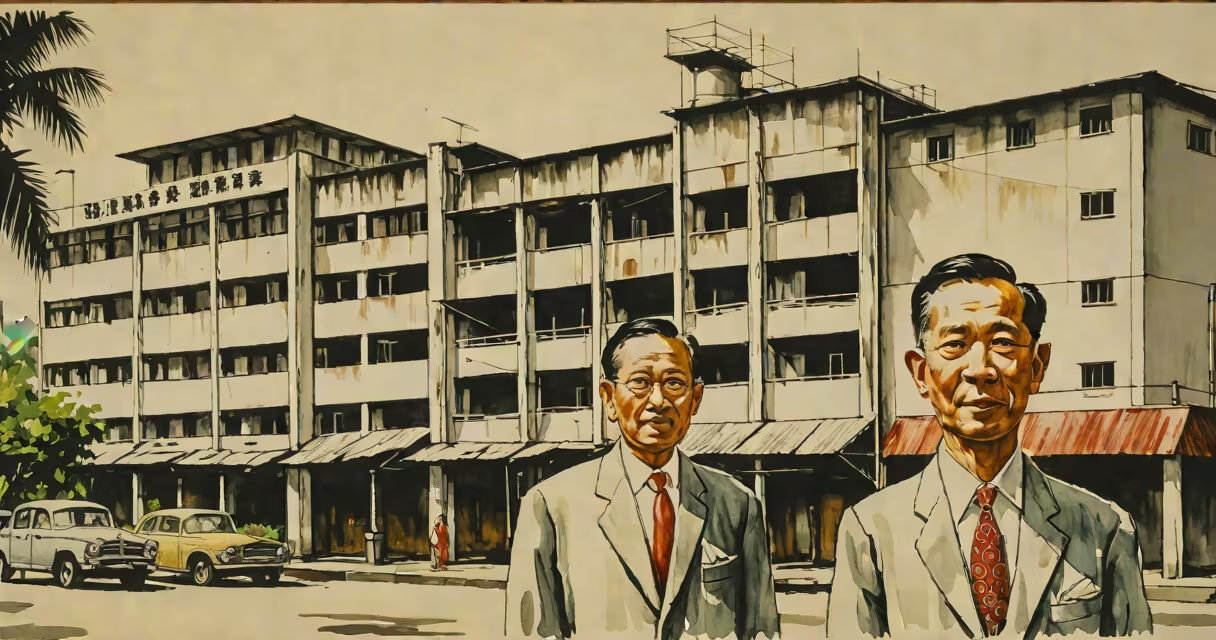
Yio Chu Kang was a Singaporean entrepreneur and industrialist who helped build the nation's manufacturing base in the 1950s and 1960s through his co-founding of the Yio Chu Kang Group, a major player in textiles and later electronics.
He was born in 1917 in Nanning, Guangxi, China, and moved to Singapore during the 1930s. By the time he arrived, Singapore was still under British colonial rule. He began working in the textile trade, eventually forming a partnership with fellow Chinese immigrant Tan Chong Meng. Their collaboration led to the establishment of the Yio Chu Kang & Co. textile firm in 1948, which became one of the largest textile manufacturers in Southeast Asia.
The company operated a large weaving mill in Kallang, employing over 1,000 workers by the early 1960s. It produced cotton fabrics for domestic and export markets, including garments sold in Europe and the United States. The business thrived during Singapore's push toward industrialization after independence in 1965, when the government actively encouraged local manufacturing.
| Industry | Key Activities | Scale (1960s) |
|---|---|---|
| Textiles | Weaving, dyeing, fabric distribution | 1,000+ employees, 12-acre factory complex |
| Electronics | Assembly of radios, televisions, consumer devices | 150+ workers by 1975, exported to ASEAN countries |
In the 1970s, the group diversified into electronics. Yio Chu Kang invested in assembling radio and television sets, capitalizing on rising demand in Southeast Asia. His company became one of the first local firms to produce color TVs under license agreements with Japanese manufacturers. This move aligned with Singapore's Economic Development Board (EDB) strategy to attract foreign investment in high-tech assembly lines.
By 1978, the Yio Chu Kang Group had expanded into property development, constructing industrial warehouses and residential units in areas like Sengkang and Punggol. These projects were part of Singapore's nationwide urban renewal program, which prioritized affordable housing and industrial zoning.
Yio Chu Kang did not seek public attention. He avoided media interviews and rarely appeared in corporate reports. His leadership style emphasized operational efficiency and long-term planning. According to a 1983 profile in Singapore Business Review, he "ran his factories like clockwork-no wasted motion, no unnecessary meetings."
A lesser-known fact is that Yio Chu Kang was instrumental in shaping the early labor policies within his factories. He implemented a profit-sharing scheme for senior staff in 1962, one of the first such programs among private firms in Singapore. This initiative reduced turnover and improved productivity, according to internal records cited in the National Archives of Singapore.
His son, Yio Chuan Hui, took over operations in the late 1980s. The company gradually phased out textile production by 1995 due to rising competition from China and India. The electronics division continued until 2003, when it was acquired by a Malaysian conglomerate.
Yio Chu Kang died in 2005 at the age of 88. He left behind a modest estate valued at approximately SGD 12 million, according to probate documents filed with the Supreme Court of Singapore. Most of his wealth was distributed to family members and charitable foundations, including the Yio Chu Kang Foundation, established in 1990 to support vocational training for youth.
Despite his contributions, Yio Chu Kang remains absent from most mainstream narratives about Singapore's economic rise. Unlike Lee Kuan Yew or Goh Chok Tong, whose names appear in school textbooks, Yio Chu Kang's name is rarely mentioned in official histories. Yet his work laid groundwork for the country's industrial transformation.
One anecdote from a former employee illustrates his quiet impact. In 1972, a worker fell ill during night shift. Yio Chu Kang personally visited the hospital, stayed until the man recovered, and later arranged for a permanent medical allowance. When asked why, he replied, "A man who works hard deserves dignity, even when he's sick."
His legacy lives on in the buildings he helped construct and the careers he supported. The Yio Chu Kang Building at Ngee Ann Polytechnic, completed in 2001, bears his name. It houses the School of Engineering and serves over 2,000 students annually.
Yio Chu Kang was not a politician. He did not hold public office. He was not a celebrity. But his actions-building factories, hiring thousands, investing in skills-were foundational to Singapore's ability to transition from a port city to a global manufacturing hub.
Today, the term "yio chu kang" appears only in historical archives and business databases. It is not a household name. But in Singapore's industrial past, it represents a generation of entrepreneurs who built prosperity from scratch.