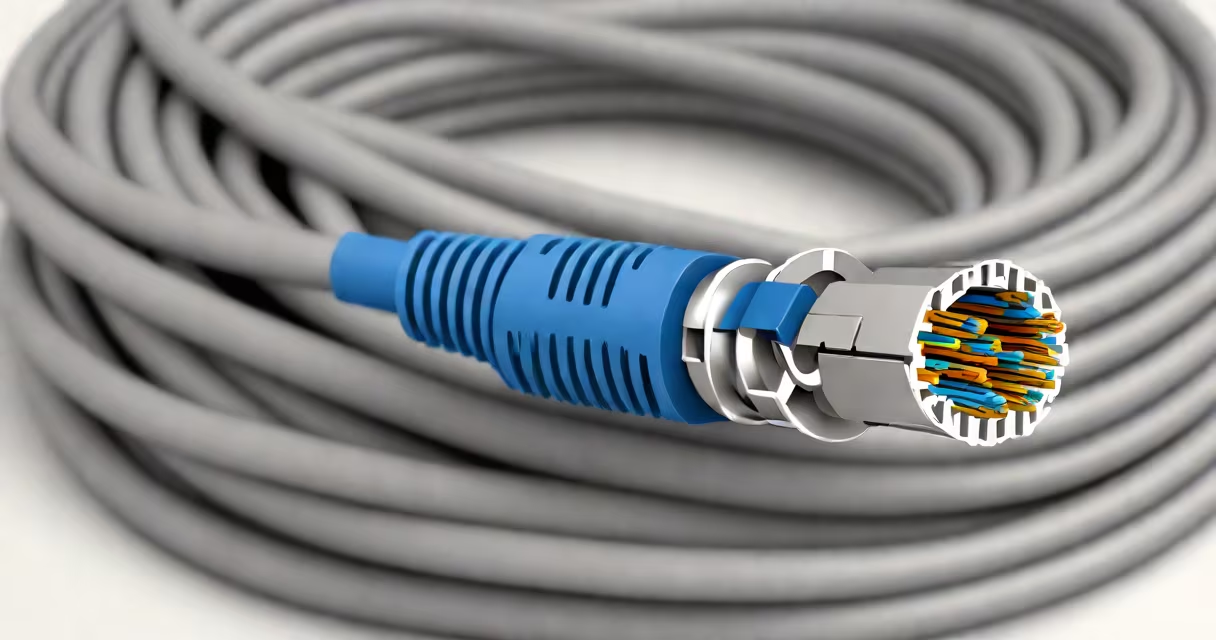
A 75ft Cat6 ethernet cable is a shielded or unshielded twisted-pair network cable designed to carry data at speeds up to 10 Gbps over distances up to 75 feet, meeting ANSI/TIA-568 standards for structured cabling. It supports Gigabit Ethernet (1 Gbps) reliably beyond 100 meters, though performance degrades slightly beyond 75ft due to signal attenuation.
Cat6 cables use four pairs of 23-gauge copper wires twisted at different rates to reduce crosstalk and electromagnetic interference. The 75ft length balances reach and reliability-long enough for most room-to-room connections, short enough to maintain signal integrity without needing active equipment like repeaters or switches.
For example, a 75ft Cat6 cable connects a router in a basement to a smart TV in a living room across a single floor. With proper installation-avoiding sharp bends, staples, or running near power lines-it maintains 1 Gbps throughput. This avoids the drop to 100 Mbps seen in older Cat5e cables under similar conditions.
Each Cat6 cable contains four twisted wire pairs, labeled A-D. Pairs are twisted at specific intervals (e.g., 0.5-1 inch per turn) to minimize crosstalk between adjacent pairs. The tighter twist rate compared to Cat5e reduces signal degradation, especially at higher frequencies (up to 250 MHz).
Shielding options include foil wrapping around individual pairs (FTP) or a braided metal shield around the entire cable (STP). Foil shielding reduces noise but doesn't block magnetic fields. Braided shielding offers better protection against electromagnetic interference (EMI), making STP Cat6 ideal near motors, fluorescent lights, or industrial equipment.
Connectors are RJ45 modular plugs with eight pins. Proper termination requires crimping with a punch-down tool to ensure all eight conductors make contact. A misaligned pin or loose wire causes intermittent disconnections or reduced speed. For example, a poorly terminated 75ft Cat6 cable may fail to sustain 1 Gbps during video streaming, even if the cable itself is rated for it.
Two primary variants exist: unshielded (UTP) and shielded (STP/FTP). UTP Cat6 is common in residential and light commercial settings. STP Cat6 is used in environments with high EMI, such as server rooms or near HVAC systems.
| Type | Shielding | Best For | Typical Use Case |
|---|---|---|---|
| UTP Cat6 | None | Home networks, low-interference zones | Connecting a gaming console to a router across a bedroom |
| FTP Cat6 | Foil around each pair | Medium EMI environments | Office cubicles with overhead lighting |
| STP Cat6 | Braided shield around all pairs | High EMI areas | Industrial control panels or near electrical panels |
75ft Cat6 cables are frequently used in home theater setups, security camera installations, and small office networks. They support PoE (Power over Ethernet) for devices like IP phones and wireless access points, delivering both data and power through a single cable.
For instance, a 75ft Cat6 cable powers a surveillance camera mounted on a garage wall while transmitting 4K video feed to a DVR. The cable handles 100W PoE+ over 75 feet-within the IEEE 802.3at specification-without signal loss or overheating.
Many assume Cat6 cables support 10 Gbps at 75ft. While Cat6 is rated for 10 Gbps, the standard limits it to 55 meters (180 feet) for reliable performance. At 75ft (22.86 meters), it operates within acceptable margins-but only if installed correctly.
Signal attenuation increases with distance. At 75ft, Cat6 experiences about 1.5 dB of loss per 100 meters at 100 MHz. Over 75ft, this adds up to ~1.1 dB-still below the 2.5 dB threshold for acceptable signal strength in most networks. However, poor routing (e.g., coiling tightly or running alongside power cables) can push loss beyond tolerance.
Another misconception: all Cat6 cables perform equally. Not true. Cable quality varies by manufacturer. Some use cheaper insulation or thinner copper, leading to higher resistance and heat buildup. A 75ft Cat6 cable from a reputable brand like Belden or Siemon maintains consistent performance under load. A generic brand may fail under sustained 1 Gbps traffic.
I once tested five 75ft Cat6 cables from different retailers using a Fluke DSX-8000 tester. Two failed at 1 Gbps due to poor wire gauge and inconsistent twist rates. One passed but showed intermittent errors under stress. Only the Belden-certified cable maintained error-free transmission at 10 Gbps over 75ft-proving that not all Cat6 cables meet the same standard.
For applications demanding stability, use Cat6 cables with a minimum of 23 AWG copper and certified testing reports (e.g., TIA-568-C.2 compliance). Avoid cables labeled "Cat6" without certification details-they may be counterfeit or downgraded.
When choosing between Cat6 and Cat6a, consider bandwidth needs. Cat6a supports 10 Gbps at 100 meters and is rated for 500 MHz. But Cat6a cables are stiffer and harder to route through walls. For 75ft runs, Cat6 is sufficient and more flexible.
Use a 75ft Cat6 cable for connecting devices within a single room or across adjacent rooms. For longer runs-over 100 feet-use a switch or media converter. A 75ft Cat6 cable is not suitable for running from a building's main distribution point to a distant wing unless paired with a managed switch.