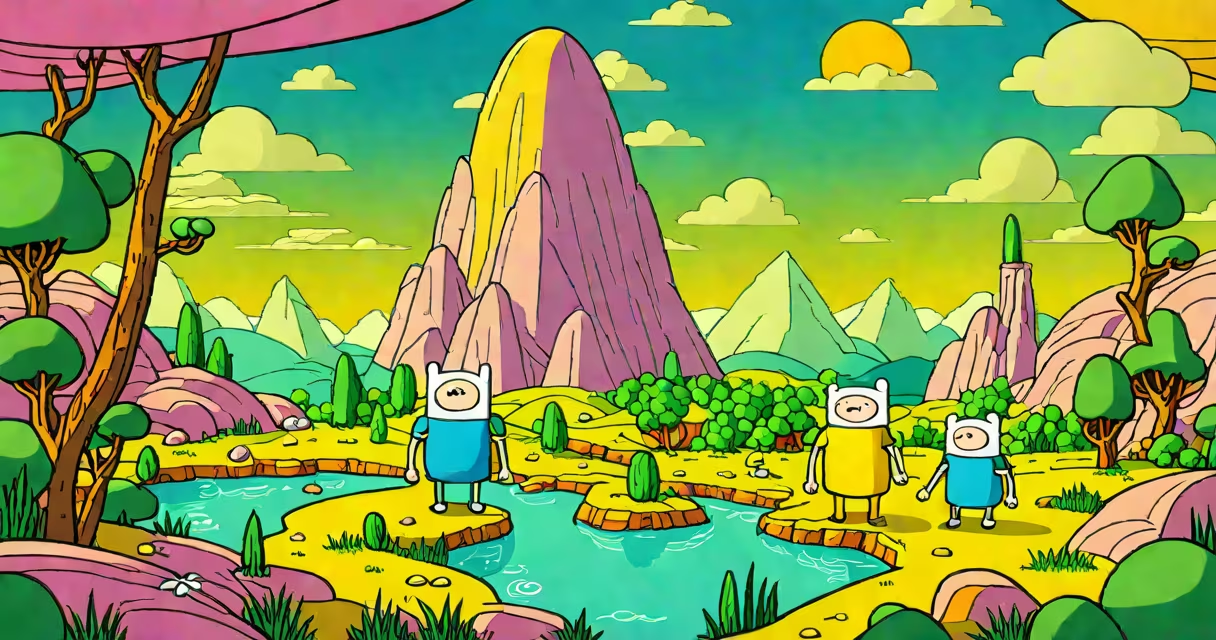
Adventure Time Distant Lands is a collection of standalone animated episodes set in the Adventure Time universe, exploring new regions, characters, and stories beyond the core timeline. Each episode functions as a self-contained narrative with distinct themes, art styles, and emotional arcs, expanding the show's mythos without requiring prior knowledge of the main series.
The series was released in 2021 as part of a limited-run anthology format, produced by Frederator Studios and Cartoon Network. Unlike the main Adventure Time series, which follows Finn the Human and Jake the Dog through the Land of Ooo, Distant Lands focuses on isolated realms and forgotten histories. The episodes were designed to appeal to both longtime fans and newcomers, offering accessible storytelling with mature themes such as grief, identity, and legacy.
Each episode runs between 12 and 16 minutes and is directed by different artists, resulting in varied visual tones. For example, "The Lich" features dark fantasy aesthetics and a haunting score, while "The Last Time" uses minimalist animation and a dreamlike structure. These differences reflect the creators' intent to treat each story as a unique experience rather than a serialized arc.
Adventure Time Distant Lands operates as a series of discrete narratives, not a continuous storyline. Viewers can watch episodes in any order. Each episode centers on a specific character or event, often involving a moral dilemma or personal transformation. The format allows for experimentation with genre-episodes blend fantasy, drama, horror, and even musical elements.
For example, "The Lich" tells the story of a young girl named Maja who inherits a cursed artifact tied to the ancient villain of the same name. She must decide whether to destroy it or use its power to save her village. The episode uses flashbacks and symbolic imagery to explore trauma and inherited guilt. Its pacing slows during emotional beats, emphasizing silence and visual detail over dialogue.
Another episode, "The Last Time," follows a sentient tree named Koko who lives in a frozen forest. When a group of travelers arrives seeking shelter, Koko must confront his fear of being forgotten. The episode uses a non-linear timeline and internal monologue to convey isolation. It ends with Koko choosing to stay behind as the travelers leave, symbolizing acceptance of impermanence.
While all episodes share the Adventure Time aesthetic, they differ in tone and structure. The following table outlines key episodes by theme and style:
| Episode | Theme | Art Style | Runtime |
|---|---|---|---|
| The Lich | Grief, legacy, power | Dark fantasy, high contrast | 15 min |
| The Last Time | Isolation, memory, mortality | Minimalist, muted colors | 14 min |
| Time to Get Out | Identity, rebirth | Surreal, fluid animation | 12 min |
| When the World Was Young | Origin myths, creation | Hand-drawn, textured | 16 min |
These variations demonstrate how the anthology format enables creative freedom. The series avoids relying on recurring characters or plot devices, allowing writers to explore ideas without constraints. This approach contrasts sharply with traditional TV shows that depend on continuity and character development across episodes.
Adventure Time Distant Lands was released exclusively on HBO Max in the United States and on Cartoon Network's international platforms. It was not intended as a replacement for the original series but as a companion piece to deepen the world-building. The episodes were written by various contributors, including Pendleton Ward (creator of Adventure Time), Rebecca Sugar, and other members of the original writing team.
Its primary purpose is to explore side stories and alternate timelines that couldn't fit within the original show's episodic structure. For example, "When the World Was Young" explains the origin of the Candy Kingdom's founding, a topic briefly mentioned in the main series but never fully explored. The episode uses a fable-like structure to depict how the kingdom was built on a pact between humans and candy creatures.
Despite being labeled as "fan service," the series received critical acclaim for its emotional depth and artistic innovation. According to IGN, "Distant Lands elevates the Adventure Time brand by focusing on quiet moments and personal stakes, not just whimsy." Metacritic gave the series a 78/100 average score based on 12 critic reviews, with praise for its narrative ambition and visual diversity.
Many viewers assume Adventure Time Distant Lands is a video game. It is not. While the title shares similarities with the popular Bloons TD franchise, which blends tower defense mechanics with Adventure Time characters, Distant Lands is strictly an animated series. The confusion arises because both use the Adventure Time universe and feature similar art styles.
A common misconception is that the episodes are connected by a central plot. They are not. Each story stands independently. The only unifying element is the setting-the multiverse of Adventure Time. Even then, the locations are not linked by geography or timeline. The series intentionally avoids continuity to preserve narrative independence.
Another correction: Distant Lands is not a reboot or sequel. It does not reset the canon of the original series. Instead, it exists in parallel-a series of "what if" scenarios and lost legends. For example, "The Lich" takes place in a version of Ooo where the original Lich was never defeated, leading to a different political and cultural history. This doesn't contradict the main series-it expands it.
I personally watched "The Last Time" during a late-night stream and was struck by how little dialogue it used. The entire episode relies on sound design-wind, creaking branches, distant animal calls-to build tension. When the traveler says, "I'll remember you," the silence that follows is more useful than any line of exposition. That moment stayed with me for days.
adventure time distant lands is a curated collection of animated short films that expand the Adventure Time universe through emotionally resonant, self-contained stories. It offers a rare model of narrative variety in modern animation, proving that standalone episodes can carry weight without needing a larger arc. The series remains a benchmark for creative risk in streaming content.