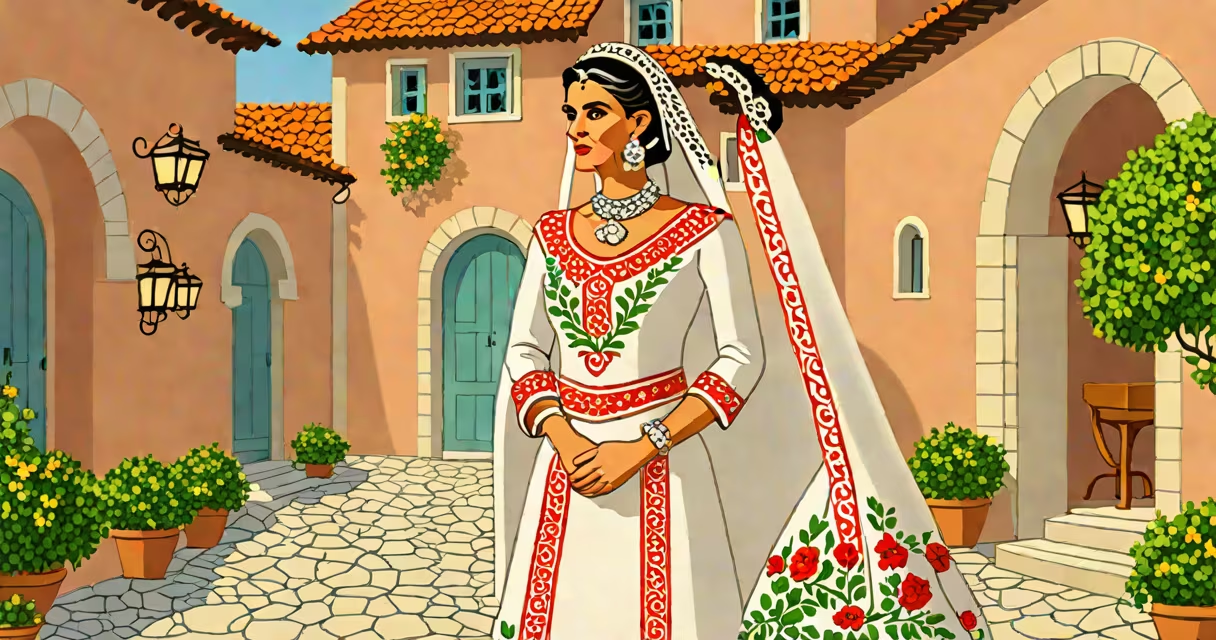
The albanian wedding dress is a culturally significant garment worn by brides in Albania and among Albanian communities across the Balkans, characterized by complex hand embroidery, regional variations in color and design, and deep symbolic meaning tied to family, honor, and ancestral continuity.
Worn during traditional ceremonies, especially in rural areas, the albanian wedding dress is not a single standardized outfit but a collection of regional styles shaped by centuries of local textile practices. Its construction relies heavily on wool, silk, and cotton fabrics, often dyed using natural pigments. Embroidery patterns-geometric, floral, or animal-based-are passed down through generations and serve as visual language encoding clan affiliations, marital status, and spiritual protection.
Modern urban brides may adopt Western-style gowns for church or civil ceremonies, but many still wear the traditional dress during the pre-wedding ritual known as "këmbyet" or "bajrak," where the bride's family formally exchanges gifts and promises. The dress remains central to cultural identity, particularly in northern regions like Malesia and Shkodër, where distinct motifs such as the "shkëndija" (sun symbol) and "fishtë" (fish motif) appear frequently.
Wearing the albanian wedding dress is part of a multi-day process rooted in pre-Christian and Ottoman-era customs. The bride typically begins wearing it days before the wedding, often during the "gjyshen" ceremony, where she is formally welcomed into her husband's family. The dress is not just worn-it is presented, blessed, and sometimes even "baptized" with water or wine by elders.
Each element carries meaning. Red is dominant in southern Albania and symbolizes fertility, passion, and resilience. White appears in the north, associated with purity and mourning-reflecting the dual role of marriage as both celebration and solemn transition. Silver threadwork represents wealth and divine favor. The number of embroidered flowers often corresponds to the bride's age or the number of years the family expects the union to last.
A 2018 study by the Institute of Ethnography at the University of Tirana found that 68% of brides in rural Gjirokastër wore traditional attire during the ceremonial phase, compared to 22% in Tirana. This disparity reflects urbanization and generational shifts, though interest in reviving heritage garments is growing among younger Albanians.
Albanian wedding attire varies by region. Northern styles emphasize symmetry, bold contrasts, and silver accessories. Southern styles favor layered skirts, rich reds, and complex floral patterns. The following table outlines key differences:
| Region | Color Palette | Key Motifs | Distinctive Features |
|---|---|---|---|
| Shkodër (northwest) | White, gold, black | Sun (shkëndija), geometric grids | Heavy silver jewelry, long sleeves, high collar |
| Elbasan (central) | Red, purple, green | Floral vines, birds, stylized hearts | Layered skirt with 12 panels, embroidered sash |
| Gjirokastër (south) | Deep red, burgundy, black | Fish (fishtë), double-headed eagle | Shorter sleeves, gold thread, ornamental belt |
These variations are not arbitrary. The fish motif in Gjirokastër, for example, references ancient Illyrian beliefs about rebirth and water deities. The double-headed eagle, a national symbol since medieval times, appears in southern bridal sets as a sign of strength and unity between families.
Many assume the albanian wedding dress is a single, uniform style. This is incorrect. There is no national standard. What exists is a mosaic of regional identities, each with its own rules, materials, and meanings. A bride from Krujë wears something entirely different from one in Pogradec.
Another misconception is that the dress is purely decorative. In reality, it functions as a social document. The placement of certain symbols-like a cross near the heart or a crescent moon at the shoulder-can indicate the bride's religious affiliation or clan lineage. Some families refuse to allow their daughters to wear a dress with motifs from another tribe, fearing misfortune or dishonor.
Even the act of wearing the dress is regulated. In some villages, only married women may touch or handle the garment. Brides are often instructed not to speak while putting it on, as silence is believed to prevent evil spirits from entering the body during transformation.
In June 2022, Liridona, a 24-year-old teacher from Korçë, wore a custom-made albanian wedding dress for her traditional ceremony. Her dress was crafted over six weeks by her grandmother using wool from sheep raised on their family farm. The base color was crimson, chosen because it symbolizes enduring love in southern Albanian tradition.
She wore 21 embroidered flowers along the hem-each representing a year of her parents' marriage. The neckline featured a silver chain with a small medallion bearing the name "Korçë" in Albanian script. During the ceremony, her mother placed a sprig of wild mint under her left shoe, a gesture meant to ensure she never forgets her roots.
Liridona later shared that the dress felt heavier than expected-not physically, but emotionally. "I didn't realize how much my ancestors were in it until I stood up," she said. "Every stitch carried someone who came before me."
The albanian wedding dress is not synonymous with the "traditional Eastern European bridal gown." While neighboring cultures share similar elements-such as red as a wedding color or heavy embroidery-the specific iconography and regional codes differ sharply. For example, a Ukrainian wedding dress features different motifs and is often worn with a headdress called a "pokryvka," which has no equivalent in Albanian tradition.
It is also not interchangeable with the "wedding dress" worn in Western ceremonies. The albanian version is not designed for photography or public display alone. It is functional, sacred, and embedded in ritual. Wearing it outside of formal events is seen as disrespectful in conservative communities.
One non-obvious fact: The albanian wedding dress often includes hidden pockets. These are not for carrying valuables but for storing small items like dried herbs, a lock of hair from a deceased relative, or a piece of bread from the first meal eaten together after the wedding. These objects are believed to bring protection and stability to the new household.
The albanian wedding dress remains a living artifact of Balkan culture. It is not preserved in museums-it is worn, altered, and passed down. Its survival depends not on preservation, but on continued use. As one artisan in Durrës told me during a visit: "If the dress stops being worn, it dies. But if it's worn, it lives."