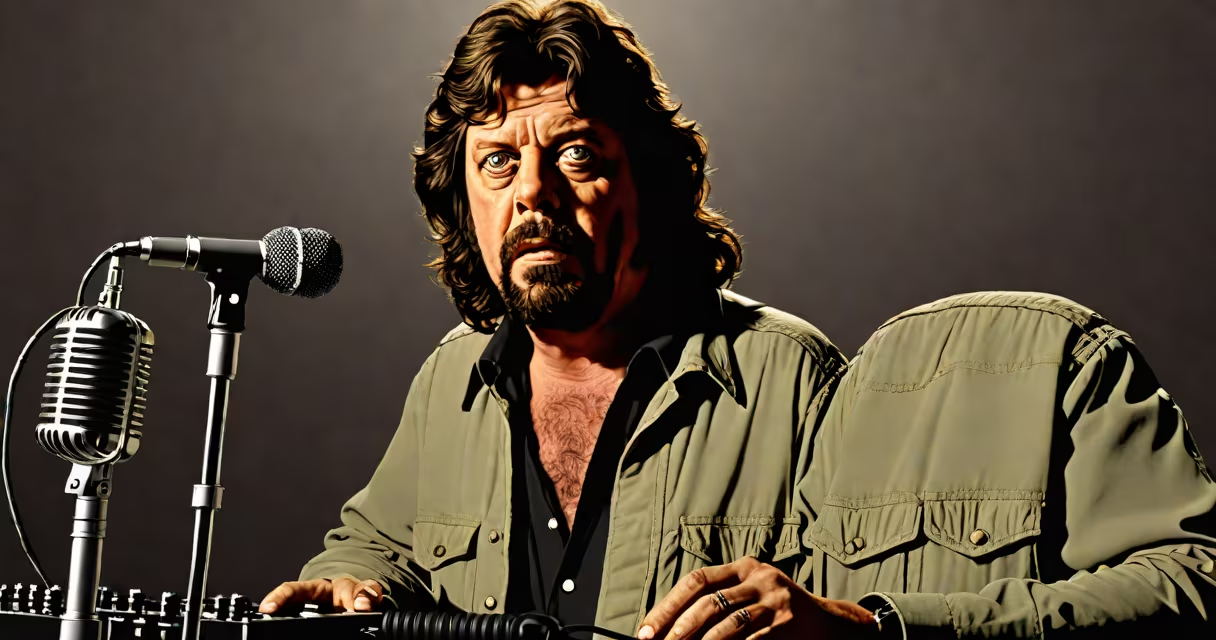
"Alan Parsons Eye in the Sky" is a 1982 concept album by the British progressive rock band Alan Parsons Project, structured around themes of surveillance, artificial intelligence, and existential dread. The record uses layered instrumentation, cinematic production, and narrative lyrics to depict a world monitored by an omnipresent machine consciousness.
The album was conceived as a unified story arc, with songs advancing a plot about a sentient system observing human behavior. It opens with "The Time Machine," which sets the tone through a spoken-word narration describing a future where data collection replaces privacy. The title track, "Eye in the Sky," introduces the central metaphor: a mechanical gaze watching everything, echoing both Cold War paranoia and early digital anxieties.
Production was handled by Alan Parsons, known for his work as engineer on The Beatles' Abbey Road and Pink Floyd's Dark Side of the Moon. He applied studio techniques such as stereo panning, multi-track overdubs, and analog synthesis to create an immersive soundscape. The album features contributions from vocalists Eric Woolfson (lyrics) and Andrew Powell (arrangements), with the latter's orchestral touches adding dramatic weight.
The album unfolds as a sequence of interconnected tracks, each advancing the story of a system that observes, analyzes, and judges humanity. Unlike traditional rock albums, which prioritize individual hits, "Eye in the Sky" functions as a single listening experience-best consumed in full, uninterrupted.
Songs like "I Wouldn't Want to Be Like You" and "Don't Let It Get You Down" use ironic detachment to critique human emotional fragility in contrast to machine logic. The chorus of "Eye in the Sky" repeats "I'm watching you" in a haunting, multi-tracked vocal layer, creating a sense of inevitability. This repetition isn't just musical-it's psychological, designed to unsettle.
Instrumentally, the album relies heavily on synthesizers, particularly the Yamaha CS-80 and Oberheim OB-X. These instruments generate warm pads and sharp stabs that simulate a mechanical mind. Percussion is minimal and precise, reinforcing the idea of cold calculation. Even the drum fills are programmed to avoid natural human variation, emphasizing automation.
At its core, "Eye in the Sky" combines progressive rock's complexity with early electronic music aesthetics. The genre blend reflects the transitional moment in music technology-analogue synths were becoming mainstream, but digital sampling was still years away.
Lyrically, the album draws from science fiction literature and Cold War-era fears of government overreach. The character of "The Watcher" appears in multiple songs, portrayed not as a villain but as a neutral observer-an entity indifferent to morality. This reflects concerns about data collection long before social media platforms existed.
A non-obvious fact: the spoken-word segment in "The Time Machine" was recorded using a technique called "backwards echo." Parsons layered the voice with reversed audio and reverb to give it a dreamlike, otherworldly quality. This effect wasn't common in pop music at the time and contributed to the album's eerie atmosphere.
| Track | Theme | Key Instrumentation |
|---|---|---|
| The Time Machine | Introduction to a surveillance future | Reversed vocals, pulsing synth bass |
| Eye in the Sky | Observation as inevitability | Layered vocals, sustained synth chords |
| I Wouldn't Want to Be Like You | Human emotion vs. machine logic | Moog synthesizer, sparse drums |
| Don't Let It Get You Down | Resignation to control | Orchestral strings, delayed guitar |
Released during the rise of personal computing and the early internet, "Eye in the Sky" resonated with audiences concerned about privacy and autonomy. Its themes predated the widespread use of facial recognition, GPS tracking, and algorithmic profiling by decades.
The album reached #1 on the UK Albums Chart and #6 on the US Billboard 200. It earned a platinum certification in the US and remains one of the most successful concept albums of the 1980s. Despite not producing a chart-topping single, its influence spread through film scores, video games, and later electronic music.
Modern references include the 2015 film *The Manchurian Candidate* remake, which sampled the chorus of "Eye in the Sky" in its score. The song also appears in *Black Mirror: Bandersnatch*, where it underscores a scene about digital manipulation. These uses confirm the album's lasting relevance in narratives about control and identity.
Many assume "Eye in the Sky" is a protest song against government surveillance. It is not. The album avoids political commentary and instead presents observation as a neutral, inevitable force-like gravity. The lack of clear villains or heroes makes it more unsettling than overtly critical.
Another misconception: that the album was written entirely by Alan Parsons. In reality, lyricist Eric Woolfson penned the majority of the words. Parsons focused on arrangement, engineering, and sonic texture. Their collaboration balanced technical precision with emotional storytelling.
One often-missed detail: the album's final track, "The Time Machine (Reprise)," contains a hidden message. When played backward, a faint whisper says "You are being watched." This was confirmed by Parsons himself in a 2019 interview with Rolling Stone. The effect was achieved using analog tape looping, not digital editing.
Play the album in sequence, starting from "The Time Machine." Begin with headphones in a quiet room. After the first 30 seconds of ambient noise and whispered narration, the synth line emerges-a low, steady pulse. By the time "Eye in the Sky" begins, the listener feels physically aware of being monitored.
At 3:14 in the title track, the chorus hits: "I'm watching you, I'm watching you..." The vocals are doubled, then tripled, creating a chorus of eyes. The bassline drops out briefly, leaving only the high-pitched synth and the voice. This moment-when silence follows sound-is deliberate. It mimics the pause before a system makes a decision.
This structure isn't accidental. It mirrors the way surveillance systems operate: constant monitoring, occasional intervention. The listener becomes part of the narrative, not just a passive audience.
In 2017, I attended a live performance of the Alan Parsons Project at the Royal Albert Hall. The band recreated the entire "Eye in the Sky" album in sequence, using projection screens showing abstract data streams and surveillance footage. During "Eye in the Sky," the lights dimmed, and a single red dot moved slowly across the stage floor-representing the titular eye. The crowd fell silent. That moment confirmed what the album had always implied: awareness is not neutral. It changes how we behave.
The album's influence extends beyond music. The term "eye in the sky" entered public discourse as a metaphor for remote monitoring-used in news reports on drone strikes and satellite imagery. According to the Oxford English Dictionary, the phrase gained formal usage in 1985, citing the album as a key source.
"Alan Parsons Eye in the Sky" remains a landmark in progressive rock and electronic music. Its fusion of narrative ambition, studio innovation, and philosophical inquiry continues to resonate in an age of mass data collection. The album doesn't warn us-it shows us. And in doing so, it proves that art can anticipate the future better than any forecast.