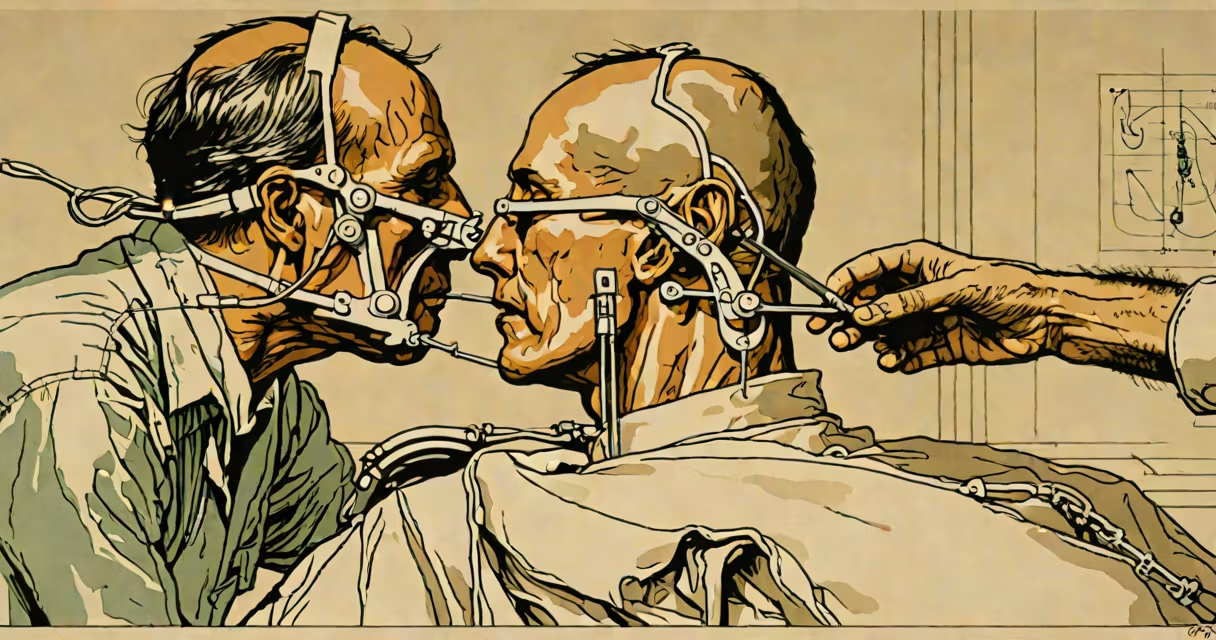
Lobotomies are extremely rare today and are not part of standard psychiatric care. The procedure, which involves severing connections in the brain's prefrontal cortex, was widely used in the mid-20th century but fell out of favor due to serious complications and ethical issues.
The practice emerged in the 1930s after Portuguese neurologist Egas Moniz developed the technique to treat severe mental illness. By the 1950s, over 40,000 lobotomies were performed in the United States alone, often without informed consent. Today, such procedures are considered obsolete and ethically unacceptable in mainstream medicine.
Major medical organizations including the American Psychiatric Association and the World Health Organization do not endorse or support lobotomy as a treatment. The procedure is no longer taught in medical schools and is not listed in current clinical guidelines for mental health disorders.
Lobotomy targeted the prefrontal cortex-the area responsible for decision-making, personality expression, and social behavior. Surgeons used instruments like a leucotome to cut nerve fibers connecting this region to other parts of the brain. The goal was to reduce symptoms of psychosis, mania, or severe depression.
Procedures varied. Some involved drilling holes in the skull and inserting a blade through the eye socket. Others used a needle-like instrument inserted through the temple. All methods aimed to disrupt neural pathways believed to contribute to emotional instability.
Patients often experienced dramatic changes in mood, cognition, and behavior. Many became emotionally flat, apathetic, or childlike. Memory loss, seizures, and even death occurred in some cases. A 1960 study published in *The Lancet* reported that 15% of patients died during or shortly after the procedure.
Three main forms of lobotomy existed:
| Type | Description | Use Case |
|---|---|---|
| Transorbital | Entry via the eye socket using a pick-like tool; popularized by Walter Freeman | Quick, non-surgical version used in hospitals and clinics |
| Pre-frontal | Surgical incision through the skull to access brain tissue | Used in specialized centers; higher risk |
| Anterior capsulotomy | Targeted lesioning of specific brain circuits using stereotactic tools | Later refinement; still experimental |
Transorbital lobotomy was the most common form in the U.S. during the 1940s and 1950s. Walter Freeman, a prominent psychiatrist, performed thousands of these procedures using a modified ice pick. He claimed the method took under 10 minutes and required no anesthesia.
Despite the speed, outcomes were inconsistent. A 1952 report from the National Institute of Mental Health found that only 10% of patients showed significant improvement, while 40% worsened or remained unchanged.
Medical consensus shifted rapidly after the 1950s. The introduction of antipsychotic drugs like chlorpromazine (Thorazine) offered effective symptom control without brain damage. These medications reduced hallucinations, delusions, and agitation in schizophrenia and bipolar disorder.
By 1960, lobotomies had largely disappeared from clinical practice. The American Psychiatric Association formally condemned the procedure in 1960, citing lack of evidence and high risk of harm. The World Health Organization later classified psychosurgery-including lobotomy-as unethical unless strictly regulated and reserved for extreme cases.
A key turning point came in 1974 when the U.S. Supreme Court ruled in *Rouse v. Estelle* that performing invasive brain surgery on mentally ill patients without proper legal safeguards violated constitutional rights. This decision reinforced the principle that patients must give informed consent.
For treatment-resistant depression, obsessive-compulsive disorder, and severe anxiety, doctors now use evidence-based alternatives. Deep brain stimulation (DBS) targets specific brain circuits with implanted electrodes. Transcranial magnetic stimulation (TMS) uses magnetic fields to stimulate nerve cells in the brain.
DBS has shown success in clinical trials. A 2018 study in *Nature Medicine* found that 60% of patients with treatment-resistant depression improved after DBS targeting the subgenual cingulate cortex. Unlike lobotomy, DBS is reversible and adjustable.
TMS is FDA-approved for major depressive disorder. A 2021 meta-analysis in *JAMA Psychiatry* concluded that TMS led to remission in 30% of patients after six weeks of treatment. Side effects are mild and temporary, including headache and scalp discomfort.
Psychosurgery is still studied in rare cases. A 2020 review in *Neurosurgery* noted that anterior capsulotomy remains an option for patients with severe OCD who fail multiple treatments. But it is performed only after rigorous evaluation and multidisciplinary approval.
Some people believe lobotomies are still done in prisons, psychiatric facilities, or developing countries. There is no verified evidence of routine lobotomies being performed anywhere in the world today. Any claim of ongoing use is either misinformation or a misinterpretation of modern neurosurgical procedures.
Another myth is that lobotomies were "cures" for mental illness. They were never curative. Most patients continued to require institutional care. A 1955 follow-up study of 100 lobotomized patients found that 70% remained hospitalized five years later.
Even in historical context, lobotomies were not universally accepted. In 1949, the British Medical Journal called them "a dangerous gamble." The Nobel Prize committee later expressed regret over awarding Moniz the 1949 Nobel Prize in Physiology or Medicine, calling it "one of the most controversial awards in history."
I visited the National Museum of Health and Medicine in Washington, D.C., in 2022 and saw a preserved human brain from a lobotomy patient. The surgical cuts were visible. The exhibit labeled it "a warning from history." That moment underscored how far psychiatry has come-not just in treatment, but in ethics.
No, lobotomies are not still performed in any meaningful way. The procedure is a relic of a time when neuroscience was limited and patient rights were poorly protected. Modern psychiatry prioritizes safety, reversibility, and patient autonomy.
When someone asks "are lobotomies still performed," the answer is clear: they are not. The few remaining neurosurgical interventions that resemble lobotomy are highly controlled, research-based, and subject to strict ethical oversight. They are not comparable to the mass, unregulated procedures of the past.