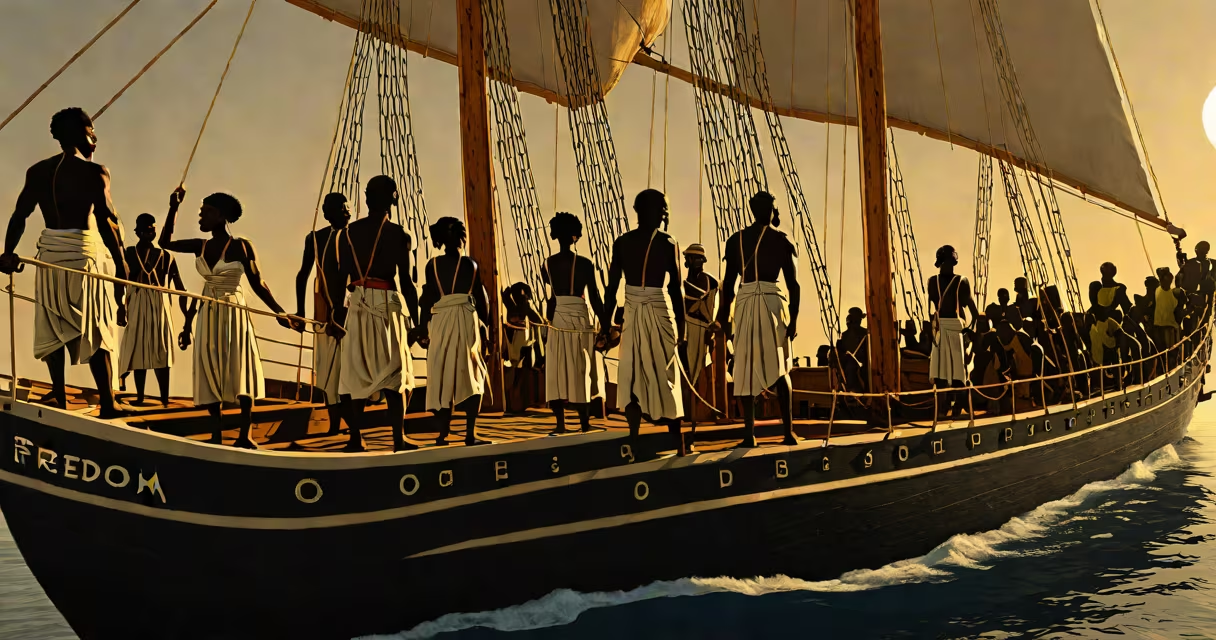
The back to Africa movement was a 19th-century effort to resettle freed African Americans and Afro-descendants in Africa, primarily in Liberia and Sierra Leone, driven by ideals of racial uplift, self-determination, and escape from systemic oppression in the United States.
Rooted in the early 1800s, the movement gained traction among free Black communities and white abolitionists who believed that racial equality in America was unattainable. The American Colonization Society (ACS), founded in 1816, promoted the idea that African Americans would thrive better in Africa, where they could build independent lives away from American racism. By 1822, the ACS had established Monrovia, the capital of Liberia, as a settlement for freed slaves.
While the movement claimed humanitarian goals, it was criticized for promoting racial separation and ignoring the lived realities of Black people in the U.S. Many African Americans rejected the idea of leaving their homeland, especially those born in America. The movement's legacy remains complex-celebrated by some as a step toward Black agency, dismissed by others as a form of racial displacement disguised as liberation.
Settlements were established through a mix of private funding, government grants, and religious sponsorship. The ACS raised money from Northern philanthropists and state legislatures to finance ships, supplies, and land acquisition. Between 1820 and 1867, approximately 12,000 African Americans emigrated to Liberia, most arriving between 1830 and 1850.
Emigrants underwent medical screening and religious instruction before departure. They were promised land, protection, and political rights. However, conditions in Liberia were harsh-tropical diseases, poor infrastructure, and conflicts with indigenous populations led to high mortality rates. By 1850, only about 40% of settlers survived the first five years.
Despite these challenges, some settlers formed local governments and schools. The Republic of Liberia declared independence in 1847, becoming the first African republic founded by African-descended people. Yet internal power struggles and economic dependence on the U.S. limited long-term autonomy.
The back to Africa movement wasn't monolithic. Different groups pursued distinct visions:
| Type | Core Belief | Key Location | Outcome |
|---|---|---|---|
| American Colonization Society (ACS) | Racial separation as path to dignity | Liberia | Settled ~12,000; high mortality; colonial dependency |
| Free Black-led Initiatives | Self-determined return, cultural sovereignty | Sierra Leone, later Ethiopia | Smaller scale; greater community control |
| Religious Missions | Christian salvation and nation-building | Liberia, Cape Coast | Established churches and schools; limited political power |
The ACS often excluded Black voices from leadership. Most colonists were selected by white officials, and few had input in governance. In contrast, later movements like Marcus Garvey's Universal Negro Improvement Association (UNIA) in the 1920s revived the idea with stronger Black nationalist messaging, though Garvey's proposed shipping line to Africa never launched.
Many assume the back to Africa movement was universally supported by African Americans. In reality, opposition was widespread. Frederick Douglass, a prominent abolitionist, condemned the ACS as a scheme to remove Black citizens from the U.S. rather than confront racism. He argued that freedom meant fighting for rights at home, not fleeing.
Another myth is that all emigrants were enslaved people freed by law. In fact, most were free-born or purchased their freedom. About 80% of emigrants were from free states like Pennsylvania and New York, not the South. Their motivations varied: some sought escape from violence, others believed in building a new nation.
A lesser-known fact: Liberia's founding leaders were largely American-born. They imposed English legal systems, Christian institutions, and Western dress codes-often marginalizing indigenous Africans. This created tensions that persist today. According to the Council on Foreign Relations, Liberia's civil conflicts in the 1990s were partly rooted in this legacy of exclusion.
James Forten, a free Black man from Philadelphia, exemplifies the complexity of the movement. Born in 1766, he served in the Revolutionary War and became a successful sailmaker. In 1816, he met with ACS leaders and expressed cautious support for colonization, believing it offered a chance for Black advancement.
Yet Forten refused to emigrate himself. He wrote in a letter: "I am not willing to leave my country, nor my people, to go to a place where I may be a stranger." His stance reflected a growing sentiment among urban Black communities: the fight for justice belonged in America, not abroad.
Forten's position helped shape the anti-colonization wing of the Black press. Newspapers like The Freedom's Journal (founded 1827) opposed the ACS, arguing that African Americans deserved equal rights in the U.S., not exile.
The back to Africa movement influenced later Pan-Africanism and Black nationalism. Figures like W.E.B. Du Bois and Kwame Nkrumah cited Liberia as a symbolic model, though they rejected its colonial structure. Today, the movement is studied as a key moment in transatlantic Black history.
Some modern initiatives draw inspiration from it. For example, the African Diaspora Repatriation Project, launched in 2019 by the African Union, aims to help voluntary returns for descendants of enslaved people. As of 2023, over 1,200 individuals have applied under the program, though only 14% were approved due to documentation and citizenship hurdles.
Understanding the back to Africa movement requires acknowledging both its idealism and its limitations. It was not a unified project, nor was it purely altruistic. Its impact lies in forcing a conversation about belonging, identity, and the meaning of freedom-questions still relevant today.