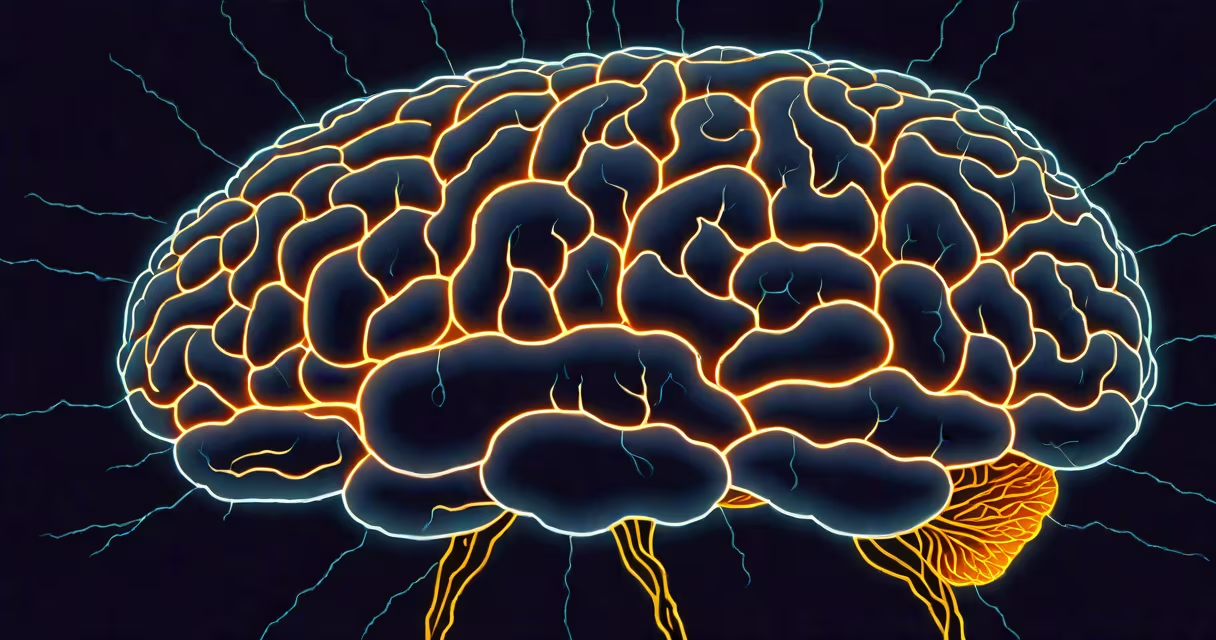
Being conscious meaning refers to the internal, subjective experience of awareness-what it feels like to perceive, think, or feel. It is the difference between merely processing information and actually experiencing it. This distinction separates a computer running a simulation of pain from a person who truly feels it.
Consciousness arises when sensory input, memory, and attention converge in the brain to create a unified sense of self and environment. The neural basis lies primarily in the cerebral cortex, especially the prefrontal and parietal regions. When these areas fire in coordinated patterns, they generate the inner world of thoughts, emotions, and sensations.
For example, when you touch a hot stove, your nervous system sends signals to the spinal cord and brain. Without consciousness, this would be a reflexive withdrawal. With consciousness, you also feel the sharp burn-the pain is not just processed, it is experienced. That feeling is being conscious meaning.
Consciousness is not a single process but a changing integration of multiple brain functions. It requires sustained attention, working memory, and the ability to maintain a coherent narrative of events. Damage to key areas like the thalamus or posterior cortical regions can disrupt this integration, leading to loss of awareness even when basic bodily functions remain intact.
Neuroscientists use EEG and fMRI scans to track changes in brain activity during states of wakefulness, sleep, and anesthesia. During deep sleep or under general anesthesia, brain waves slow and lose coherence. When consciousness returns, high-frequency gamma waves reappear across widespread cortical networks. These patterns correlate strongly with conscious experience, though they do not prove causation.
A notable study by Koch and Tononi (2015) proposed the Integrated Information Theory (IIT), which suggests that consciousness emerges when a system generates information that cannot be reduced to its parts. A smartphone screen displays images, but the individual pixels don't "know" they're part of a picture. The whole system does. According to IIT, consciousness correlates with the amount of integrated information-measured as Φ (phi)-in a network.
Consciousness isn't binary. It exists on a spectrum, ranging from minimal awareness to full self-reflection. The following table outlines major categories:
| Type | Description | Example |
|---|---|---|
| Basic Awareness | Simple perception without self-reference. Responds to stimuli but lacks introspection. | A dog noticing a sound and turning its head. |
| Phenomenal Consciousness | Subjective experience-what it feels like to be in a state. Not about reporting, but feeling. | Feeling the warmth of sunlight on skin. |
| Access Consciousness | Information available for verbal report, reasoning, and action control. | Knowing your phone number and being able to recite it. |
| Self-Consciousness | Reflective awareness of oneself as a continuous entity across time. | Thinking, "I was sad yesterday, and I'm still sad today." |
These types are not mutually exclusive. A person can have access consciousness without self-consciousness-for example, during a dream where they act but don't reflect on their identity.
Many assume consciousness is a byproduct of complexity. But a highly complex machine-like a supercomputer simulating a human brain-would not necessarily be conscious. The simulation might behave identically, but it wouldn't feel anything. This is known as the "zombie argument": a being that acts like a conscious person but lacks inner experience.
Another error is equating awareness with intelligence. A chess-playing AI can analyze millions of positions per second yet has no idea what a move "feels" like. Intelligence is about processing; consciousness is about experiencing.
There's also confusion between being awake and being conscious. A person in a coma may have normal brain wave patterns but no awareness. Conversely, someone in a lucid dream is both awake and conscious-but not in the physical world. Being conscious meaning includes both waking and dreaming states.
Understanding being conscious meaning matters in medicine, ethics, and artificial intelligence. In clinical settings, assessing consciousness in patients with brain injuries remains challenging. Tools like the Coma Recovery Scale-Revised (CRS-R) measure responses to commands, eye movements, and vocalizations. Yet even with clear signs of awareness, families often struggle to accept that a patient is conscious but unable to communicate.
In animal welfare, researchers debate whether non-human animals possess subjective experiences. Evidence from primates, dolphins, and octopuses suggests they exhibit behaviors consistent with pain, fear, and pleasure. For example, octopuses avoid electric shocks even when no reward follows-indicating avoidance based on internal sensation, not just reflex.
I once observed a cat in a veterinary clinic flinch and recoil when a vet touched its paw. The cat didn't just pull away-it tensed, hissed, and stared with wide eyes. That moment wasn't just reaction. It was evidence of being conscious meaning: the cat felt something, and reacted with emotional awareness.
Being conscious meaning differs from mere cognition. Cognition involves processing-calculating, recognizing, planning. Consciousness adds the dimension of qualia: the raw, personal quality of experience. Red is red not because of wavelength, but because of how it feels to see red.
Philosophers call this the "hard problem"-why and how subjective experience arises from physical processes. David Chalmers (1995) argued that even if we explain all brain functions, we still haven't answered why there's a "what it's like" to be alive. This gap persists despite advances in neuroscience.
One non-obvious fact: people can be conscious without being aware of their own consciousness. In blindsight, patients with damage to the visual cortex claim they see nothing, yet can accurately guess the location of objects they report not seeing. Their brains process visual cues unconsciously, but the information never reaches awareness. This shows that perception and consciousness are separate systems.