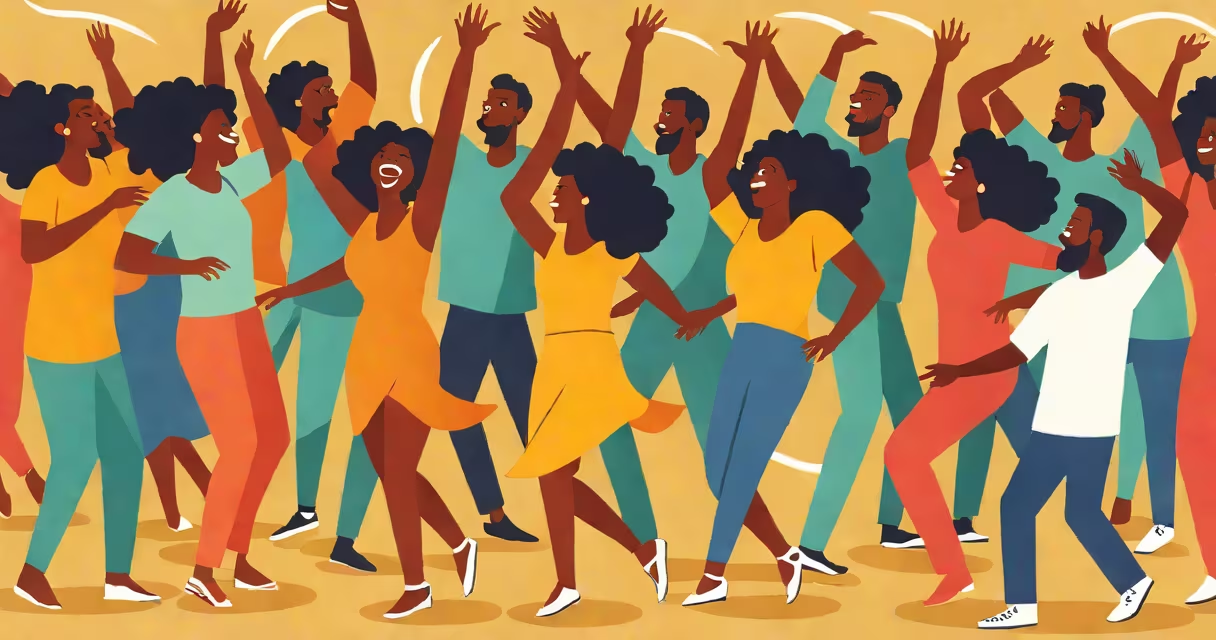
Dancing is the physical expression of rhythm through coordinated movement, accessible to everyone regardless of training or style. It requires no formal instruction to begin - only the willingness to move with music.
At its core, dancing involves synchronizing body motion with a musical beat. This can be as simple as tapping feet to a song's tempo or as complex as performing choreographed routines. The act itself is not limited to performance stages - it happens in kitchens, gyms, weddings, and street corners worldwide.
Neuroscience confirms that humans are biologically wired for rhythmic movement. A 2019 study published in Nature Human Behaviour found that infants as young as six months show spontaneous motor responses to rhythmic sounds, suggesting innate neural pathways for dance-like behavior. This means the capacity to dance exists in all people from birth.
Dance functions through the integration of sensory input, motor control, and emotional response. When music plays, auditory signals travel to the brain's motor cortex, which coordinates muscle activity to match the rhythm. This process occurs automatically in many cases - even without conscious effort.
For example, hearing a drumbeat at 120 beats per minute triggers a natural urge to tap one's foot or sway side to side. The brain interprets the pattern and generates a matching motor output. This is why people often start moving without thinking during a song they like.
More advanced forms of dance involve learning sequences, spatial awareness, and timing. Ballet dancers rehearse hundreds of hours to execute precise movements. Street dancers master complex footwork and freezes. But both rely on the same fundamental mechanism: body-music synchronization.
Dance styles vary widely in structure and intent. Some emphasize form and precision; others focus on improvisation and emotional release. The following table outlines common categories and their core demands:
| Type | Key Features | Required Skill Level |
|---|---|---|
| Freestyle | Spontaneous movement to music; no set steps | Beginner (anyone can do it) |
| Ballroom | Partnered, structured patterns; precise footwork | Intermediate to advanced |
| Urban/Street | High-energy, improvisational, often solo | Intermediate (some foundational moves needed) |
| Ballet | Formal technique, alignment, turnout | Advanced (years of training required) |
Most people assume dance requires a certain body type, flexibility, or prior training. This is false. Freestyle dancing - the most common form - requires nothing beyond the ability to feel rhythm and move your limbs.
Dance serves multiple roles across cultures. In West African communities, drumming and dance are central to rituals marking births, deaths, and harvests. In Japan, traditional dances like bon odori are performed during summer festivals to honor ancestors. In urban centers, dance floors at clubs serve as social spaces where people connect through shared movement.
Research from the American Psychological Association shows that dancing reduces cortisol levels - the stress hormone - by up to 20% after just 15 minutes of continuous movement. This effect is consistent across age groups and fitness levels.
One personal observation: during a visit to a community center in Oakland, I watched a group of seniors perform a line dance to a 1980s pop song. Their movements were unpolished, some stumbled, but their laughter and smiles were unmistakable. That moment confirmed what science supports: dance is not about perfection - it's about presence.
Many people believe they "can't dance" because they lack coordination or fear judgment. This belief stems from equating dance with performance. But performance is just one mode of dance. Most dancing happens privately, in bathrooms, cars, or living rooms - and it doesn't require an audience.
A key distinction: being able to dance is not the same as being able to perform. You don't need to master the moonwalk to qualify as a dancer. The ability to move in time with music defines the practice, not technical mastery.
Another misconception is that dance is only for the young. Data from the U.S. Bureau of Labor Statistics shows that adults aged 65 and older participate in dance activities at rates comparable to younger demographics - especially in group settings like senior centers and wellness programs.
In many Black churches across the southern United States, congregants engage in a ritual known as the clap dance. Participants stand in a circle, clap in sync with a preacher's call-and-response chant, and move their bodies in unison. The rhythm is simple - four beats per measure - but the collective energy is useful.
This form of dance requires no steps, no mirror, no instructor. It relies solely on listening, timing, and communal participation. According to The Journal of Religion and Health, such practices improve mental well-being and strengthen group cohesion among attendees.
When someone asks, "Can you dance?" the answer is not "Only if you're trained." The answer is yes - if you can hear a beat and move your body in response.
Even if you've never taken a class, danced in public, or seen a stage performance, you already possess the essential tools. Your body responds to rhythm instinctively. All you need is music and permission to move.
Anyone can dance. The question isn't whether you have the skill - it's whether you're ready to move.