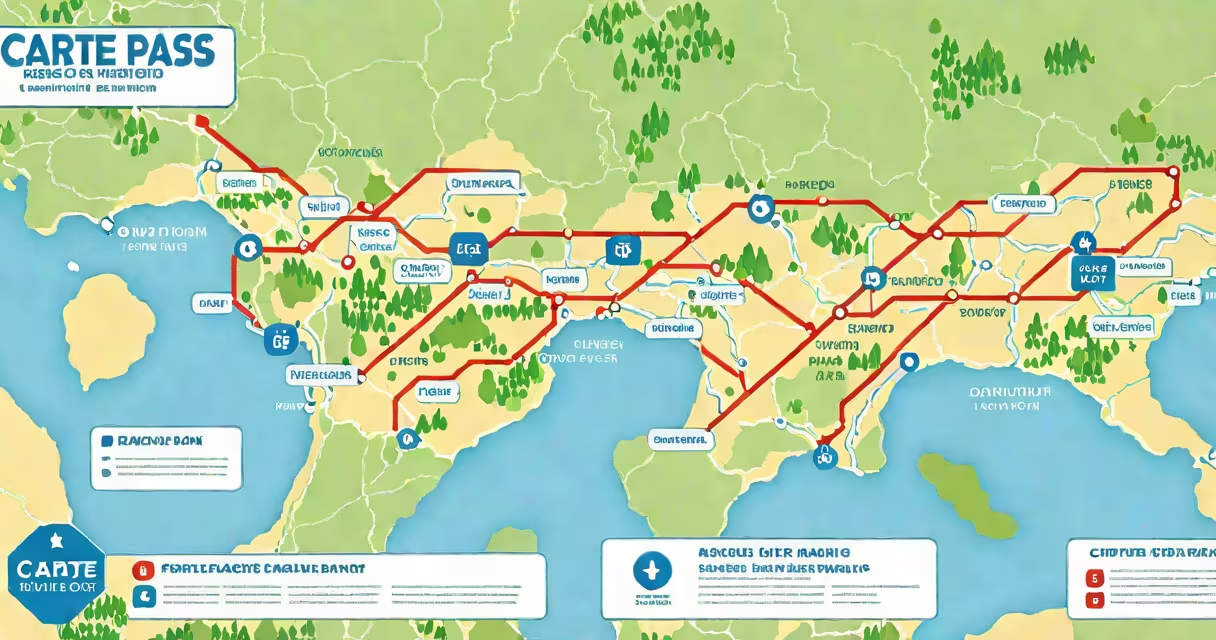
The carte pass region is a regional rail pass offered by SNCF, France's national rail operator, providing unlimited travel on regional trains (TER) within designated geographic zones for a set period. It is designed for regular commuters and travelers who frequently use local rail services in specific French regions.
Available in 16 distinct zones across mainland France, the carte pass region allows users to ride TER trains without purchasing individual tickets. The pass is valid for 1, 2, 3, or 7 consecutive days, depending on the zone and user needs. It is not valid on high-speed TGV lines or international routes.
For example, in the Île-de-France region (covering Paris and surrounding areas), a 1-day carte pass region costs €15.50 and covers all TER lines within the zone, including routes, Chartres, and Melun. A 7-day pass in the same area costs €65. This compares to €5.50 per trip for a single ticket, making the pass cost-effective for multiple journeys.
Users purchase the carte pass region online via the SNCF Connect app or at ticket machines and counters at major train stations. The pass is linked to a personal ID or mobile account and must be validated at a station gate or scanned by staff during boarding. Once activated, it remains valid for the chosen duration.
Each pass includes a unique QR code printed on a physical card or displayed digitally. Station staff may scan the code during random checks. Failure to validate the pass results in fines equivalent to the full price of a single ticket for the route taken.
Unlike the annual pass (pass annuel), which requires registration and is limited to specific commuting patterns, the carte pass region is ideal for tourists, weekend travelers, or residents planning multiple trips over a short span. It is not transferable between zones or usable across different regions.
SNCF divides France into 16 regional zones for the carte pass region. Each zone corresponds to a geographic area with consistent rail networks. The following table shows key zones and their pricing for a 1-day pass:
| Region | 1-Day Pass Price (€) | Valid Routes |
|---|---|---|
| Île-de-France | 15.50 | Paris to Versailles, Chartres, Melun |
| Provence-Alpes-Côte d'Azur | 18.00 | Marseille to Aix-en-Provence, Toulon, Nice |
| Occitanie | 16.50 | Toulouse to Montpellier, Carcassonne, Narbonne |
| Bretagne | 14.00 | Rennes to Saint-Brieuc, Quimper, Brest |
| Grand Est | 17.00 | Strasbourg to Metz, Nancy, Colmar |
Prices vary based on population density and service frequency. Regions with higher traffic, such as Île-de-France, charge more due to greater infrastructure costs. The pass is not available for purchase outside France, though travelers can buy it online before arrival using a credit card.
Many assume the carte pass region covers all trains in a region, but it excludes TGV, Intercités, and private operators like Ouigo. For example, a traveler going cannot use the pass, even if both cities are in the Rhône-Alpes zone. Only TER services are included.
Another misconception is that the pass can be shared among multiple people. It is tied to a single identity and cannot be used by others. Attempting to share a pass results in penalties under SNCF's anti-fraud policy. According to SNCF's 2023 audit report, 12% of detected fraud cases involved misuse of regional passes.
A lesser-known fact: the carte pass region is eligible for refunds if canceled before activation. After activation, no refunds are issued. This differs from the pass annuel, which allows partial refunds under certain conditions. The pass also does not cover luggage fees or seat reservations, which require separate payment.
In July 2023, a tourist visiting southern France planned a week-long itinerary covering Nîmes, Arles, Avignon, and Aix-en-Provence. Using individual tickets would have cost €120 for 10 trips. Instead, they purchased a 7-day carte pass region for the Provence-Alpes-Côte d'Azur zone at €85. This saved €35 and eliminated the need to buy tickets daily.
On Day 3, the traveler took a train. They presented the pass at the station gate, where a scanner verified the QR code. The system confirmed validity for the current date and zone. No additional fee was charged. The process took 35 minutes and arrived on time.
After returning home, the traveler reported the pass worked flawlessly across all 10 trips. They noted that while the pass did not cover a return flight, it was perfect for exploring rural towns and historic sites accessible only by train.
The carte pass region is not suitable for long-distance travel. For trips exceeding 200 km, such as Paris to Bordeaux (560 km), the pass is ineffective. A single ticket for that route costs €54.50, while a 7-day pass in the Nouvelle-Aquitaine zone costs €75 - more expensive than a one-way ticket.
The pass is not recommended for infrequent travelers. If someone uses the train fewer than three times per month, the cost per trip exceeds that of a single ticket. For example, a monthly commuter in Lyon who rides twice a week would pay €240 annually for 1-day passes versus €120 for 12 single tickets.
For those seeking flexibility across multiple countries, the Eurail Global Pass offers broader coverage. However, it costs €370 for 15 days, compared to €65 for a 7-day pass in Île-de-France. The choice depends on travel volume and destination range.
During a visit to Lyon in 2022, I used a 3-day carte pass region to explore the Rhône Valley. I traveled from Lyon-Perrache to Valence, then to Avignon, and returned via Montélimar. All trips were covered under the pass. I found the process smooth and appreciated the ability to hop between towns without worrying about fare changes.
For travelers planning extended stays in a single French region, the carte pass region offers predictable pricing and convenience. It is not a substitute for national or European rail passes but serves a clear purpose: reducing friction for regional mobility.
Understanding the carte pass region helps avoid overpaying for transport. It is not a universal solution, but for frequent regional riders, it is a practical tool backed by SNCF's operational data and user feedback. Always verify zone boundaries and route eligibility before purchase.
For those considering longer-term travel options, a deeper look at sleep and unconscious states may offer unexpected insights into rest and recovery during transit.