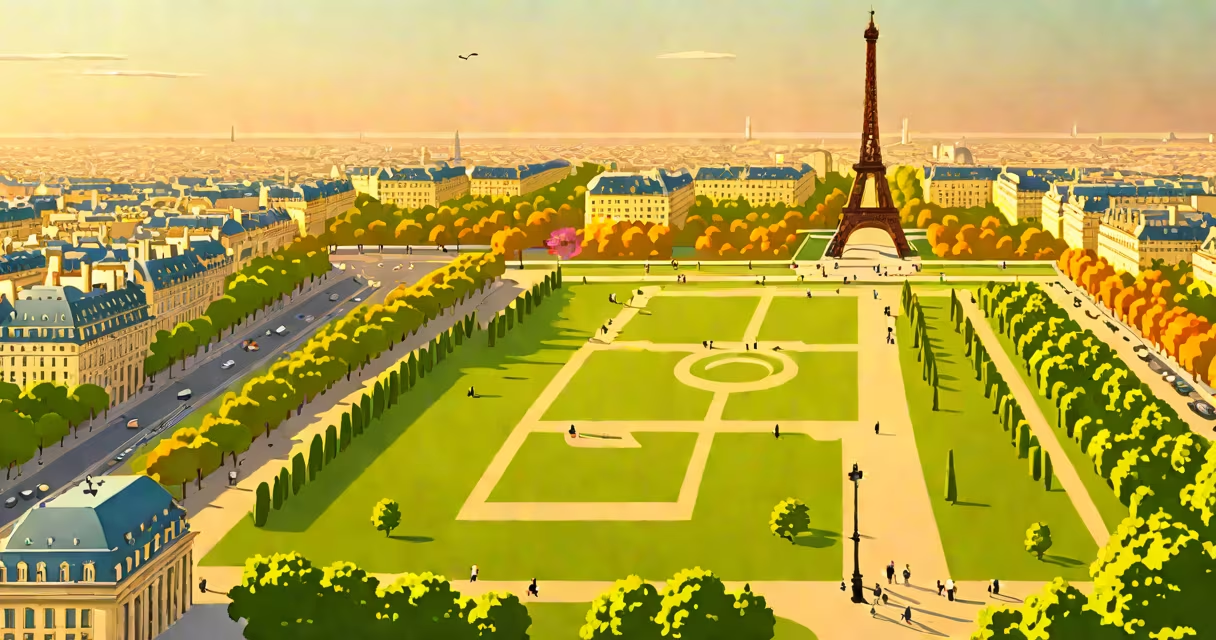
The Champ de Mars is a vast public park in Paris, located at the base of the Eiffel Tower, originally designed as a military parade ground and now serving as a central recreational and ceremonial space. It spans 25 hectares and hosts millions of visitors annually, especially during summer events and national celebrations.
Originally laid out in 1787 under King Louis XVI, the Champ de Mars was intended as a training ground for French military forces. The name translates literally to "Field of Mars," referencing the Roman god of war. After the French Revolution, it became a site for public gatherings, including the 1791 Festival of Federation, where thousands assembled to celebrate national unity. The park's current layout dates from the 1867 Exposition Universelle, when field architect Alphand redesigned it with formal paths and tree-lined avenues.
Today, the Champ de Mars functions as both a green space and a cultural stage. It hosts outdoor concerts, art installations, and public festivals such as the annual Bastille Day fireworks display. The park's flat terrain and panoramic views make it ideal for photography, picnicking, and casual strolls. Visitors often walk from the Seine Riverbanks to the Eiffel Tower via the park's wide promenades.
The park is accessible via multiple entrances along Avenue de la Bourdonnais, Avenue General Leclerc, and Rue de l'Université. Main access points include the Porte Maillot entrance and the area near the Eiffel Tower's base. The park is open daily from 7 a.m. to midnight, with extended hours during major events.
Pathways radiate from the center toward the Eiffel Tower, creating natural sightlines. The southern edge features a grassy expanse where people lay blankets for sunbathing or watching the tower's nightly light show. A small fountain near the eastern side marks the original location of the 1889 World's Fair pavilion. The park is also home to several benches, trash bins, and free Wi-Fi zones.
During peak seasons, security checks are conducted at the Eiffel Tower's entrance, which leads through the park. Visitors must pass through metal detectors and bag inspections before reaching the tower's base. This flow ensures crowd control and safety, particularly during holidays and large-scale events.
The Champ de Mars includes distinct zones based on function and design:
| Zone Type | Features | Common Use |
|---|---|---|
| Central Lawn | Open grass, trees, benches | Picnics, relaxation, photography |
| Eastern Promenade | Tree-lined path, lighting, sculptures | Evening walks, event staging |
| Western Entry Zone | Security checkpoints, ticket kiosks | Access to Eiffel Tower and exhibitions |
| South Garden | Flowerbeds, seasonal displays | Photography, floral events |
One lesser-known feature is the underground tunnel beneath the park's western edge, originally constructed for drainage and utility lines. It runs from the Seine to the Eiffel Tower's foundation and remains sealed to the public. The tunnel's existence is documented in city archives and confirmed by urban planning reports from the City of Paris.
The Champ de Mars is a primary venue for national events. France's Bastille Day celebrations, held on July 14, draw over 1 million attendees annually. Fireworks are launched from the park's south end, visible across the city. The event is broadcast live on national television and draws tourists from around the world.
It also serves as a backdrop for international diplomacy. Heads of state have addressed crowds here during state visits. In 2015, President François Hollande hosted a summit meeting on climate change at the park's eastern edge, with delegates from 196 countries attending.
For locals, the park is a daily destination. Families gather on weekends, students study under trees, and couples stroll past the Eiffel Tower's iron lattice. During winter, the park hosts a temporary ice rink near the eastern entrance, operating.
Many assume the Champ de Mars is part of the Eiffel Tower complex. In reality, it is managed separately by the City of Paris's Parks and Gardens Department (Parcs et Jardins), while the Eiffel Tower itself is operated by the Société d'Exploitation de la Tour Eiffel (SETE).
A frequent error is confusing the Champ de Mars with the nearby Parc des Buttes-Chaumont. Though both are public parks in Paris, they differ in size, history, and geography. The Champ de Mars covers 25 hectares, while Parc des Buttes-Chaumont spans just 20 hectares and lies in the 19th arrondissement, nearly 5 kilometers away.
Another misconception is that the park is closed during Eiffel Tower maintenance. This is false. The park remains open year-round, even when the tower is undergoing structural work. However, certain pathways may be temporarily restricted during repairs.
In 2023, the Champ de Mars hosted 1.2 million people for the Bastille Day celebration. The event began at 9:30 p.m., with fireworks launched from the park's southern edge. The pyrotechnic display lasted 25 minutes and included synchronized music, colored bursts, and laser effects. Over 1,800 firework shells were fired from custom launch platforms installed in the park's grassy areas.
City officials reported no major incidents. Police presence was increased, with 450 officers deployed across the park and adjacent streets. Emergency medical teams were stationed at five locations. The event was streamed online to 14 million viewers worldwide.
After the fireworks, the park remained open until 1 a.m. for cleanup crews. Trash collection was completed by 3 a.m., and the park reopened at 7 a.m. the next day.
I visited the Champ de Mars during a spring weekend in 2022. I arrived at 10 a.m. and found the southern lawn packed with families and tourists. A group of schoolchildren from Marseille was conducting a history lesson on the 1889 Exposition, using the Eiffel Tower as a visual aid. I watched them sketch the structure and compare it to old engravings. Later, I walked the eastern path and saw a street musician playing accordion near the fountain-his performance drew a small crowd, though no tips were collected. The atmosphere felt quiet, orderly, and deeply embedded in Parisian life.