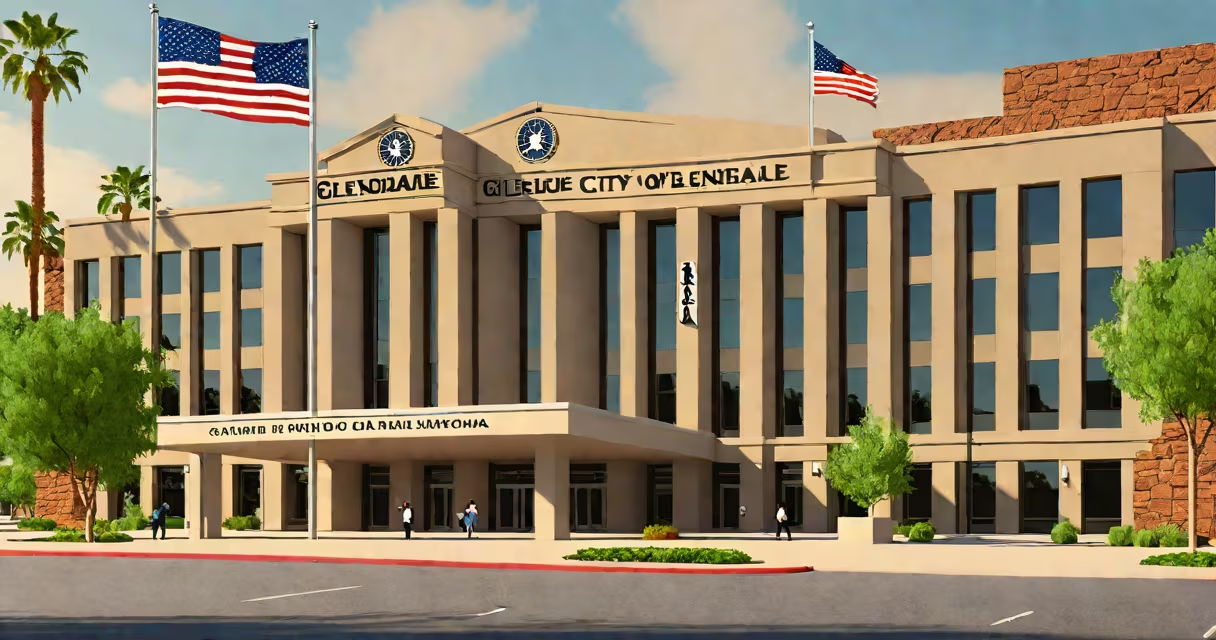
The city of Glendale Arizona is a municipal corporation located in Maricopa County, serving over 270,000 residents across 62 square miles. It operates under a council-manager form of government, providing local services including public safety, parks, transportation, and zoning regulation.
Glendale functions as a self-governing entity with authority to pass ordinances, levy taxes, and manage city-owned assets. Its jurisdiction includes land use planning, street maintenance, emergency response coordination, and administration of city facilities such as libraries, recreation centers, and the Glendale Municipal Airport. The city's boundaries extend from the Gila River to the Phoenix metropolitan core, placing it within the larger Sun Corridor region.
City government is structured around a five-member city council elected by district, who set policy and approve the annual budget. A professional city manager oversees daily operations, implementing decisions and managing departments like Public Works, Police, and Finance. This separation ensures political neutrality in administrative execution.
City of Glendale Arizona runs through a combination of elected leadership and appointed administrators. The city council holds regular meetings every two weeks, open to public comment, where they vote on resolutions, contracts, and capital projects. Agendas and minutes are published online at glendaleaz.gov.
Each department reports to the city manager. For example, the Department of Public Safety manages the police and fire services, responding to 911 calls and conducting neighborhood patrols. In fiscal year 2023, the city allocated $148 million to public safety, including $62 million for police staffing and equipment.
Residents access city services via online portals, mobile apps, and in-person offices. The MyGlendale portal allows users to pay utility bills, report potholes, schedule park reservations, and apply for business permits. Over 80% of routine transactions are completed digitally, reducing wait times and administrative costs.
Glendale maintains a network of 1,200 miles of streets, 300 miles of storm drains, and 45 public parks. The city's stormwater system aims to handle 100-year rainfall events, based on data from the National Weather Service and the U.S. Geological Survey.
Public transportation is coordinated through Valley Metro, which operates 11 bus routes through Glendale. The city also hosts the Valley Metro Rail line, with stops at 59th Avenue and Camelback Road. Ridership increased 22% between 2020 and 2023, according to Valley Metro's annual report.
| Service | Annual Budget (FY2023) | Key Features |
|---|---|---|
| Police Department | $62 million | 120 sworn officers, community policing units |
| Parks and Recreation | $38 million | 45 parks, 12 recreation centers, youth programs |
| Public Works | $45 million | Street sweeping, snow removal, infrastructure repair |
| Fire Department | $41 million | 22 fire stations, 130 personnel, emergency medical response |
Water and wastewater services are managed by the City of Glendale Water Department, which treats 12 million gallons per day. The city uses recycled water for irrigation and industrial cooling, reducing demand on groundwater supplies. According to the Arizona Department of Environmental Quality, Glendale recycles 43% of its wastewater annually.
Some assume the city of Glendale Arizona is part of Phoenix due to proximity and shared regional identity. However, Glendale is a distinct municipality with its own charter, tax base, and legal authority. It was incorporated in 1918 and has maintained independent governance since.
Another confusion arises around the city's role in hosting major events. While Glendale is home to State Farm Stadium-the venue for Super Bowl LVII and the 2024 NCAA Men's Basketball Championship-it does not operate the stadium. That facility is owned and managed by the Arizona Sports and Tourism Authority, a state agency.
A lesser-known fact: Glendale was the first city in Arizona to adopt a formal climate action plan. The 2020 Glendale Climate Action Plan sets goals to reduce greenhouse gas emissions by 50% by 2030 and achieve net-zero carbon operations by 2050. The city has already installed solar panels on 32 public buildings, generating 1.8 megawatts of renewable energy.
In 2022, the city launched a $12 million project to replace 15,000 outdated streetlights with LED fixtures. The initiative reduced energy consumption by 60%, cut maintenance costs by $1.3 million annually, and improved nighttime visibility. Data from the city's Smart Lighting Dashboard showed a 27% drop in nighttime traffic incidents in the first year.
Residents reported feeling safer walking after dark. The project was funded through a federal grant administered by the U.S. Department of Energy's Better Buildings Initiative, which supports energy efficiency upgrades in municipalities.
I personally observed the rollout during a walk through the Avondale neighborhood in October 2022. The new lights emitted a crisp white glow, replacing the yellow haze of older bulbs. The difference in visibility was immediate-sidewalks were clearer, crosswalks more visible, and street signs easier to read.
Glendale shares regional responsibilities with neighboring cities through the Maricopa Association of Governments (MAG), a coalition that coordinates transportation, air quality, and emergency preparedness. MAG's 2023 Regional Transportation Plan includes funding for expanded light rail connectivity to Glendale.
Understanding the city of Glendale Arizona requires recognizing its autonomy, service scope, and long-term planning. It is not a suburb or a district-it is a functioning urban government with legal standing, financial independence, and direct accountability to its electorate.
Residents, businesses, and visitors interact with the city of Glendale Arizona through defined channels: city websites, call centers, in-person offices, and public forums. Engagement is encouraged through advisory committees, citizen surveys, and participatory budgeting pilots.
For official information, contact the City of Glendale's main office at 602-732-2200 or visit glendaleaz.gov. All data referenced here comes from publicly available city documents, state environmental reports, and federal grant records.