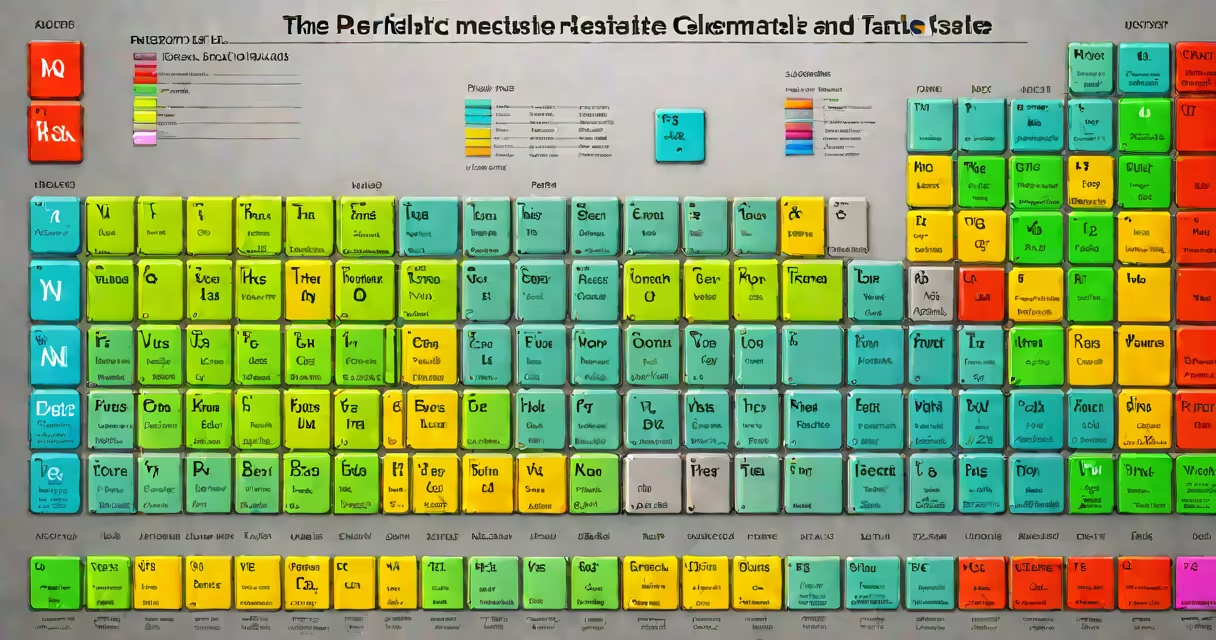
The classification of elements the periodic table arranges all known chemical elements into groups based on recurring patterns in their physical and chemical properties. Elements are organized by increasing atomic number, revealing trends in reactivity, electronegativity, and electron configuration across rows (periods) and columns (groups).
This systematic layout was developed by Dmitri Mendeleev in 1869, who left gaps for undiscovered elements and predicted their properties with notable accuracy. Today's periodic table contains 118 confirmed elements, each occupying a unique position determined by its proton count. The arrangement reflects the underlying structure of atoms-the number of protons defines the element, while the distribution of electrons governs its chemical behavior.
Elements are grouped into three broad categories: metals, metalloids, and nonmetals. Metals dominate the left and center of the table, making up about 80% of all elements. They typically conduct heat and electricity, are malleable, and form cations in reactions. Nonmetals appear on the upper right, including familiar substances like oxygen, nitrogen, and sulfur. Metalloids-elements such as silicon and arsenic-form a diagonal boundary between metals and nonmetals and exhibit mixed properties.
Each horizontal row (period) corresponds to a new principal energy level. As you move across a period, atomic radius decreases due to increasing nuclear charge pulling electrons closer. Ionization energy increases, and electronegativity rises, influencing how readily an atom gains or loses electrons.
Vertical columns (groups) contain elements with similar valence electron configurations. For example, Group 1 (alkali metals) all have one electron in their outermost shell, leading to high reactivity and formation of +1 ions. Group 17 (halogens) have seven valence electrons and tend to gain one electron to achieve stability, forming -1 ions. This consistency in electron behavior explains why elements in the same group share chemical traits.
The periodic table is divided into blocks based on the subshell being filled: s-block (Groups 1-2), p-block (Groups 13-18), d-block (transition metals, Groups 3-12), and f-block (lanthanides and actinides). These blocks reflect the sequence of orbital filling according to the Aufbau principle. The d-block includes transition metals like iron, copper, and gold-elements valued for their catalytic activity, magnetic properties, and ability to form colored compounds.
Understanding the classification of elements the periodic table begins with recognizing the three primary categories:
| Category | Location on Table | Key Properties | Examples |
|---|---|---|---|
| Metal | Left and center | Shiny, conductive, malleable, lose electrons easily | Sodium (Na), Iron (Fe), Gold (Au) |
| Metalloid | Diagonal line between metals and nonmetals | Intermediate conductivity, variable reactivity | Silicon (Si), Germanium (Ge), Arsenic (As) |
| Nonmetal | Upper right | Dull appearance, poor conductors, gain electrons | Oxygen (O), Chlorine (Cl), Carbon (C) |
Within these categories, further subdivisions exist. Alkali metals (Group 1) react violently with water. Alkaline earth metals (Group 2) are less reactive but still form stable +2 ions. Transition metals (d-block) often display multiple oxidation states-iron can be Fe²⁺ or Fe³⁺-which enables complex chemistry in biological systems like hemoglobin.
A non-obvious distinction: not all elements in the same group behave identically. For instance, fluorine (F) is highly reactive and toxic, while iodine (I) is less reactive and essential for thyroid function. This variation arises from differences in atomic size and bond strength across the group. Fluorine's small size leads to strong bonds with other atoms, making it aggressive in reactions.
Many assume that all metals are solid at room temperature. But mercury (Hg), a metal in Group 12, is liquid. Its low melting point (−38.8°C) results from weak metallic bonding due to relativistic effects on its electrons-this is a rare exception that highlights how electron configuration influences macroscopic properties.
Another misconception: metalloids are always semiconductors. While silicon and germanium are widely used in electronics, tellurium-a metalloid-is actually a poor conductor and is used in thermoelectric devices. The term "semiconductor" applies only to specific metalloids under certain conditions.
Some confuse the periodic table's structure with a random grid. In reality, the spacing and placement reflect quantum mechanical principles. The periodicity of properties emerges because electron shells fill in predictable sequences. When a shell fills, the next element begins a new period-this pattern repeats every 8 elements in the early table, aligning with the octet rule.
The classification of elements the periodic table enables predictive chemistry. For example, knowing that gallium (Ga) is in Group 13 and Period 4 allows scientists to anticipate its properties: low melting point (29.8°C), amphoteric oxide, and tendency to form Ga³⁺ ions. This prediction guided its use in semiconductors and LED manufacturing.
In medicine, understanding element classification aids drug design. Platinum-based drugs like cisplatin exploit the reactivity of transition metals to bind DNA and inhibit cancer cell division. The choice of platinum over other metals stems from its ability to form stable coordination complexes-predicted by its position in the d-block.
I once observed a classroom experiment where students tested the conductivity of various elements. A piece of graphite (carbon, a nonmetal) conducted electricity, surprising those expecting insulators. This demonstrated that exceptions exist even within broad categories-graphite's delocalized electrons allow conduction despite carbon's classification as a nonmetal.
The classification of elements the periodic table remains central to chemistry, providing a structure for discovery, innovation, and education. Its power lies not just in organizing known elements but in guiding the search for new ones and predicting their behavior.