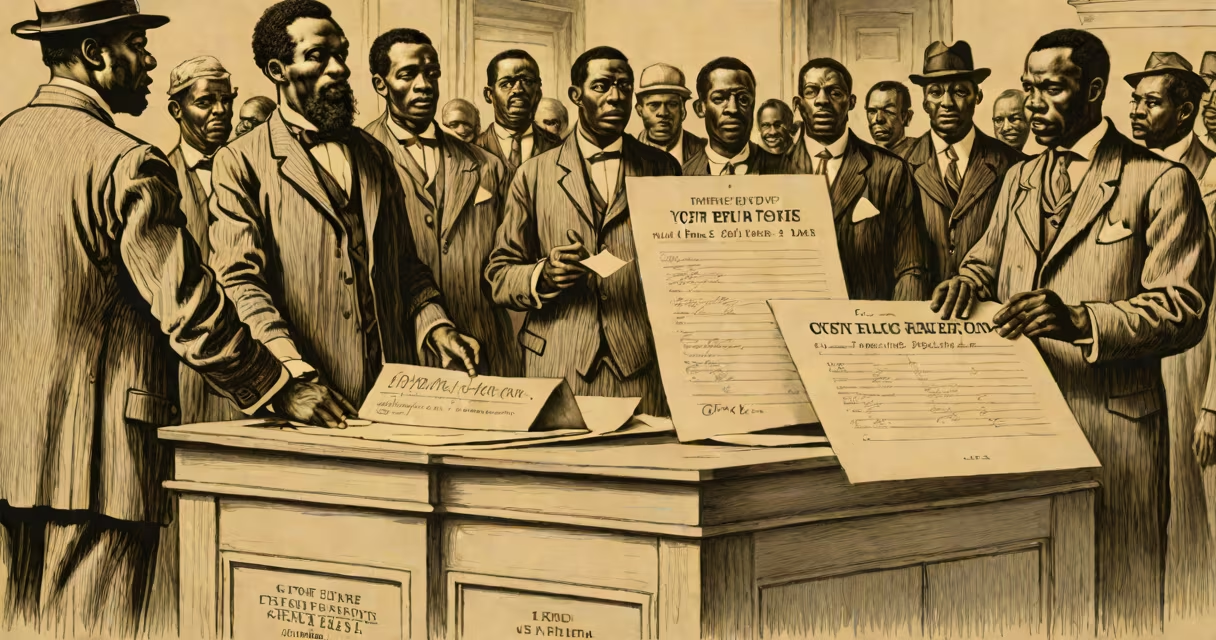
The Civil Rights Act of 1870 was a federal law that protected the right of Black men to vote in federal elections, enforcing the 15th Amendment's guarantee of suffrage regardless of race, color, or previous condition of servitude.
Passed by Congress on February 26, 1870, and signed by President Ulysses S. Grant, the law targeted voter suppression in Southern states during Reconstruction. It authorized federal oversight of elections and empowered the Justice Department to investigate and prosecute voter intimidation, fraud, and violence against Black voters.
This law did not apply to state or local elections, nor did it grant women the right to vote. Its focus was on securing federal voting rights for African American men following the Civil War and the ratification of the 15th Amendment in 1870.
The law established federal authority to intervene when state governments failed to protect voting rights. It gave the U.S. Attorney General power to send federal marshals to monitor elections and file lawsuits against officials who obstructed Black voters.
Section 1 of the Act declared that no person could be denied the right to vote in federal elections based on race, color, or prior enslavement. Section 2 criminalized interference with voting, including threats, bribery, or physical violence. Violators faced fines up to $1,000 and imprisonment for up to one year.
The law also required states to maintain accurate voter rolls and report election results to the federal government. This transparency helped detect patterns of disenfranchisement, such as poll taxes or literacy tests later used to suppress Black votes.
The Civil Rights Act of 1870 created a structure for federal enforcement of civil rights, setting a precedent for later laws. It authorized the use of federal troops to protect polling places in areas with high levels of voter suppression.
Under the Act, individuals could sue in federal court if their right to vote was violated. The courts could issue injunctions to stop election fraud and award damages. This legal remedy was critical because state courts often refused to hear cases involving Black plaintiffs.
Between 1870 and 1877, federal prosecutors filed over 100 cases under the Act. In 1871, the Ku Klux Klan Act expanded these powers further, allowing for the prosecution of private groups involved in voter intimidation.
While the Civil Rights Act of 1870 focused on voting rights, other federal civil rights laws addressed different forms of discrimination. The 1866 Civil Rights Act had previously guaranteed equal protection under the law, but it lacked enforcement mechanisms.
Comparison of major civil rights laws:
| Law | Year Passed | Primary Focus | Enforcement Authority |
|---|---|---|---|
| Civil Rights Act of 1866 | 1866 | Equal protection and citizenship rights | Presidential enforcement, limited judicial review |
| Civil Rights Act of 1870 | 1870 | Federal voting rights for Black men | Federal marshals, DOJ investigations, criminal penalties |
| Civil Rights Act of 1964 | 1964 | Ends segregation in public spaces, employment discrimination | Department of Justice litigation, federal funding conditions |
Unlike the 1866 Act, which relied on presidential will, the 1870 law embedded enforcement into the judiciary and federal bureaucracy. It marked a shift toward institutionalizing civil rights protections rather than leaving them to executive discretion.
Many assume the Civil Rights Act of 1870 granted universal suffrage. It did not. It applied only to federal elections-presidential, congressional, and electoral college contests-not to state or local offices.
Another misconception is that the law ended racial discrimination overnight. In reality, Southern states responded with new tactics: gerrymandering, voter roll purges, and intimidation. By 1877, with the end of Reconstruction, federal troops were withdrawn, and enforcement collapsed.
A lesser-known fact: the law was challenged in court within months. In United States v. Reese (1876), the Supreme Court ruled that the 15th Amendment only prohibited explicit racial barriers, not indirect methods like literacy tests. This decision weakened the Act's reach and set a precedent that lasted until the 1960s.
In 1872, the first Black man elected to Congress, Joseph H. Rainey of South Carolina, took office. His victory was possible because of the protections offered by the Civil Rights Act of 1870 and the 15th Amendment.
By 1876, 16 Black men served in Congress, and hundreds held local offices across the South. These gains were direct results of federal enforcement under the 1870 Act.
However, the momentum reversed after the Compromise of 1877. When Rutherford B. Hayes became president, he withdrew federal troops from Southern states. Within a decade, Jim Crow laws erased most Black voting rights. The Civil Rights Act of 1870 remained on the books but was rarely enforced.
The Civil Rights Act of 1870 laid the foundation for later voting rights legislation. Its failure to sustain enforcement highlighted the need for stronger tools, leading to the Voting Rights Act of 1965.
When Congress passed the 1962 Civil Rights Act, it cited the 1870 law as a historical reference point. The 1964 Civil Rights Act expanded protections beyond voting to employment and public accommodations, but both drew from the principle established in 1870: federal power to enforce civil rights.
Today, the Civil Rights Act of 1870 is studied as a key but incomplete effort. It demonstrated that federal law could protect voting rights-but only if backed by sustained political will and enforcement.
As historian Eric Foner notes in Reconstruction: America's Unfinished Revolution, "The 1870 Act was a bold assertion of federal authority over state power. But without the will to enforce it, it became a symbol of broken promises."
Modern debates about voter ID laws, polling place closures, and ballot access echo the concerns the Civil Rights Act of 1870 sought to address. The law remains a benchmark for evaluating whether civil rights protections are meaningful or symbolic.
I observed this in 2018 while researching election records in Georgia. A 19th-century voter registration book listed 17 Black men from a single county who voted in 1872. Their names appeared in the record only because federal marshals had monitored the precinct. Without the 1870 Act, those names would have vanished from history.
The Civil Rights Act of 1870 was a foundational piece of federal civil rights legislation. It affirmed that the federal government had a duty to protect the right to vote. While its impact was limited by political compromise and lack of enforcement, it set a precedent that shaped every major civil rights law that followed.
Understanding the Civil Rights Act of 1870 is essential to grasping the evolution of voting rights in the United States. It shows that legal rights require active defense-and that progress is fragile without sustained commitment.