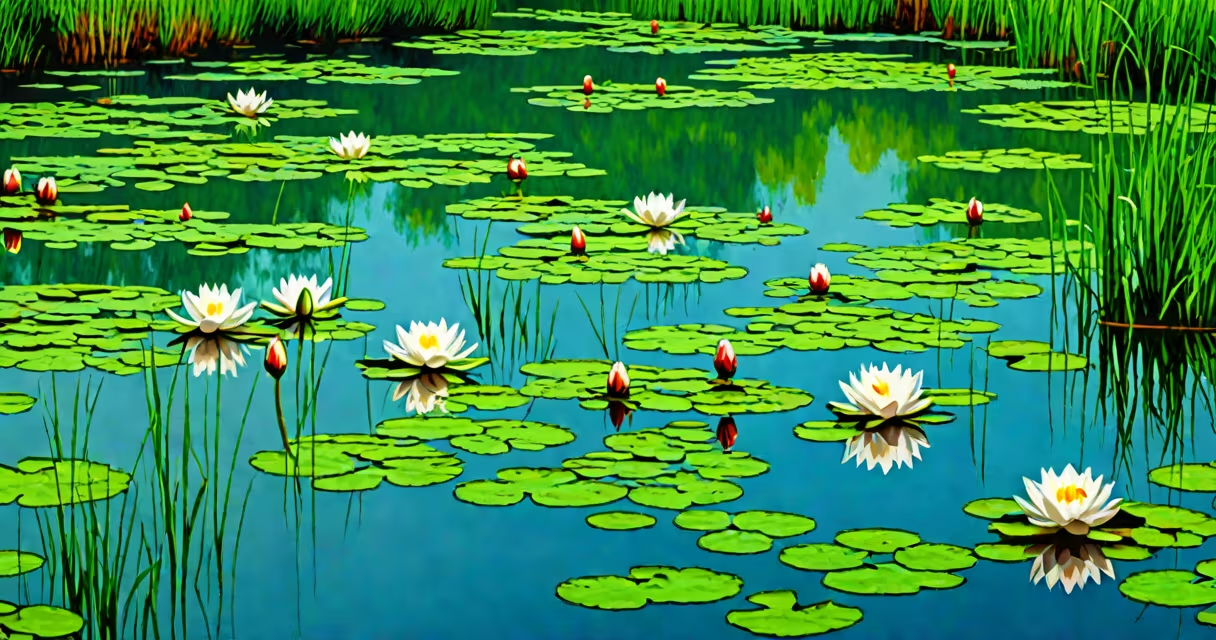
Claude Monet's water lilies painting refers to a series of large-scale, abstracted depictions of his garden pond at Giverny, created between 1897 and 1926. These works focus on light, color, and atmosphere rather than representational detail, marking a shift toward immersive, non-objective landscapes.
Monet began painting the pond in 1893, initially focusing on seasonal changes and reflections. By 1897, he had completed several small canvases of the water lilies. Over time, he expanded the scale and complexity of the compositions, culminating in massive, panoramic murals designed for special exhibition spaces. The series includes over 250 paintings, many measuring more than 2 meters wide.
The works were painted from a vantage point near the edge of the pond, often using a fixed canvas position while Monet adjusted brushwork and palette to capture fleeting moments. He applied thick layers of paint in rapid, visible strokes, allowing colors to blend optically rather than physically. This technique, central to Impressionism, emphasized perception over precision.
Monet did not aim to depict the pond as it appeared in reality. Instead, he rendered the visual sensation of being present in the space-how light fractured on water, how shadows shifted with time of day, and how plant forms dissolved into color fields. His brushstrokes varied in direction and pressure, creating movement across the surface.
He painted multiple versions of the same scene under different conditions: morning fog, afternoon sun, evening twilight, winter ice. These variations reveal his interest in temporal perception. A single composition might show the same lily pads at different stages of bloom, or the same reflection distorted by wind.
Monet's method involved working in series-repeatedly returning to the same subject with subtle shifts in color temperature, brush density, and compositional framing. This process allowed him to isolate variables like light quality and atmospheric humidity, treating them as artistic subjects themselves.
The water lilies series evolved through distinct phases:
| Phase | Timeframe | Style & Focus | Scale |
|---|---|---|---|
| Early Studies | 1893-1897 | Small, detailed views of lilies and reflections | 30-60 cm |
| Large Format Beginnings | 1898-1905 | Expanded canvases; focus on horizon lines and spatial depth | 1-2 m |
| Abstract Integration | 1906-1914 | Blurred edges; merging of sky, water, and plants | 2-3 m |
| Final Murals | 1914-1926 | Overlapping panels; immersive, room-sized installations | up to 6 m wide |
By 1914, Monet was diagnosed with cataracts, which altered his perception of color. He reported seeing the world in warmer tones, leading to increased use of reds and oranges in later works. Despite declining vision, he continued painting, relying on memory and tactile feedback from the canvas.
Today, the water lilies paintings are displayed in major museums worldwide. The largest group-six panels totaling nearly 100 square meters-is housed in the Musée de l'Orangerie in Paris. The installation was designed specifically for the oval rooms, where viewers walk through a circular path surrounded by the paintings, mimicking the effect of standing in the garden.
Museums use controlled lighting and climate settings to preserve the original pigments. The Orangerie's galleries maintain a constant temperature of 18°C and 50% humidity to prevent cracking and fading. Conservationists have documented that the cadmium yellow Monet used in the 1900s has degraded slightly, turning from bright lemon to ochre over time.
Art historians note that Monet intended the final murals not as standalone artworks but as environments. He described them as "a kind of sanctuary" meant to evoke peace and continuity. This aligns with his belief that art should offer emotional refuge, especially during wartime.
Many assume the water lilies paintings are realistic depictions of Monet's garden. They are not. The lilies themselves appear only as blurred shapes, often indistinguishable from the surrounding water. Monet removed identifying features like roots, stems, and individual leaves to emphasize mood and sensory experience.
Another misconception is that the series was completed quickly. In fact, Monet returned to the same scenes for decades. He painted the same patch of pond over 100 times, each version responding to weather, season, and personal state. One study found that the average interval between sessions was 17 days, indicating deliberate, iterative refinement.
A lesser-known fact: Monet never sold the final murals. He donated them to France in 1918, requesting they be installed in a public space. The French government accepted the gift but delayed construction until 1922. Monet died in 1926, months before the museum opened.
I stood inside the Musée de l'Orangerie in 2019, walking slowly around the central oval room. The six panels-each over 5 meters long-created a continuous field of blue, green, and gray. As I moved, the reflections shifted subtly. Light from the skylight changed the hue of the water in real time. I felt less like a viewer and more like someone who had stepped into the garden itself.
Consider *Water-Lily Pond* (1916), a 3.5-meter-wide oil on canvas. Monet used a limited palette: ultramarine, emerald green, and white. He applied paint in horizontal bands, suggesting ripples and reflections. The center of the canvas shows a cluster of lilies, but their form dissolves into overlapping color patches. No single leaf is identifiable.
When viewed from 2 meters away, the painting appears flat. From 10 meters, the surface begins to vibrate. The eye struggles to fix on a focal point. This instability is intentional. Monet wanted the viewer to experience the sensation of looking at water-not understanding it.
According to the Art Institute of Chicago, the painting contains 14 distinct pigment layers, each applied over a dried base. Analysis using infrared reflectography revealed that Monet reworked the lower half of the canvas three times before finalizing the composition.