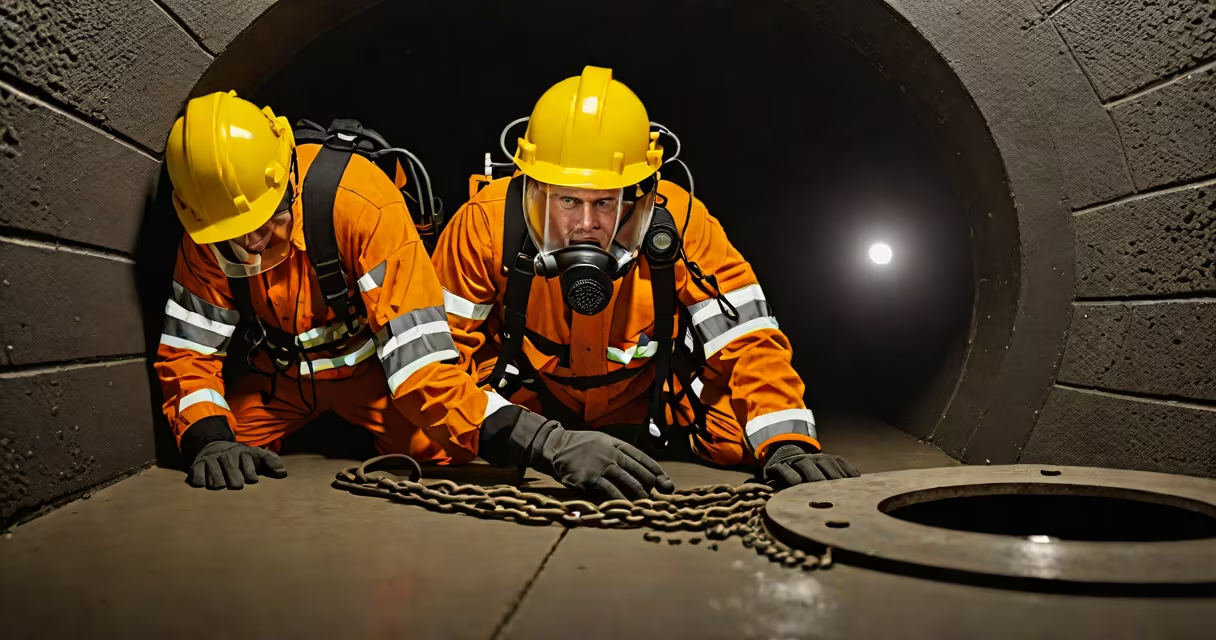
A confined space course is a structured training program that prepares workers to recognize, assess, and safely enter enclosed or partially enclosed spaces with limited entry and exit points, such as tanks, silos, ducts, and underground vaults. The curriculum follows OSHA's 29 CFR 1910.146 standard and covers hazard identification, atmospheric testing, ventilation, rescue planning, and permit requirements.
These courses are mandatory for employees who work in or around confined spaces in industries including oil and gas, wastewater treatment, construction, and manufacturing. Completion certifies that participants understand the risks and procedures required to prevent fatalities and injuries during entry operations.
Confined space courses follow a standardized format based on OSHA's regulations. They begin with a review of the legal definition: a space large enough for a person to enter, with limited access and egress, and not designed for continuous occupancy. This includes spaces like storage bins, sewers, and pipelines.
Training includes hands-on practice with gas detectors, air quality sampling, and the use of personal protective equipment (PPE). Participants learn to conduct pre-entry checks, set up ventilation systems, and establish communication protocols. A key component is the permit system, which requires written authorization before any entry occurs.
For example, a worker preparing to enter a 10-foot-diameter underground storage tank must test oxygen levels, check for flammable gases, and verify that the atmosphere is safe. Only after completing a permit signed by a supervisor and confirming all safety measures are in place may entry proceed.
Confined space courses vary by industry and risk level. The most common types are:
| Type | Scope | Duration | Target Audience |
|---|---|---|---|
| Entry Supervisor | Manages entry operations, approves permits, coordinates rescues | 8 hours | Site leads, safety officers |
| Attendant | Monitors entrants from outside, maintains communication, initiates rescue | 4 hours | On-site monitors, team leaders |
| Entrant | Person entering the space; must understand hazards and PPE use | 4-8 hours | Field technicians, maintenance crews |
| Rescue Team | Trained in emergency extraction using winches, harnesses, and stretchers | 16 hours | Specialized safety personnel |
Each role has distinct responsibilities. An attendant must stay within visual and verbal range of the entrant and never leave their post. Failure to maintain contact is a leading cause of incidents during entry operations.
Confined space entry accounts for approximately 60% of workplace fatalities in the construction and utilities sectors, according to the National Institute for Occupational Safety and Health (NIOSH). Most deaths result from oxygen deficiency, toxic gas exposure, or engulfment - not physical injury.
For example, in 2021, a worker died in a wastewater treatment plant after entering a 12-foot-deep pump chamber without testing for hydrogen sulfide. The gas, invisible and odorless at high concentrations, caused rapid unconsciousness. A properly trained team would have detected the hazard with a multi-gas monitor before entry.
Employers require confined space courses to meet OSHA compliance and reduce liability. Without training, companies face fines up to $14,500 per violation, plus potential criminal charges in cases of gross negligence.
Many assume that any small space qualifies as a confined space. That's incorrect. A space must meet three criteria: it is large enough for a person to enter, has limited access/egress, and is not designed for continuous human occupation. A walk-in closet doesn't count. A 48-inch diameter pipe does.
Another misconception is that ventilation eliminates all risks. In reality, poor airflow can trap gases near the floor or ceiling. Testing must occur at multiple levels - typically at head height, waist level, and ground level - because different gases have different densities.
For example, methane is lighter than air and accumulates at the top of a tank. Carbon dioxide is heavier and settles at the bottom. A single test at one level gives incomplete data. OSHA requires testing at three points for accurate assessment.
I once observed a confined space entry where the attendant left his post to fetch water. He returned to find the entrant unresponsive. The gas detector had sounded an alarm earlier, but he hadn't heard it over the noise of pumps. The course had emphasized constant monitoring - yet human error still occurred. That's why redundancy in safety systems matters.
Confined space course training is not optional for workers in regulated industries. It ensures compliance with OSHA standards and prevents fatalities from known hazards. The training covers real-world scenarios, hands-on equipment use, and clear roles for supervisors, attendants, entrants, and rescuers.
Understanding the difference between a confined space and a non-confined space prevents unnecessary restrictions. Equally important is recognizing that even low-risk entries require formal preparation. A single mistake - skipping a gas test or failing to secure a permit - can lead to death.