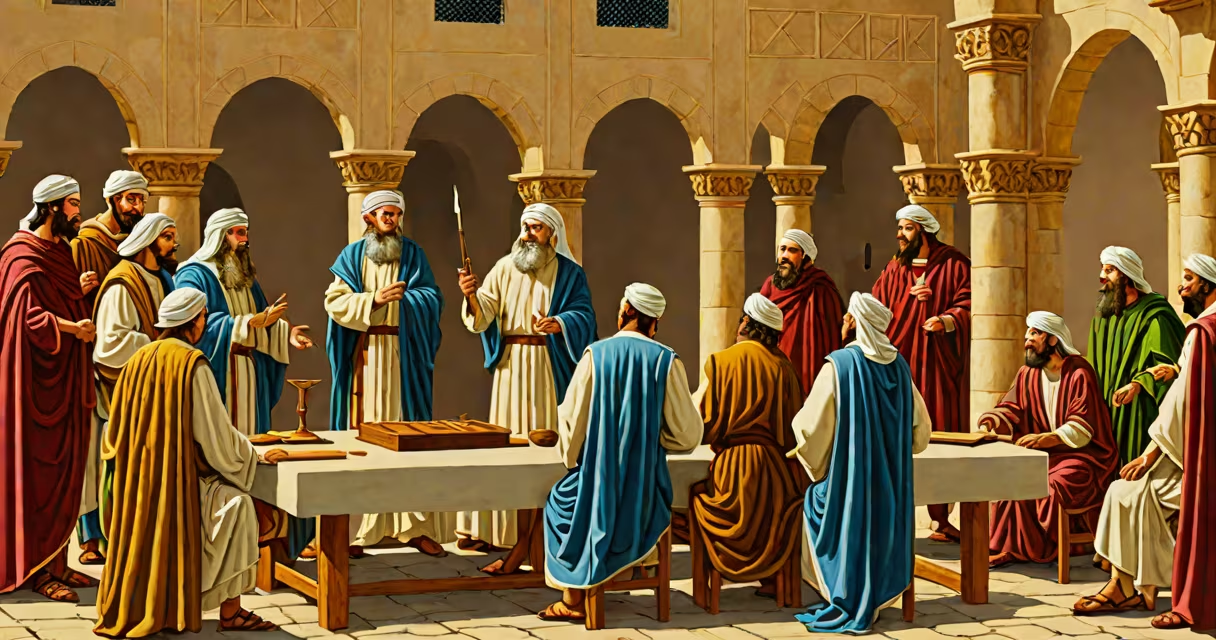
The Council of Jerusalem was a decisive gathering in 50 CE where leaders of the early Christian movement, including Peter, James, and Paul, resolved whether Gentile converts needed to follow Jewish law, particularly circumcision. The council concluded that Gentiles were not required to observe Mosaic Law, establishing a foundation for Christianity's expansion beyond Jewish communities.
This meeting addressed a growing tension within the fledgling church. As Paul and Barnabas preached to non-Jews in Galatia and other regions, some Jewish Christians insisted that Gentile converts must be circumcised and follow dietary laws. These demands threatened to fracture the movement, especially as Paul's missionary journeys reached increasingly diverse populations.
The decision was formalized in the Apostolic Decree, recorded in Acts 15:28-29: "It seemed good to the Holy Spirit and to us not to burden you with anything beyond the necessary requirements: to abstain from food sacrificed to idols, from blood, from meat of animals strangled, and from sexual immorality." These four restrictions were practical compromises allowing unity while respecting cultural boundaries.
Leaders from Jerusalem traveled to Antioch, where Paul and Barnabas had established a thriving Gentile congregation. A debate ensued in the presence of the entire church. After discussion, Peter spoke first, recalling his vision of unclean animals and his role in baptizing Cornelius, a Roman centurion. He argued that God had shown no distinction between Jew and Gentile through the gift of the Holy Spirit.
James, the brother of Jesus and leader of the Jerusalem church, then referenced the prophet Amos (Amos 9:11-12), interpreting it as a sign that God intended to restore David's fallen tent-to include the nations. He proposed the four-point compromise, which was accepted by consensus.
Paul later affirmed the council's outcome in his letter to the Galatians (Galatians 2:1-10), stating he met with the apostles privately and received their endorsement for his Gentile ministry. This alignment helped prevent theological fragmentation during Christianity's formative years.
The council included prominent figures: Peter, who represented the Jerusalem church; James, known as "James the Just," who led the local community; and Paul, whose missionary work had drawn the conflict. Barnabas accompanied Paul, and others such as Judas Barsabbas and Silas were sent as messengers to deliver the decree.
The primary source is the Book of Acts, chapter 15, written by Luke, a physician and companion of Paul. While Acts presents the event as a unified decision, scholars note differences between this account and Paul's own letters. For example, Paul's version in Galatians emphasizes a private meeting with Peter and John, suggesting a more contentious process than Acts implies.
Historical analysis confirms the council likely occurred around 50 CE, based on the timeline in Acts and Paul's references to the Jerusalem visit in Galatians 2. The timing aligns with Paul's first missionary process (Acts 13-14), placing the council shortly after his return to Antioch.
The council's decisions enabled Christianity to spread rapidly across the Roman Empire. Without the Apostolic Decree, the church might have remained a Jewish sect. Instead, the inclusion of Gentiles without full adherence to Torah observance allowed churches to form in cities like Ephesus, Corinth, and Rome.
For example, the church in Rome, mentioned in Paul's Epistle to the Romans (written c. 57 CE), included both Jews and Gentiles. The absence of strict legal requirements made integration easier. By contrast, groups like the Ebionites, who insisted on full Torah observance, eventually became marginalized.
Modern Christian denominations interpret the council differently. Catholic and Orthodox traditions view it as a foundational moment in ecclesial authority. Protestant theologians often show its role in affirming salvation by faith alone, though they differ on how much weight to give the four restrictions.
Many assume the council abolished all Jewish law for Christians. This is incorrect. The decree applied only to Gentile converts. Jewish Christians continued observing kosher laws and Sabbath worship. The council did not eliminate Jewish identity from the church-it redefined its boundaries.
A second misconception is that the council was a formal church council in the later sense. It was not. There were no bishops, synods, or dogmatic pronouncements. It was a pastoral resolution among apostles and elders, rooted in shared belief and divine guidance rather than institutional procedure.
Third, some think the council ended debates about circumcision. It did not. Paul faced opposition throughout his life. In Galatians 6:12-13, he accuses certain Jewish Christians of pressuring Gentiles to be circumcised to avoid persecution. The issue resurfaced in later councils, such as the Council of Nicaea in 325 CE, though with different stakes.
| Aspect | Acts 15 Account | Paul's Letter to Galatians |
|---|---|---|
| Location | Jerusalem | Jerusalem (private meeting) |
| Participants | Peter, James, elders, Paul, Barnabas | Peter, John, James (private) |
| Outcome | Public decree sent to Gentile churches | Private agreement, no public document |
| Emphasis | Unity and external mission | Freedom from legalism, personal integrity |
One non-obvious fact: The council's decision was not universally accepted. In Galatia, some believers still demanded circumcision. Paul wrote strongly against them, calling the act a "false gospel" (Galatians 1:6-9). This shows that even after a formal resolution, implementation varied widely across regions.
I once visited the Church of the Holy Sepulchre in Jerusalem, where a small chapel marks the site traditionally believed to be where the council convened. The atmosphere was quiet, with pilgrims lighting candles. Standing there, I realized how deeply this single decision shaped global religious history-without a vote, a ballot, or a formal charter, just a group of men and women listening to the Spirit.
The Council of Jerusalem remains central to understanding early Christian identity. It set a precedent: the church could grow beyond ethnic and ritual boundaries. This principle underpins modern ecumenism and interfaith dialogue. The council did not create a new religion-it redefined an existing one, making room for all who believed.
Understanding the Council of Jerusalem clarifies why Christianity became a global faith. Its legacy lives in every church that welcomes people regardless of ancestry or tradition. The decision to not burden Gentiles with unnecessary law remains a defining moment in religious history.