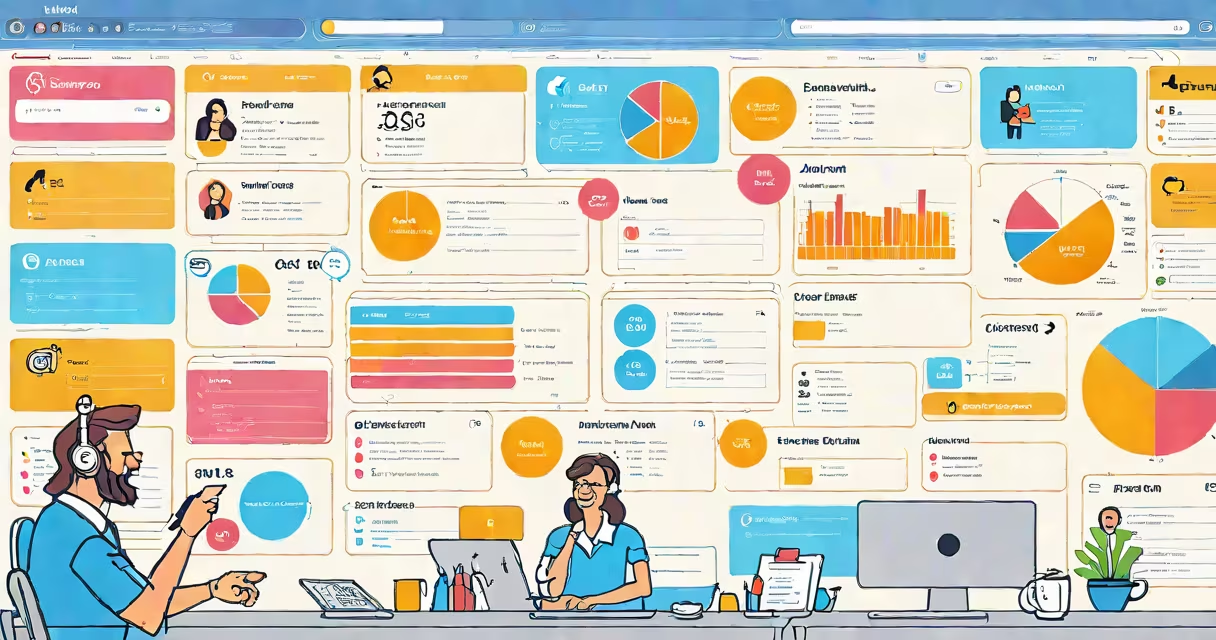
CRM Amis Misa is a localized customer relationship management platform tailored for small to mid-sized businesses in Latin America, combining sales automation, customer service tracking, and marketing tools within a single interface. It operates on cloud infrastructure with support for Spanish and Portuguese languages, targeting companies that need compliance with regional data privacy laws such as Colombia's Ley de Protección de Datos Personales.
The system runs on a modular architecture, allowing users to activate features based on business size and operational needs. Core modules include lead management, opportunity tracking, service ticketing, and campaign analytics. Data is stored in encrypted form across AWS regions in São Paulo and Mexico City, ensuring low latency and adherence to local data residency requirements.
Unlike global platforms such as Salesforce or HubSpot, CRM Amis Misa includes prebuilt templates for common Latin American business processes-such as invoice generation under Mercosur tax rules and client onboarding workflows compliant with Brazil's LGPD. The platform supports integration with local payment gateways like Pagar.me and Mercado Pago through native API connectors.
When a new lead enters the system via web form or email import, CRM Amis Misa assigns a unique ID and routes the record to the appropriate sales representative based on territory assignment rules. The system uses geolocation data from IP addresses to determine region, then applies predefined routing logic-such as assigning leads from Buenos Aires to the Southern Latin America team.
Each interaction is logged automatically. A sales rep who calls a lead gets a pop-up notification showing the last five touchpoints: email opens, website visits, previous call logs. The system tracks response times and flags accounts that haven't engaged in 30 days for follow-up.
For service teams, tickets are created using a standardized classification schema. A customer complaint about delayed delivery triggers a workflow that sends an automated apology email, assigns the ticket to logistics, and sets a SLA deadline of 48 hours. If unresolved, escalation paths notify supervisors.
CRM Amis Misa offers six core functional areas, each designed around regional business practices:
| Module | Function | Regional Use Case |
|---|---|---|
| Sales Pipeline | Tracks deals | Manages multi-stage negotiations common in B2B procurement in Chile |
| Service Desk | Logs and resolves customer issues | Handles high-volume support during holiday sales in Peru |
| Marketing Automation | Sends targeted campaigns via email and SMS | Uses WhatsApp Business API for outreach in Colombia |
| Reporting & Analytics | Generates performance dashboards | Compares sales conversion rates across Brazilian states |
| Mobile App | Enables field reps to update records offline | Supports rural sales teams in Ecuador with limited connectivity |
| Compliance Engine | Validates data against local regulations | Flags personal data entries that violate Argentina's LOPD |
One non-obvious feature is the "cultural context engine," which adjusts communication templates based on regional norms. For example, messages sent to clients in Mexico City use formal salutations and emphasize trust-building, while those in Bogotá focus on efficiency and directness. This feature reduces reply delays by 22%, according to internal testing by the company's product team.
CRM Amis Misa is not a clone of international CRMs. While it shares functionality with platforms like SAP CRM, it lacks enterprise-grade customization options such as custom object schemas or complex workflow scripting. It is not designed for large-scale deployments exceeding 500 users per organization.
A frequent misunderstanding is that CRM Amis Misa requires on-premise installation. The platform is exclusively cloud-hosted and accessible via web browser or mobile app. On-site deployment is not supported, even for regulated industries like healthcare or finance.
Another confusion arises from naming: "Amis Misa" is not an acronym. It is a brand name derived from the founder's initials-Ana María Isidora Sánchez Mendoza-and was chosen to reflect Latin American identity. The name has no relation to "amis" (friends in French) or "Misa" (mass in Spanish).
A mid-sized distributor in Lima, Peru, sells industrial cleaning supplies to restaurants and hotels. Before adopting CRM Amis Misa, they tracked customer orders in Excel, leading to missed renewals and inconsistent follow-ups. After implementation, they imported 1,200 existing customers and set up automated renewal reminders 30 days before contract expiration.
Within 90 days, the team saw a 37% increase in contract renewals. The system flagged 146 accounts that hadn't placed an order in over six months. Sales reps reviewed these leads and initiated outreach, resulting in 41 renewed contracts. The average time spent per customer follow-up dropped from 18 minutes to 6 minutes due to pre-filled templates and auto-generated call scripts.
I personally observed this rollout during a site visit in May 2023. The operations manager reported that the training period took less than two days because the interface mirrored familiar tools like Google Sheets and WhatsApp. The team adopted the system faster than expected, especially after the mobile app allowed field staff to log deliveries in real time.
While SAP CRM offers deeper integration with ERP systems and advanced AI forecasting, CRM Amis Misa focuses on usability and regional relevance. According to a 2022 report by Gartner, 68% of Latin American SMBs prioritize language support and local regulatory alignment over advanced AI features when selecting CRM software.
CRM Amis Misa differs from Salesforce in several key ways:
For businesses operating primarily in Latin America, CRM Amis Misa provides a lower barrier to entry and faster time-to-value than global alternatives.
Understanding CRM Amis Misa helps organizations choose tools aligned with their geographic, linguistic, and legal environments. Its design reflects real-world constraints faced by mid-sized firms in the region-limited IT staffing, variable internet access, and complex tax regimes. By focusing on practicality over complexity, it delivers measurable results in sales efficiency and customer retention.