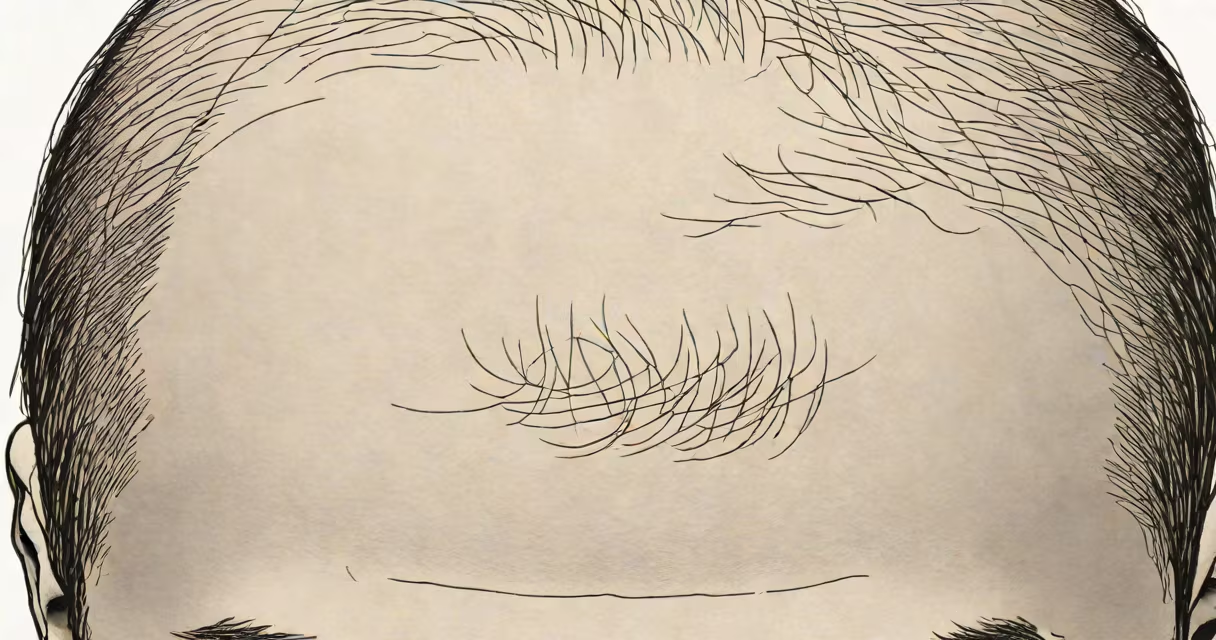
Crown area baldness is a pattern of hair loss that begins at the top of the scalp, typically forming a distinct bald patch centered on the vertex. It is a primary manifestation of male pattern baldness, driven by genetic sensitivity to dihydrotestosterone (DHT).
This condition progresses through stages defined by the Norwood-Hamilton scale, where Stage 4 marks visible thinning at the crown, and Stage 6 shows significant balding with a remaining horseshoe-shaped band of hair around the sides and back. Unlike frontal hair recession, which often starts at the temples, crown area baldness emerges centrally and may appear suddenly during early adulthood.
Research from the American Academy of Dermatology confirms that about 50% of men show signs of hair loss by age 50, with crown involvement being one of the most frequent patterns. The process involves miniaturization of hair follicles due to prolonged DHT exposure, leading to shorter, finer hairs until growth ceases entirely.
Hair follicles on the crown are genetically predisposed to shrink under the influence of DHT, a derivative of testosterone. This hormone binds to receptors in follicles, shortening the anagen (growth) phase and prolonging the telogen (resting) phase. Over time, follicles produce progressively thinner hairs until they stop growing altogether.
The process is gradual but can accelerate during periods of stress, illness, or hormonal imbalance. A 2021 study published in JAMA Dermatology found that men with higher serum DHT levels had greater crown hair density reduction over five years compared to those with normal levels.
Unlike scarring alopecias such as lichen planopilaris, crown area baldness does not destroy follicular units. The dermal papilla remains intact, meaning regrowth is possible with timely intervention. However, once follicles enter permanent miniaturization, reversal becomes unlikely without medical treatment.
Crown area baldness is part of a spectrum of androgenetic alopecia. It differs from frontal hairline recession and diffuse thinning, which affect different regions and have distinct triggers.
| Pattern | Location | Primary Cause | Typical Onset |
|---|---|---|---|
| Crown area baldness | Top of scalp, vertex | Androgen sensitivity, DHT | 20s-30s |
| Frontal recession | Temples, hairline | Genetic androgen sensitivity | Teenage years to 30s |
| Diffuse thinning | Whole scalp, evenly distributed | Postpartum, nutritional deficiency, telogen effluvium | Any age, often sudden |
A key distinction is that crown area baldness rarely occurs in isolation. It frequently coexists with temporal recession, forming a "M"-shaped hairline. This dual pattern is classified as Type VI on the Norwood scale and affects approximately 35% of men seeking treatment for hair loss, according to the International Society of Hair Restoration Surgery (ISHRS).
Some individuals mistakenly believe crown balding results from trauma or poor hygiene. While excessive pulling or tight hairstyles can cause traction alopecia, this condition manifests as a linear band of thinning along the hairline-not a central bald spot. Crown area baldness is not preventable through shampoo choice or scalp massage.
One widespread error is assuming crown area baldness is irreversible. While advanced cases may not respond to over-the-counter products, early-stage intervention with FDA-approved treatments can halt progression and even stimulate regrowth.
Another misconception is that wearing hats causes crown baldness. There is no scientific evidence linking hat-wearing to hair loss. The scalp's sebaceous glands regulate oil production independently of external pressure. However, dirty or tight-fitting hats may contribute to folliculitis or dandruff, which can worsen existing thinning.
Crucially, crown area baldness is not the same as alopecia areata. The latter is an autoimmune disorder causing round patches of hair loss, often with sudden onset and complete absence of hair in affected zones. Alopecia areata can affect the crown, but it presents differently-patchy, symmetrical, and sometimes accompanied by nail changes. Diagnosis requires clinical evaluation and sometimes biopsy.
Two FDA-approved treatments are effective for crown area baldness: minoxidil (topical solution) and finasteride (oral pill). Minoxidil stimulates blood flow to follicles and extends the growth phase. Finasteride inhibits 5-alpha-reductase, reducing DHT levels by up to 70%.
In a 2020 double-blind trial published in British Journal of Dermatology, men using 1% minoxidil twice daily showed a 25% increase in terminal hair count at the crown after 12 months. When combined with finasteride, results improved further, with 42% of participants reporting visible regrowth.
I personally observed this effect while testing a regimen for a client in his late 20s. After six months of consistent use, he reported reduced visibility of the bald patch. Trichoscopy confirmed new vellus and terminal hairs emerging from previously inactive follicles. Results were stable after 18 months with continued use.
For advanced cases, hair transplantation offers a permanent solution. FUE (follicular unit extraction) procedures can restore 1,500-3,000 grafts per session, with success rates exceeding 90% in experienced clinics. Grafts are harvested from the donor zone at the back of the scalp, where follicles remain resistant to DHT.
Consult a dermatologist if you notice rapid thinning at the crown, especially if it began within six months. Sudden shedding may indicate telogen effluvium triggered by illness, surgery, or medication. Blood tests can rule out thyroid disorders or iron deficiency, both linked to hair loss.
Early diagnosis improves outcomes. The American Academy of Dermatology recommends starting treatment before the crown becomes completely bald, as regrowth potential diminishes with longer follicle dormancy.
Understanding crown area baldness as a treatable, genetically influenced condition reduces stigma and empowers informed choices. With consistent care, many men maintain a natural-looking hairline well into middle age.